
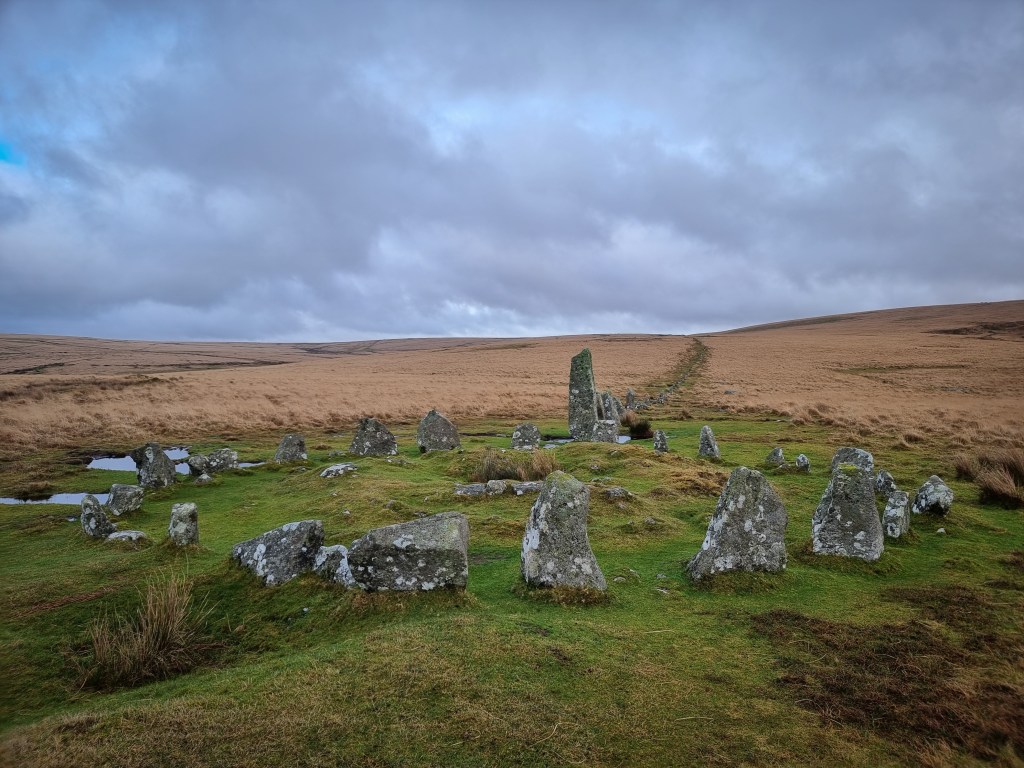

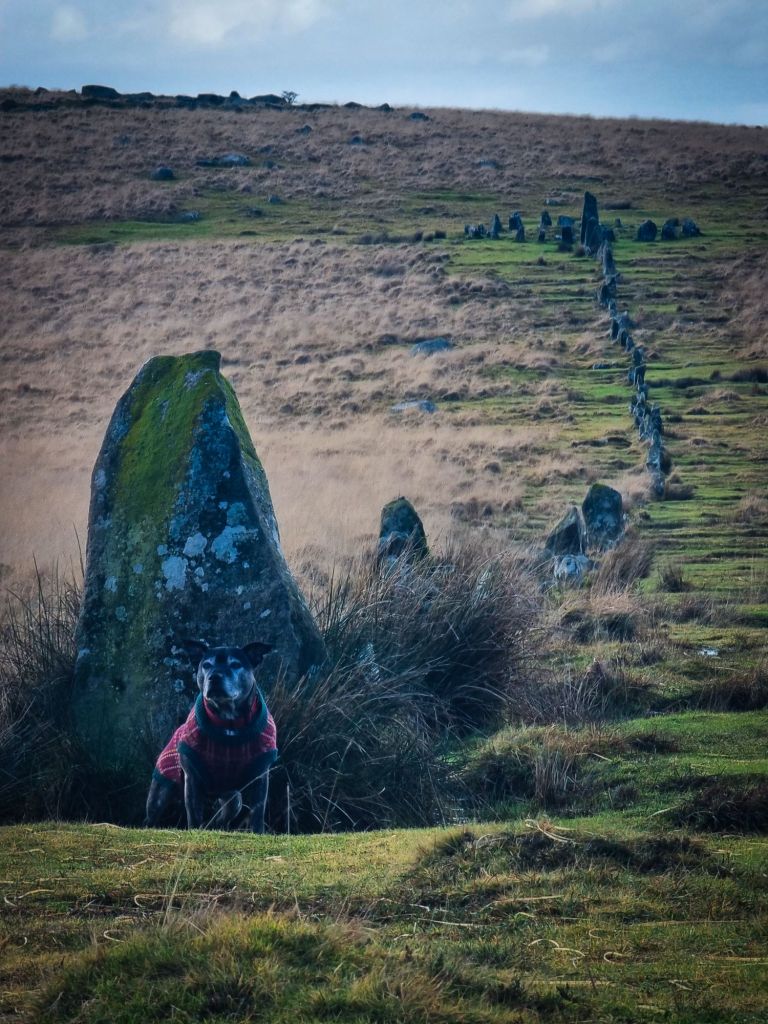
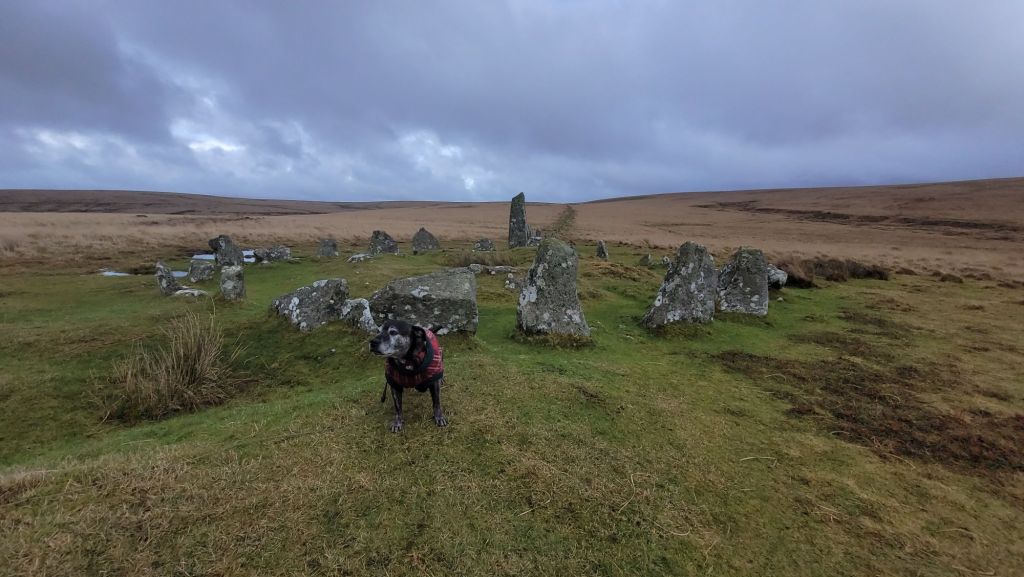
A 1145ft long stone row leading to a 36ft cairn circle in Dartmoor, England.
There are 157 stones in the row, but may have originally been 174. Some of the stones had fallen and in 1894 were re-erected in their original sockets. This has been described as one of the most magnificent of all the prehistoric monuments on Dartmoor. Situated in isolated moorland, surrounded by numerous remains of our ancient past, this one is definitely worth the trek.
In 1881 W.C. Lukis records the site in The Report of the Monuments of Dartmoor:
“…In this instance the cairns are placed on opposite elevations within sight of each other. The more important one has a ring of stones around it, 37 feet in diameter ; the other is a large cisted cairn without a circle. That which I conceive to be the connecting line of stones is 1,173 feet long, and nearly straight, as you will observe in the plan produced ; and although there are no stones marked in the 300 feet, you are not to suppose they are altogether absent. I noticed two or three, but at the time I made the survey I had not seen the previous example, or I should have been more careful to examine and insert them ; and I am now of opinion that if the soft earth were probed many stones would be discovered in their proper places concealed beneath the surface, and the entire length would be more than 1,473 feet. In this line the stones are of a more imposing size than those of any other line or avenue on the moor, and they present, in a marked manner, a feature which attaches to the Brittany Avenues, where the stones increase in height and bulk as they approach the circle or sacred spot with which they are connected. The same feature is observable in one of the Castor Avenues.
When Mr Spence Bate visited this monument about the year 1868 or 1869, the smaller of the two large stones at the west end nearest to the circle was resting against the other, and he has informed me that three years ago it was in the same position. Since then these stones have fallen, or been willfully thrown down. Indeed, when I saw them I thought they must have fallen within a few days, for the earth about the foot of the larger stone had the appearance of quite recent disturbance. This face, however, shows how desirable it is that the prehistoric monuments of our country should be planned before they become still more dilapidated.”
We found another early record of the site from 1883, in the Journal of the British Archaeological Association – On a group of prehistoric remains on Dartmoor, by Francis Brent, Esq – https://www.dartmoorwalks.org.uk/resource/docs/article74.pdf
Description of the site from ‘Dartmoor Mindscapes : Re-visioning a Sacred Landscape’, by Peter Knight (2016):
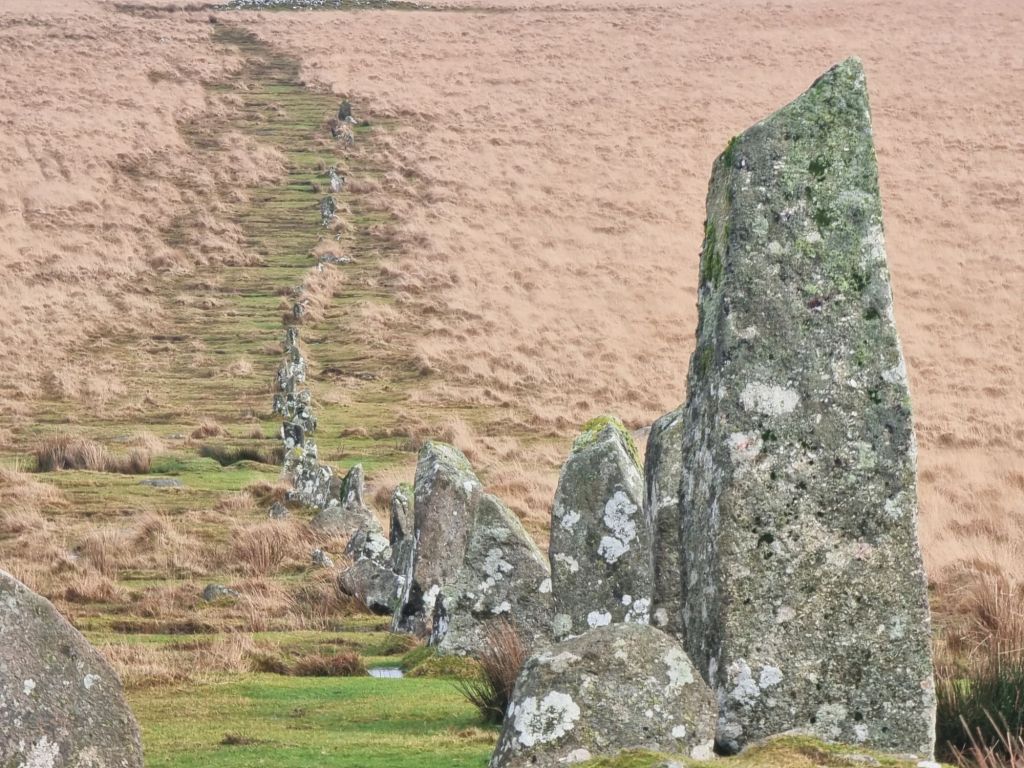
“The stone row at Hingston Hill (sometimes referred to as Down Tor row) is one of the most evocative of the moor’s stone rows. It has been described as, ‘..the most magnificent of all the prehistoric monuments on Dartmoor’ (Lethbridge 2015), a sentiment which I can endorse. It is situated in isolated open moorland, not far north of Drizzlecombe, and is a hidden gem, visited only by those pilgrims who take the mile long uphill trek from the nearest parking. Like many other stone rows, it marches across gently sloping terrain, in this case for 350m from NE-SW. The row of 161 stones terminates in three megaliths which are 1.6m, 2m and 2.8m tall respectively as one approaches the SW terminus. At this end there is a 12m diameter cairn circle comprising 25 stones. At the NE end stands a 1.5m high triangular ‘blocking stone’, and beyond that a large cairn which is aligned with the row. The row is clearly not straight, and veers to the north in the centre section. Restoration of the stones was carried out in 1894.. https://archive.org/details/dartmoormindscap0000knig/page/154/mode/1up
The following is quoted from The Stone Rows of Dartmoor, Part 1, by R. Hansford Worth (1946):
Down Tor – Although this row is commonly named after Down Tor, it lies, not on the slopes of that tor, but on Hingston Hill, and is in fact nearer Combshead Tor. At the west end of the row is a barrow with retaining circle, the circle 37 feet in internal diameter. Position, Near the circle the stones of the row are exceptionally large, that nearest the circle having been measured when fallen by Burnard and found to be 12′-10″ in length ; as re-erected it now stands 9′-6″ high.
In the matter of record this row has been unfortunate ; it is called after a Tor on whose slopes it does not stand ; it is shewn on the first edition of the Ordnance Survey as pointing toward a pound, to which it does not point ; Spence Bate appears to have intended this row when he wrote of one in this locality as being 800 yards in length ; Burnard by an obvious slip attributed to it a length of nearly 600 yards. Its actual length, as measured from the centre of the circle is c. 346 yards, or 1,038 feet. The direction of length, from end to end in N. 71° E. ; it is somewhat convex toward the north. Its apparent eastern termination is in a small menhir, which measured, as fallen, 7′-6″ in length and 3′-0″ in breadth. In the line of the row but rather over 700 feet from the terminal menhir is a cairn 54 feet diameter at the base, and 36′ diameter at the top.
Accepting the result of Burnard’s careful examination, that the total number of stones in this single row was 174, it results that the average spacing of the stones, centre to centre, is 5′-11″. The mean elevation of ground is c.1,210 feet ; the row lies along the water-parting between Deancombe and Newleycombe brooks. – https://www.dartmoorwalks.org.uk/resource/docs/article50.pdf
 CoralJackz - That History Couple
Leave a comment