
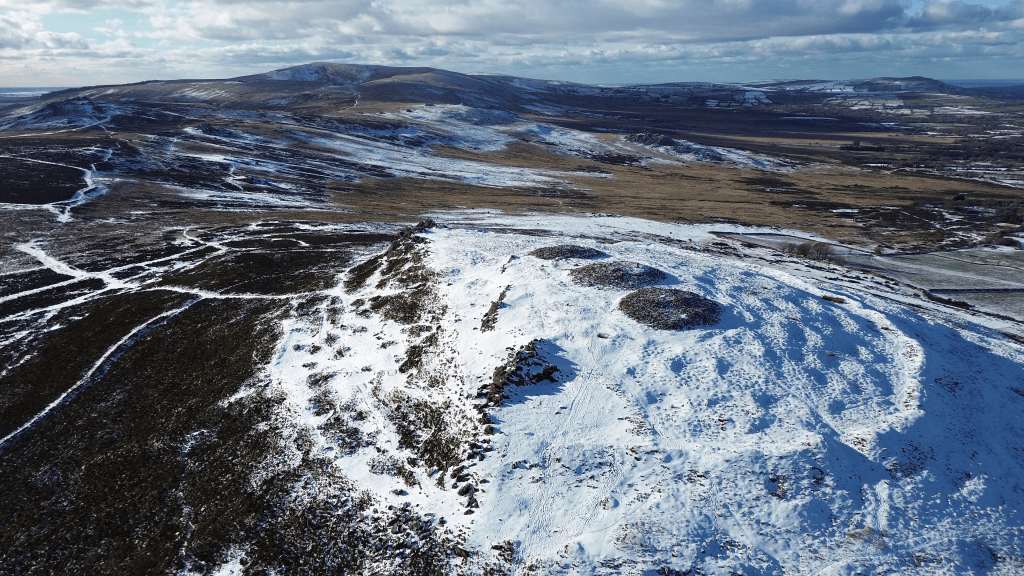

Foel Drygarn sits 1.5 miles from the village of Crymych in Pembrokeshire.. It’s classified as an Iron Age hillfort, within which lies three cairns which pre-date the fort and are thought to be from the Bronze Age.


Within the ramparts there are around 227 hut platforms.. built around three large cairns at the summit of the hill. Sabine Baring-Gould excavated the site in 1899. Found was Iron Age and Roman pottery, glass beads and sling stones. Fine glass beads, jet ring from some of the house platforms.
The Archaeologia Cambrensis (1900 Journal of the Cambrian Archaeological Association) ‘Exploration of Moel Trigarn’ by Rev. S. Baring Gould, R Burnard ESQ, Rev. Irvine K. Anderson. Here are a few excerpts from the report:
https://journals.library.wales/view/4718179/4718180/386#?cv=245&xywh=-365%2C507%2C2460%2C3464
“Outside the fortifications, below the rocks and the talus, are a good many indications of enclosures, and appearances of hut-circles, but some of the most conspicuous are modern reconstructions by shepherds”
“The exploration of the hut-sites: one of the hut circles excavated, “wood-charcoal was found strwen on a level 1ft 8 ins below the turf surface.. presumably the level floor of the dwelling. . resting on this ground they found the following objects:- Eight water worn pebbles: one of these was white and semi translucent, of the size of a pigeon’s egg, and another olive-green, opaque, the size of a sparrows egg; both these little pebbles were of striking appearance, and would be picked up by anyone as being both pretty and out of the common. A rounded piece of baked clay, not pottery. A spindle-whorl of sandstone, without ornamentation, 1 ½ ins. In diameter.”
They also excavated the fort as a whole, but only partially. They found objects which convinced them that the fort was occupied during the Iron Age. “Many fragments of metal, highly oxidised, were discovered at considerable depths, associated with spindle whorls, pounders of stone, sling stones, glass beads, portions of armlets and rings..”
Cairns:
Why are they within a hillfort? Bronze Age burial mounds and cairns were frequently enclosed by later hillforts.
It is often stated that the hillfort builders must have seen these great mounds as the seat of ancestral power.. Who was buried beneath these cairns atop Foel Drygarn? Some say that three kings are buried beneath these cairns..
The final paragraph of the 1900 Archaeologia Cambrensis report:
“At Maesgwyn Meillionog (the white clover-field) under Trigarn, is Lle Claddwyd Mon, Maelen a Madog, the burial place of the three kings, Mon Maelen and Madog. In the “Grave Englynion” in Skene, Four Ancient Books of Wales, there are four stanzas devoted to Mor, Meilir and Madauc. According to the first of these, they are buried on a hill in Pant Gwyn Gwynionauc. Madawc is said there to have been son to Gwyn of Gwynllwg; Mor son of Peridwr of Penwedig, a district in North Cardiganshire; and Meilier son of Brwyn of Brychainiog. But these names again appear in the Triads; or rather Madoc is there said to have been the son of Brwyn. We are indebted fot this information to Professor Rhys.
The farm on which are the graves of the three kings is occupied by Mr. Stephen Puton, who imperfectly opened one some time ago, but observed in it only some charcoal.”
-S. Baring Gould, R. Burnard, Irvine K. Anderson.
Certainly a powerful site to built a fortress.. around the grave of kings..
Damage to the site:
Coflein says, “The three cairns were never plundered for their stone, despite being surrounded by hundreds of houses. Could this mean that the occupants venerated their distant ancestors, while at the same time deriving power and social status from the acquisition of such a prominent and sacred hilltop?”
Although the Coflein entry says these cairns haven’t been plundered.. we sadly cannot say that was the case in our more recent past.. In the 1900 Archaeologia Cambrensis, “The three cairns have been much interfered with. The late Mr. James Fenton spent some days in digging into one, but he abandoned the work before reaching the centre, on account of the expense incurred. All have been further pulled about by treasure-seekers ; and the Ordinance Surveyors have built up a small supplementary cairn on top of the cairn itself. Visitors, more-over, seem to have amused themselves in mutilating these monuments out of pure mischief.”
On the website, megalithic.co.uk there is also mention of modern damage to the cairns:
“Army Preparation Course students have helped to repair a Scheduled Ancient Monument in the Pembrokeshire Coast National Park. The group of 14 from Pembrokeshire College joined the National Park Authority’s Archaeologist and Rangers to help reinstate damaged Bronze Age burial cairns on the Preseli Hills. It is a criminal offence to alter it [the cairns] without permission. However, visitors have been moving stones to make shelters within the cairns. The students have been helping to restore them to their original formations.
National Park Archaeologist Pete Crane said: “To the uninitiated these may just look like big piles of stones. But in fact these huge structures give the fort its name – Foel Drygarn means Hill of the Three Cairns – and give us a real picture of what an important feature this was at least 3,000 years ago.”
https://www.megalithic.co.uk/article.php?sid=4331
Battle of the Preseli:
As you approach the gate at the base of the hill, you’ll see this sign, titled “Brwydr y Preselau, Battle of the Preselau”
“These mountains would not be accessible to walkers today if it were not for the brave stand by local inhabitants at the end of the 1940s. Soon after the Second World war, in November 1946, the War Office declared its intention to turn the Preselau into a permanent military training area.
That would mean turning more than 200 farmers from their homes. However, under the leadership of Nonconformist ministers and local headmasters, a spirited campaign was organised to withstand the threat. A barrister was employed to represent the Prescelly Preservation Committee and it was made abundantly clear that not an inch of land would be surrendered.
‘We nurture souls in these areas,’ was the precise comment of the Rev R. Parri Roberta when confronted by military officers. The ‘sanctity’ of the mountains was emphasized with their 38 bluestones transported to Stonehenge, over two thousand years ago, to become part of English heritage.
By spring 1948 the Government had give in to the determination of the people of Preselau. All present day farmers and walkers are indebted to those heros of yesterday. The full story can be read in the book ‘Battle of the Presaelau – the campaign to safeguard the ‘sacred’ Pembrokeshire Hills’ by Hefin Wyn.”
Waldo Williams wrote the poem “Preseli” in a direct response to the threat of designating the Preseli hills a permanent military training ground..
“Wall of my boyhood, Moel Drigarn, Carn Gyfrwy, Tal Mynydd,
In my mind’s independence ever at my back;
And my floor, from Witwg to Wern and to the smithy
Where, from an essence older than iron, the sparks were struck.
And on the farmyards, on the hearths of my people,
Wedded to wind and rain and mist and heathery livrocky land,
They wrestle with the earth and the sky, and they beat them,
And they toss the sun to their children as still they bend.
For me a memory and a symbol – that slope with reaping party
With their neighbours’ oats falling four-swathed to their blades.
The last they took for fun at a run, and straightening their back,
Flung onc four-voiced giant laugh to the clouds.
So my Wales shall be brotherhood’s womb, her destiny,
she will dare it.
The sick world’s balm shall be brotherhood alone.
It is the pearl pledged to time by eternity
To be the pilgrim’s hope in this little crooked lane.
And this was my window – those harvestings and sheep shearings.
I glimpsed the order of a kingly court.
Hark! A roar and ravage through the windowless forest.
To the wall! We must keep our well clear of this beast’s dirt.”
 CoralJackz - That History Couple
Leave a comment