

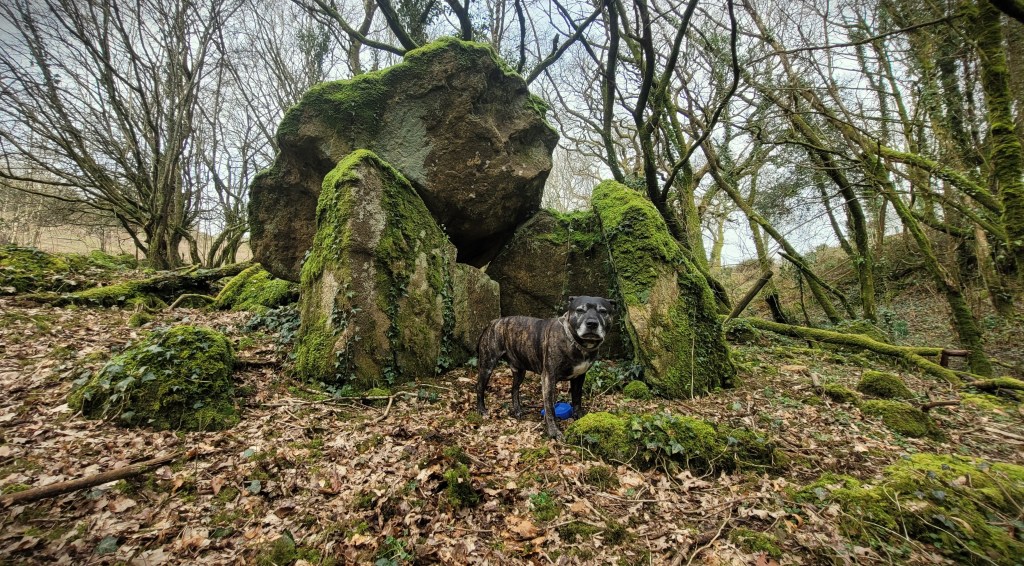
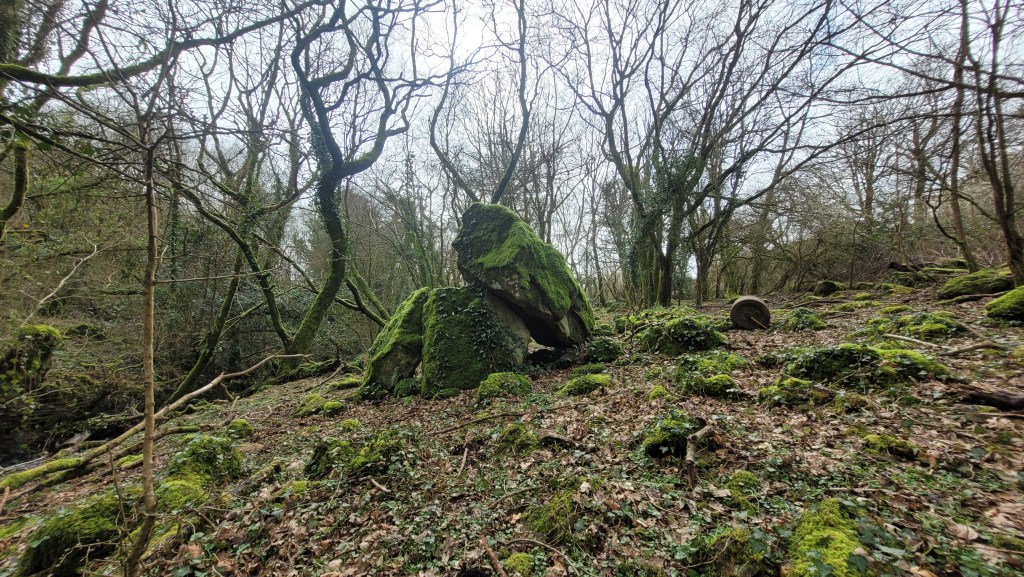
This disturbed neolithic megalith sits in a woodland in the small village of Llangynog in Carmarthenshire, Wales. In this post we’ll cover the excavations that took place here in the 1950s, as well as delve into the legends surrounding its name…

Excavation of the site:
The site was excavated in 1953 by Hubert N. Savory. The following is quoted from ‘A reassessment of the neolithic chambered tombs of south-west Wales (Carmarthenshire and Pembrokeshire)’ by Christopher Thompson Barker in 1986:
“Excavation of the site in 1953 revealed the remnants of an elongated cairn (c.60ft by 30ft; c.l8.4m by 9.2m), aligned NNE-SSW. The cairn was said to be an irregular construction with no distinct edges; the E side had been severely eroded by the action of the nearby brook.
The chamber consists of three uprights which stand partly in shallow sockets, partly upon smaller stones. The South end of the chamber is marked by a low “sill” (4inches high) consisting of five small slabs set on edge. Turf now obscures these slabs, though the top of a taller “jamb- stone” is visible adjacent to the East upright.
The capstone has been displaced and rests upon the ground and the W upright. A small hollow, filled with dark earth, was found dug into the clay floor of the chamber. Charcoal flecks occurred on the surface of the clay throughout the chamber and immediately outside it.
To the S of the chamber the excavator found traces of an “antechamber”, indicated by three stone-holes, with a fallen slab (0.6m long) lying over a fourth. Within the area defined by these stone-holes a second pit had been dug (2ft by 1ft by 6in deep); its base and sides yielded flecks of charcoal and burnt bone. Excavation to the SW of the “antechamber” revealed a curved line of low blocks which had the appearance of rudimentary “forecourt revetment”. Comparable features on the SE side had been virtually destroyed by water action. Within the presumptive “forecourt” was found a slanting “pillar” (18in/45cm high) and an oblong pit (5ft by 2ft 4in by 1ft deep). The area is now heavily overgrown; only one block is visible on the SW side.. it is 25cm high and looks decidedly natural. Any “forecourt revetment” would have stood to no great height, and the “forecourt blocking” described by the excavator may have been little more than brook-strewn stones.
No prehistoric material was recovered from the chamber.. indeed, the only other finds came from the charcoal-flecked clay surface below the cairn. Immediately to the NE of the chamber were found a small flint scraper, a stone “pendant”, and some disintegrated fragments of pottery.”
Legends of the name:
There are often many prehistoric sites that share the same name in modern times. There is also an ongoing debate as to what many of these names actually translate to.
Several other cromlechs in Wales share the name “filiast”.. We have explored the interpretations and folklore in some of our videos such as these :
It is commonly thought that “filiast” means a female greyhound, or a grey female hound. Therefore sites which go by the name “Gwal y Filiast” would mean her ‘lair’ or ‘kennel’.. Llety’r Filiast, her lodging. Opinions online seem to agree that ‘Twlc’ would imply a sty.. Making Twlc y Filiast translate to something along the lines of.. “The sty of the female grey hound”.
The main theory is that these cromlechs are dedication to the Celtic Godess Cerridwen, and some sources say that the translation should be a gray hound, as a wolf was the companion of Cerridwen, but this is disputed..
In 1909, Marie Trevelyan wrote:
“Dogs were an animal of importance in the mythology and folk-lore of Wales. Ceridwen, the moon goddess, had for one of her symbols a “milast,” or greyhound bitch. And When initiating Gwion the Little into her mysteries, Ceridwen transformed herself into a “milast.”
Another interpretation involves, Camu ar Camulus, the name under which Mars was known to the ancient British, had the greyhound bitch, and the horse dedicated to him. These animals were offered on his altar. The dog-grass weed, was also sacred to him.”
But why vary between, lair, lodging and sty? Does it relate to legend or simply to what the cromlech have been used for in modern times… One, mundanely logical explanation for Gwal Y Filliast, is that the structure was simply used a kennel for greyhounds… So it was funny to see evidence of animal activity around the woodland, and what looks like a pig sty in the nearby field.. could there simply be a long tradition of keeping pigs at this location?
“The bards and mythological triads represent Ceridwen or Cariadwen, the British Ceres, assuming the character of a sow. In her pontifical capacity she is described as a “twrch,’ or boar. Her priesthood was called ‘meichiaid,’ or swine-herds. Her disciples were known as ” moch,” or swine, and her novitiates were described as “perchyll,’ or young pigs.”
Marie Trevelyan, 1909

 CoralJackz - That History Couple
Leave a comment