
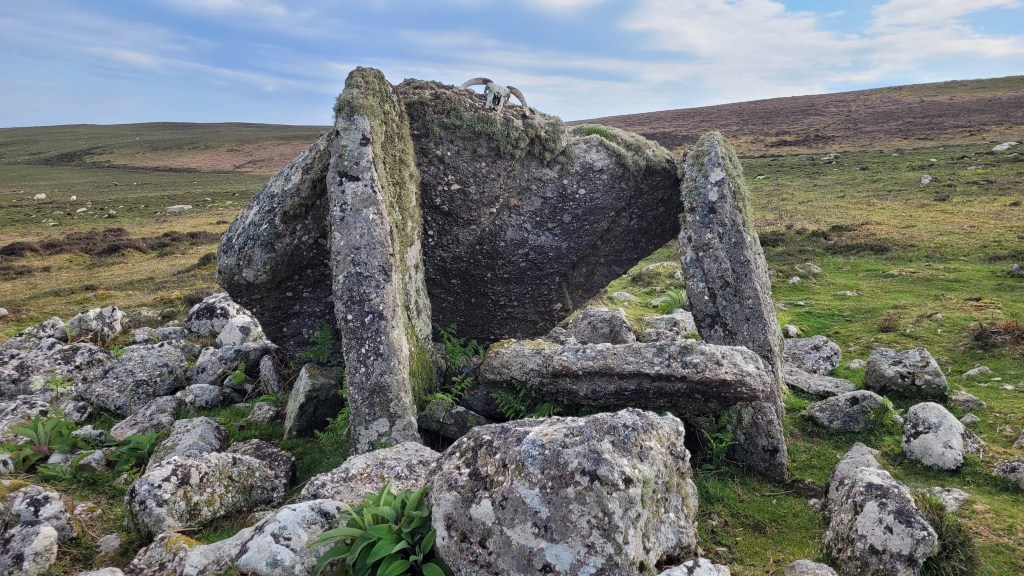

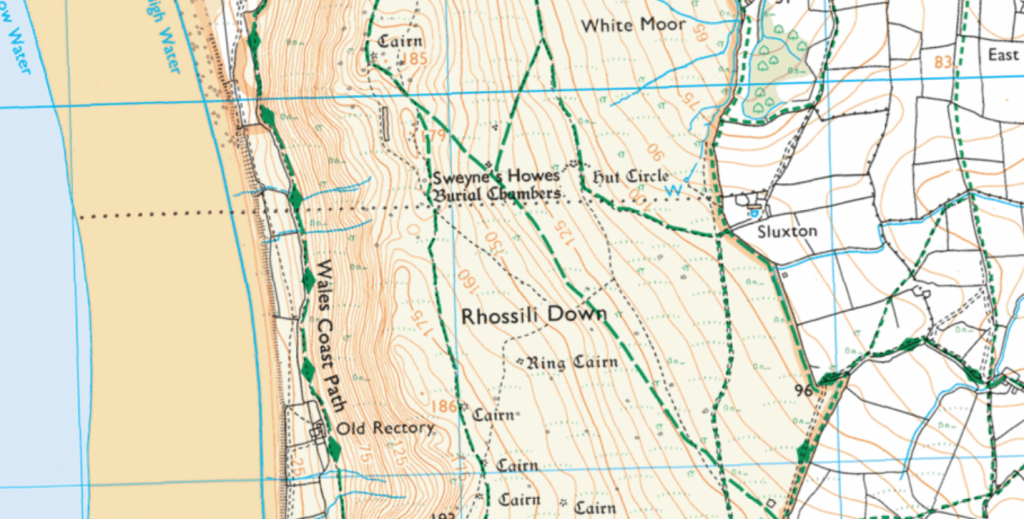
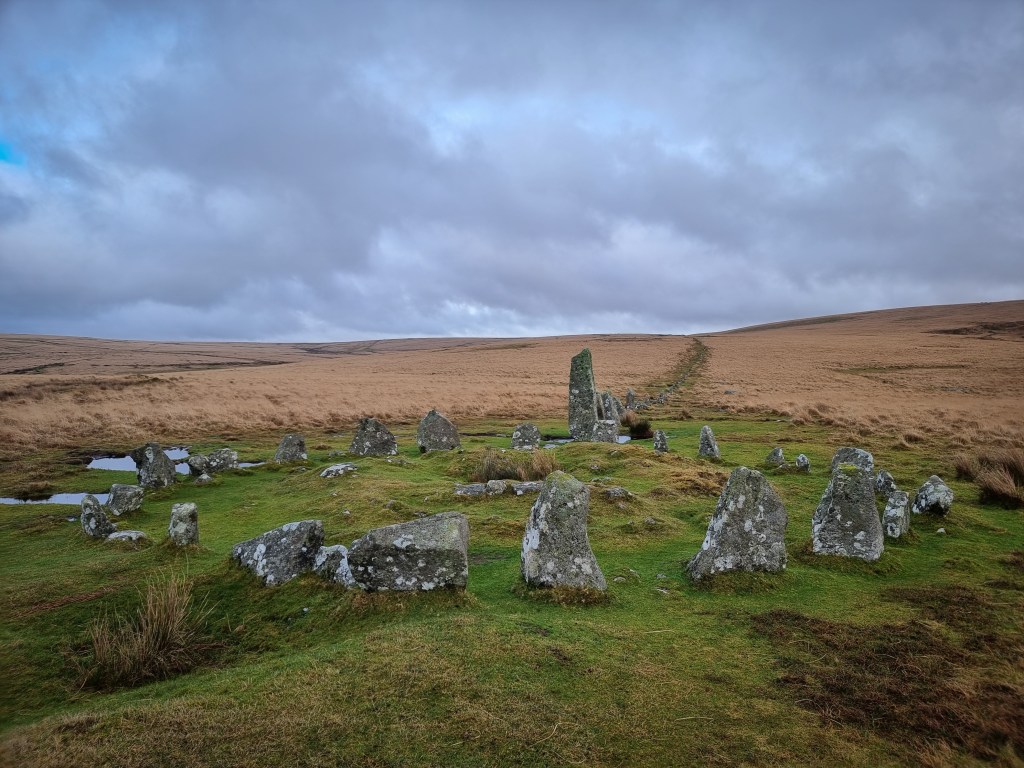
Sweyne’s Howes is a Neolithic site on Rhossili Downs in Gower, Wales. Today, the site comprises of two ruined cromlechs. In this post we will cover the archaeology of the site, as well as the Viking legends associated with the name..

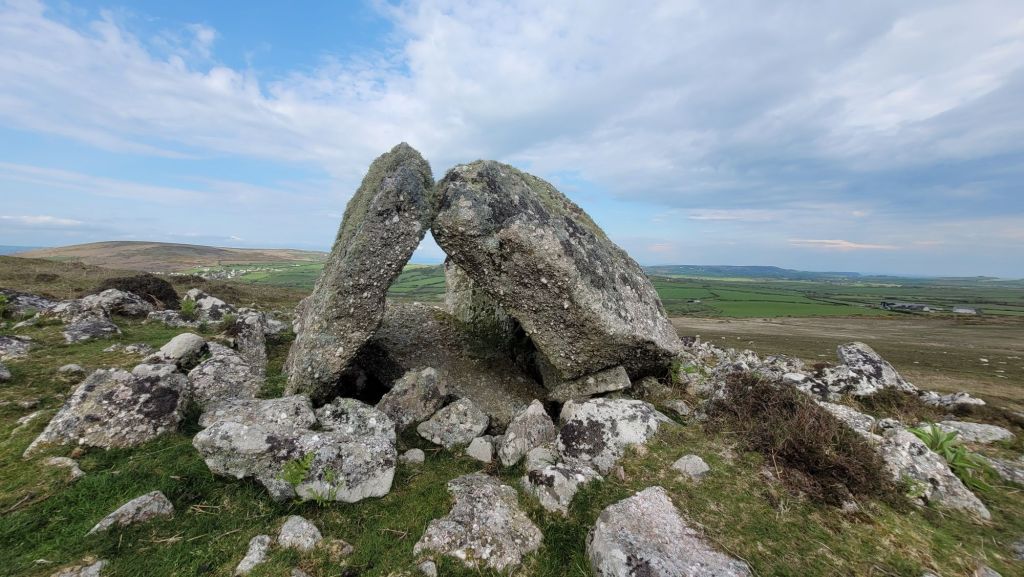
The North Cairn –
The northern of the two is the slightly better preserved.. It stands upon an oval shaped mound which is a cairn measuring roughly 60 feet by 42 feet though now in a ruinous condition. However, the condition of the “chamber” is reasonable. Two uprights support a capstone that has fallen on it’s side. In the middle there is a fallen upright stone and a smaller recumbent stone. There are slight traces of a kerb and also a few outer stones still stand close by. – https://thejournalofantiquities.com/2013/05/23/sweynes-howes-rhossili-gower-peninsula-wales/
The South Cairn –
“Like the northern of this pair of chambers the site is greatly disturbed with a chamber located in a cairn of conglomerate boulders. Measuring 20.7m (N-S) by 14.9m (E-W) this the south cairn is approximately 0.7m high. A wedge-shaped structure is suggested by several large boulders, some earth fast, near the centre of the cairn. The precise location of the chamber is unknown. Five slabs at the northern end of the cairn, of which only two are upstanding, may be the remains of a crescentic court. It has been suggested that the concave edge of one central slab (0.5m thick) has resulted from the removal of part of it for a millstone. Chambered tombs are generally assigned to the Neolithic period. The greatly mutilated condition of both of the chambers on Rhossili Down makes comparison with other megalithic burial structures difficult but a similarity with the small tombs at Maros in Carmarthenshire and Garn Wen in Pembrokeshire has been noted. It has also been suggested that these two tombs could be Portal Dolmens.”
John Latham RCAHMW 1 September 2015 –
There are no records of the Sweyne’s Howes site having been excavated, and it’s thought that their damaged state would mean any artefacts are likely to be in poor condition.. It was common practice in the years following these civilizations to use the stones of ancient monuments as building materials.
Sir John Gardner Wilkinson
There are no records of findings at Sweyne’s Howes, but that doesn’t necessarily mean ‘excavations’ did not take place here.. In 1870 Sir John Gardner Wilkinson, a world famous English pioneer egyptologist, who had a great interest in Gower and its antiquaries, wrote that he found two sherds of a cinerary urn, charcoal and calcined bones in a “tumulus near the Swines Houses”. The R.C.A.H.M. and the O.S. suggest that these came from the cairn very close to these.
In 1866, Sir John Gardner Wilkinson moved to Brynfield House at Reynoldston on the Gower peninsula. Brynfield and the surrounding area provided Wilkinson with ample opportunity to indulge his interest in ancient British remains; he had already published several articles on British archaeology and antiquities. The house was close to Cefn Bryn, the site of Arthur’s Stone. Wilkinson was the first to excavate the tomb in 1870 and claimed that the pathway followed by the ghostly apparition seen by many of King Arthur on a white steed, is the remains of a stone avenue.
He also wrote about Sweynes Howes. The following was written by Sir John Gardner Wilkinson in ‘British Remains on Dartmoor’ – 1862-1869:
“On Rhossili down in South Wales, are two cromlechs, 310 feet apart, each standing at the end of a mass of ruins, which appears to have been once enclosed by a circular wall, now thrown down (fig. 10). They appear also to have had four supporters to the cover, or cap-stone, which, in the northern one, has slipped off, as at Zennor and Malfra, and the under side, when standing on the supporting slabs, was about 5 feet 1 inch, to 5 feet 5 inches from the ground, on which its lower end now rests. Around them is a circle of fern, probably indicating other remains below it. They are called ” swine’s houses,” probably a corruption of ” Sweyne’s houses,” and may have received that name from a battle said to have been fought on these hills with the Danes, in the 900 ; though not built by those passing plunderers, who, too, are said to have been defeated on that occasion, and to have lost their ships, burnt by the Britons. They are also too far from the coast (which is not within sight of them) to mark a spot inhabited by the Danes ; or selected by them as a place of interment. They are also of much greater antiquity.” – http://www.dartmoorwalks.org.uk/resource/docs/article39.pdf
Name
During our research, we came across many variations of spelling for this site.
“Sweyne’s Howes or ‘Sweyne’s How’, ‘Swain Houses’ and also ‘Sweye’s Houses’. But it is most commonly known today as Sweyne’s Howes.
Gower was one of the places in Wales that was invaded by the Vikings and the legacy of these Nordic ‘invaders’ is reflected in some of the local place names. Legend says that the monuments are named after the infamous Viking Sweyne Forkbeard. Of course, the monuments predate him by a few thousand years.. but, hey.
Sweyne or Swain, was according to the legend, a Scandinavian warlord of the early 11th century AD who came to live on the western side of the Gower Peninsula and died there. It is actually also believed that King Sweyne also gave name to Swansea, which was once a Viking trading point. The Welsh name for the city is quite different and refers to the mouth of the river (Abertawe).
“It is most likely that the first people to realise the potential of the site at the mouth of the Tawe were the Vikings. Between the ninth and eleventh centuries, they harried the coasts of South Wales as marauders. But. they also visited these shores in a more peaceful guise as traders, and established a number of small commercial bases at points on the coast. Few tangible traces of Viking activities in this area remain, but the clearest testimony to the Norse presence is found in the many Scandinavian placenames which occur along the coast: e.g., Burry Holms, Sker, Worm’s Head, and Swansea itself.
The name “Swansea” is probably derived from two Scandinavian elements, Sweyn, a personal name and ey, an “island” or “inlet.” The island at the mouth of the Tawe has long since disappeared, if, indeed, there ever was one. Moreover, the precise identity of Sweyn is also uncertain. Sweyn was a fairly common Norse forename, but some local historians have sought to establish a connection with Sweyn Forkbeard, who was King of Denmark from 987-1014, and, briefly, King of England from 1013-14. He had undoubted links with South Wales, and was known to have been active in the Bristol Channel in 1002. If, indeed, it is his name which is commemorated in “Sweyn’s Ey,” then the foundation of Swansea must be ascribed to the beginning of the eleventh century.
However, while no Viking remains have been found at Swansea, it is certain that a Scandinavian maritime trading post was set up there at the close of the dark ages, and that this established a commercial tradition which later attracted other invaders to the site.” –
https://www.swanseahistoryweb.org.uk/subheads/samples/sweynfr.html
The word Howes or How means or refers to burial mounds or tumuli. The following is from the houseofnames website – “The name Howes is of Anglo-Saxon origin and came from when the family lived near a hill or steep ridge of land. The surname Howes is usually derived from the Old English word hoh, which means heel or projecting ridge of land. However, it is sometimes derived from the Old Norse word haugr, which means mound or hill, or barrow.”
Worms Head
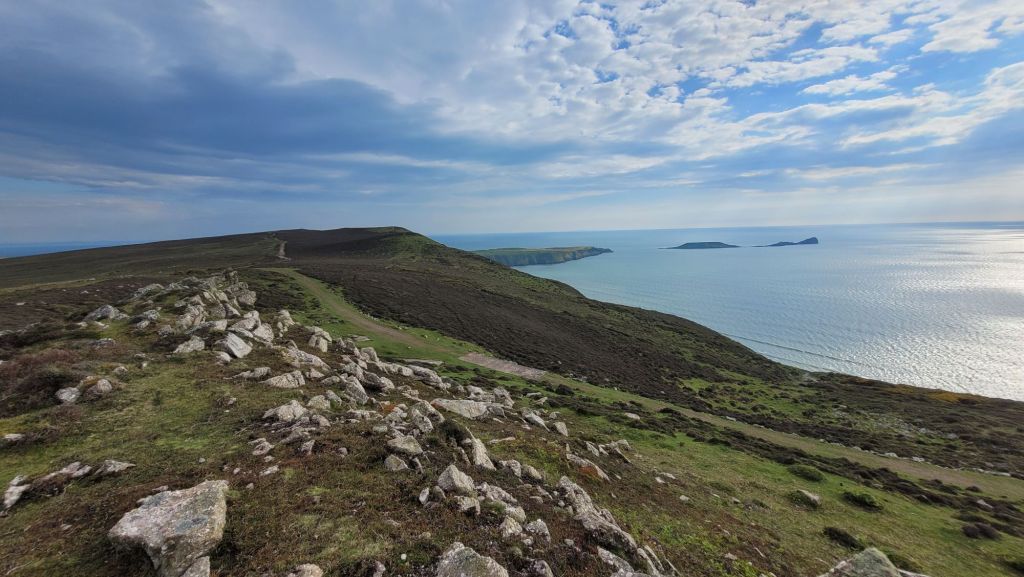
If you walk to the summit of Rhossili Down you have amazing views of the surrounding landscape and sea. From here you can see Worm’s Head which marks the most westerly point on Gower and comprises a rock causeway, linking the small island to the mainland. There is also an Iron Age Promontory Fort.
A challenging walk to The Worm takes planning around local tide times to avoid being cut off. In the past many people have lost their lives trying to swim back to land.
The famous Welsh poet Dylan Thomas initially described the Worm’s Head as “the very promontory of depression” and was forced once to spend the night on the Head after being trapped by the tide.
Dragons
The name Worm’s Head is thought to come from the Norse word ‘Wurme’, meaning dragon or serpent. It is said that the Vikings named it so because the island resembles a dragon..
In stormy weather, a blow-hole on the outer tip of the island is known to make loud booming and hissing noises.. only furthering this islands association with dragons!
The island’s association with dragons is present in many old Welsh folk tales.. Dragons and winged serpents are said to frequent the lands around Worms Head.
Marie Trevelyan in her 1853 book “Folk lore and Folk stories in Wales”, often talks of Wales’ connection to these mystical creatures..
“Linked with all the dragon, griffin, and winged serpent stories was the belief that in lonely ravines, moorlands, and forests treasures of gold and hoarded gems were guarded by these creatures, who sometimes conveyed their goods through the air at midnight when the old hiding-places were discovered.” .. perhaps there is some hidden treasure on these lands that the winged beasts are protecting..
https://archive.org/details/afl2317.0001.001.umich.edu/page/168/mode/2up?q=gower
Here is the video we made covering the Sweyne’s Howes megaliths!
 CoralJackz - That History Couple
Leave a comment