

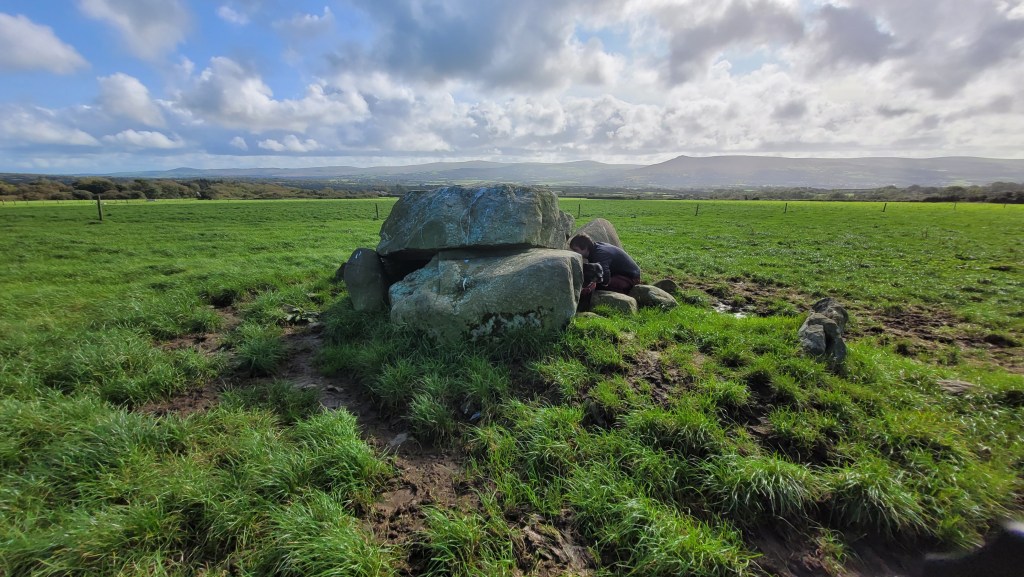
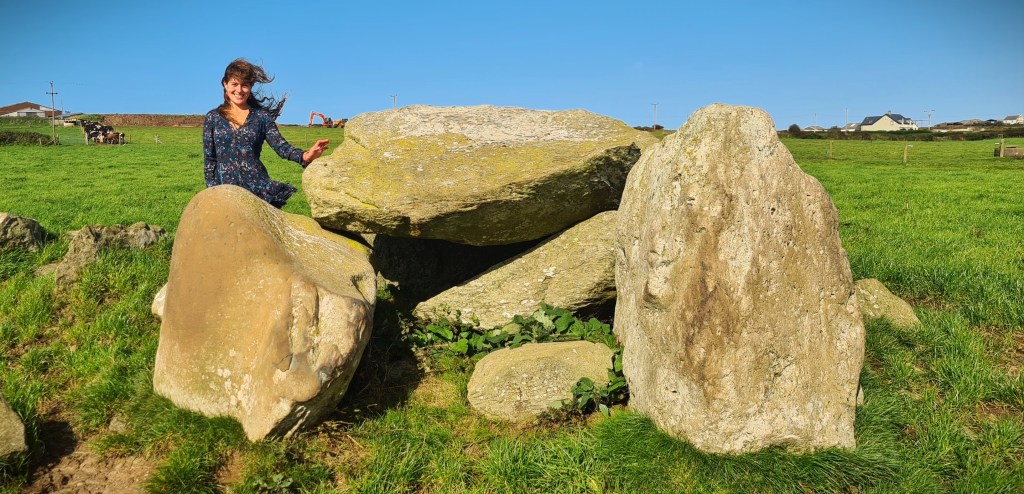

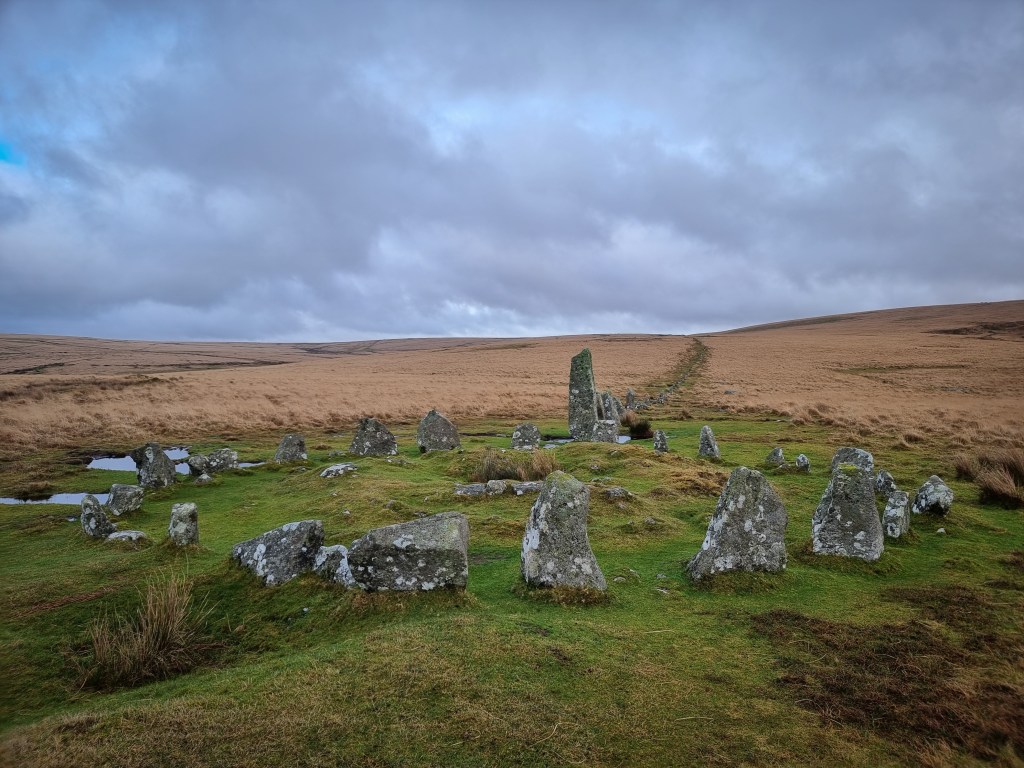
This collapsed neolithic monument is a fascinating site estimated to be at least 6,000 years old. It features ancient rock art and has yielded important finds relating to the earliest evidence of dairy production in Wales.. It also has some very old legends attached to it!
Trellyffaint is on private land (and a busy working farm) so there is no public right of way. We were driving past the site and stopped to look from a distance when a friendly farmer pulled up next to us on his quad. We explained we were making a video and he was happy to let us go see the monument up close and spoke enthusiastically about archaeological research that had taken place on the land.
Rock Art & Excavations:
There appears to have been two chambers, one of which is still partially intact and around 75 prehistoric ‘cupmarks’ and possibly several lines on the capstone. Trellyffaint was recently part of a four year study, which i believe started around 2016, which was initially focused on the rock art here.. But also included an earthwork survey of the site which revealed a range of important discoveries…
Shards of pottery, flint and chert were found at the site. The remains of pottery were a particularly special discovery because the acidity of local soil meant that remains such as pottery and bone very rarely survive in this area. The pottery was found to contain traces of burnt on food residue indicating that the vessels were used for cooking. Further testing revealed that the residue originated from milk-based substances such as butter, cheese or likely yoghurt, that was dated to 3100BC. These results represent the earliest known direct evidence of dairy production in Wales, and confirmed that Neolithic groups were exploiting dairy by at least the 4th Millenium BC and most likely earlier. At the bottom of this post we’ll link to a video in which Dr George Nash himself discusses the topic.

Rock Art at Trellyffaint. Photograph: George Nash
Legend of the toads..
Trellyffaint is said to mean “home of the toads” or “toad hall” which appears to stem from an old story documented by medieval priest and historian Geraldus Cambrensis. His Itinerarium Cambriae, the intinerary through Wales, was written around 1188 and includes the following tale:
“Two circumstances occurred in the province of Cemmeis, the one in our own time, the other a little before, which I think right not to pass over in silence. In our time, a young man, native of this country, during a severe illness, suffered as violent a persecution from toads, as if the reptiles of the whole province had come to him by agreement; and though destroyed by his nurses and friends, they increased again on all sides in infinite numbers, like hydras’ heads. His attendants, both friends and strangers, being wearied out, he was drawn up in a kind of bag, into a high tree, stripped of its leaves, and shred; nor was he there secure from his venomous enemies, for they crept up the tree in great numbers, and consumed him even to the very bones. The young man’s name was Sisillus Esceir-hir, that is, Sisillus Long Leg.”
In A Historical Tour Through Pembrokeshire, published in 1810, antiquarian Richard Fenton visits the site:
“I proceed to Trellyffan, or Toadstown, the place alluded to by Giraldus Cambrensis, who relates a singular story of a person here being destroyed by toads ; and alight to see the figure of a toad, -well sculptured in black marble, which is introduced into a chinmeypiece, and was formerly covered with glass to preserve it from any injury. It is said to have been brought from Italy, the work of a foreign artist. My enquiries as to the date of its introduction here were fruitless, and all I could learn was, that it had filled its present station for some centuries, but, perhaps, on too vague an authority to be depended on. Whether the present occupiers of Trellyffan are descendants of the original family, one of whom was the unfortunate victim of Giraldus’s account, I cannot pretend to say; but they have lived there for some generations, and as the respectable clergyman our companion informed me, who traces to the same stock, bear a toad for their crest, adopted at first, no doubt, from a motive of piety, as it were, to commemorate that supposed horrid visitation, and by reminding the bearer of it to correct human pride.
If stature or bodily peculiarities run in families, and are hereditary, by fair inference might not the relationship in some degree be established between the former and the present possessors of Trellyffan? Giraldus calls the devoted wretch of his time “Syssylt Escir hir, Syssylt tibia longd, Syssilt longshanks.” Perhaps there can be few instances adduced of tallness being continued in a family so long as in this, every one of the present as well as the former generation being upwards of six feet, and even a female only nineteen years of age nearly as tall.”
The following is from a document we found on Coflein.gov titled ‘The Archaeological Landscape of the Parish of Dinas: A Summary and Overview of the Evidence, written by Rhiannon Comeau’ in 2008:
“The old name for Dinas Island was Ynys Llyffant (Gwynrug 10.12.08) or Ynys Fach Llyffan Gawr (Owen 1994, 116). Gawr means giant; llyffan/llyffant means toad or frog, and recurs five miles away in the farm name Trellyffaint/Trellyffan (Nevern parish). Trellyffan is linked with a story told by Giraldus Cambrensis, about a man – Seisyll Esgairhir (Cecil Longshanks) – being consumed by frogs, but Charles considers that the name refers to local marshy ground (Charles 1992, 145-6; Gerald of Wales 2004, 169-70). It is conceivable though that llyffan/llyffaint is a corruption of a personal name, and that Esgairhir/Longshanks and Gawr/giant refer to the same tall person or family based in the Nevern area before the end of the twelfth century; this would fit with the later links between Dinas Island and landowners from the Pentre Ifan/Nevern area. Bartrum lists Llyffan Gawr as a legendary giant, linked to Castell Llyphan on the Teifi in Ceredigion, whose wife was slain by Gwalchmai, the Gawain of Arthurian legend (Bartrum 1993 420).
The only other recorded folklore from Dinas concerns the ‘Tre Bendith y Mame’, or Fairies’ Town – Bendith y Mame, or ‘the Blessing of the Mothers’ being the 19th century Dinas term for fairies. This was a floating island, sometimes seen in the sea near Pwllgwaelod (Amsang ein Tadau, n.d., 284). The islands of the Pembrokeshire fairies – also known as the Tylwyth Teg (the Fair Folk) or Plant Rhys Ddwfn (Children of Rhys the Deep) – apparently lay to the west (Davies 1911, 91).” – https://coflein.gov.uk/media/77/126/dd_2009_026.pdf
Here is the video we made covering Trellyffaint:
Dr George Nash – Trellyffaint: art and feasting –
 CoralJackz - That History Couple
Leave a comment