
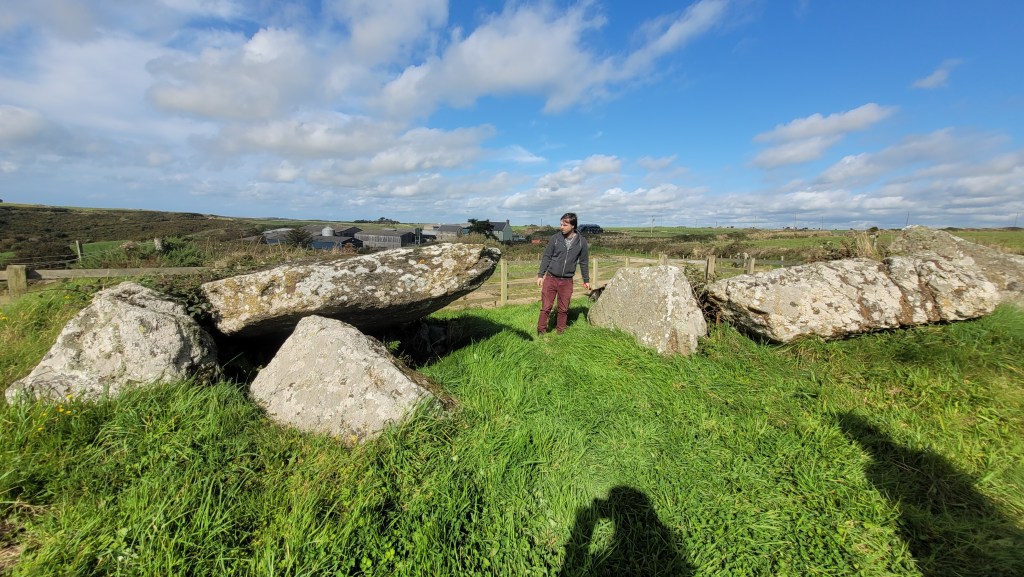

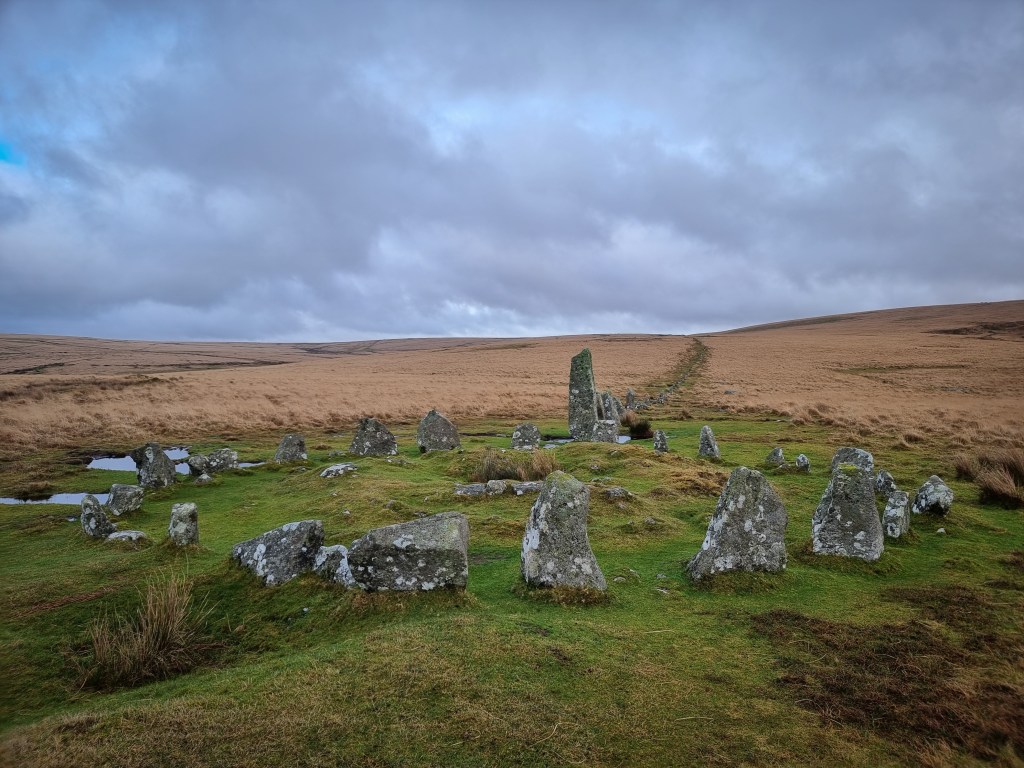
Remains of a Neolithic ‘double cromlech’ near Solva..
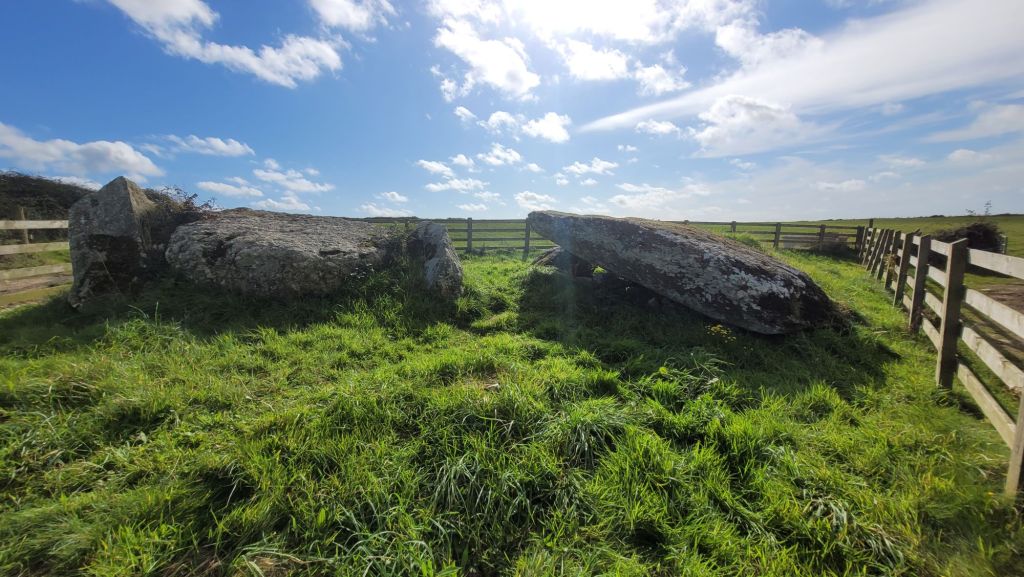
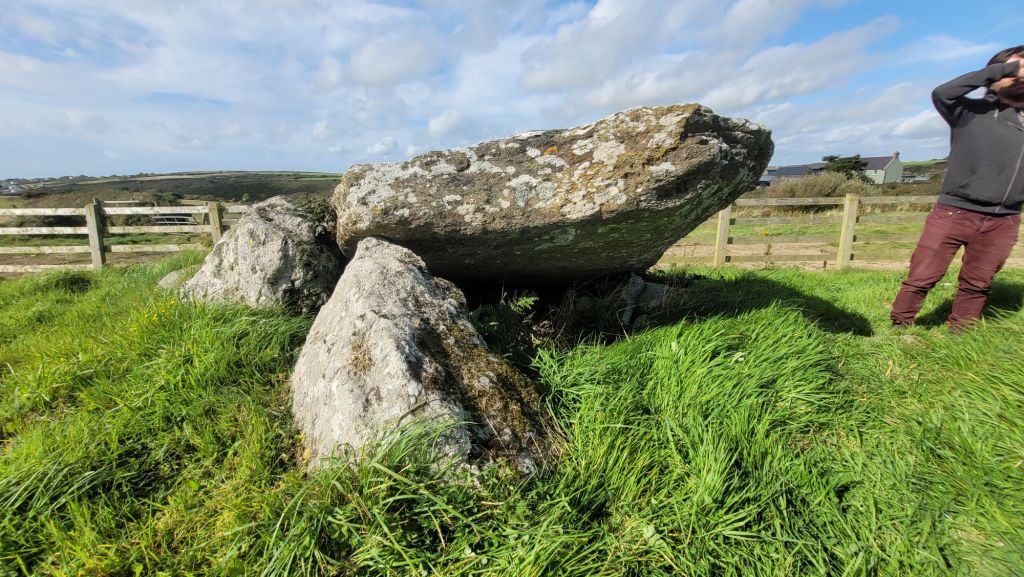
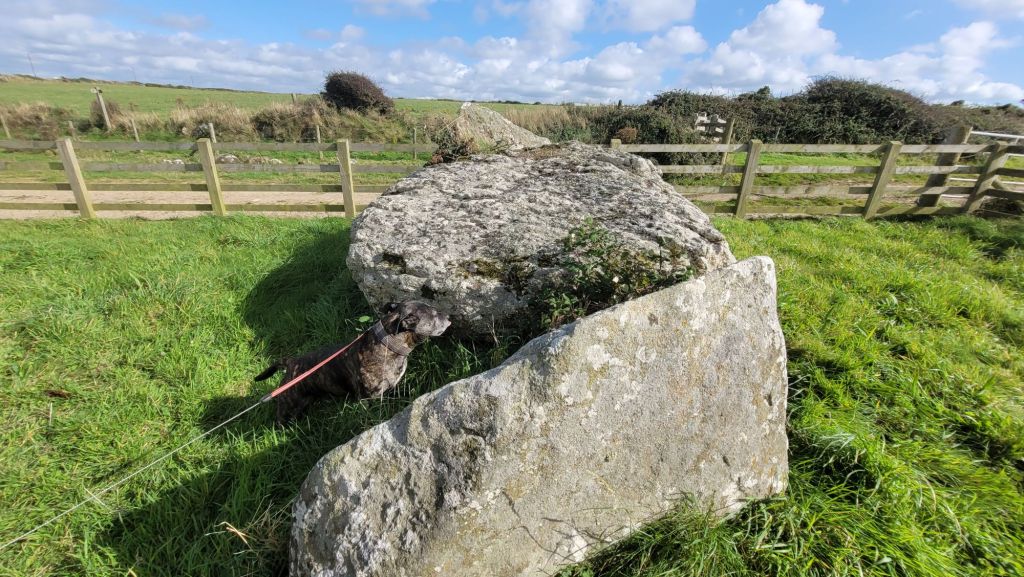

About the site:
The remains of two chambers can be discerned; on the W side is a large capstone measuring ca 3.3m x 2.4m x 0.7m which is supported on the S side by a stone 0.7m high and surrounded by several smaller stones, some partly buried. The chamber measures 4m sq. and is 1m high at the highest point. the second chamber consists of a capstone measuring 1m x2m x 0.6m and the other 1.5m x 2m x 0.7m. The latter was once used as a gate post as there is an iron bar set into it.
Archaeologist W.F. Grimes claimed in 1936 that the monument has been excavated without result, but it has proven difficult to prove this.
The following is quoted from ‘A Historical Tour Through Pembrokeshire’ written by Richard Fenton in 1810:
“…A little beyond to the right of the road lies the small church of St. Elwys, a parish consisting of only two or three farms. Here on a point of land projecting into the sea, part of the tenement called after the church, there are several adits and other evidence of works once carried on there in search of silver mines, Temp. Eliz. The proprietor of the land at that time was John Voyle, Esq. a man of most extensive possessions in this county, who, joining with his son-in-law Sir Thomas Canon, Knt. a man of learning, enterprise, and fortune, from the very flattering appearances of the mineral strata was induced to attempt a trial of some pretensions.
The deed of partnership, dated the 12th of March, 1623, to which those gentlemen adventurers were parties, I have had an opportunity of seeing, among other valuable documents, by favour of Lord Milford, who, with a liberality unclogged by any pitiful, insulting restrictions, permitted me to have access to all the valuable collection of papers at Picton Castle.
The terms of the agreement were, that Sir Thomas was to procure and purchase from the crown a lease or grant of such metals as by virtue of the royal prerogative it was entitled to, and that in the working of the said mines they were to be at equal charges, and were equally to share the profits. What was done in consequence of this instrument does not appear. However, in my memory, the then possessor Thomas Williams, Esq. of Trelethin, made an attempt to penetrate into this Potosi, but whether his operations were carried on with sufficient spirit and judgment I know not; yet it is certain that he expended some money to very little purpose, and lost the substance for a shadow.
In this small parish on the farm of Llechvaen there is a large druidical monument of the Cromlech kind, a fresh circumstance tending to corroborate a remark that an attentive observation on the position of such monuments has frequently compelled me to make, namely, that I scarce ever recollect to have seen a Cromlech, if in a practicable or accessible situation, without a church not far off, as if to purge the place from the profanation or idolatry; a striking fact, that hardly leaves a doubt of the origin and use of the Cromlech, that it was sacrificial and not sepulchral.”

Here is some more information we found on https://heritageaction.wordpress.com/2011/03/19/st-elvis-cromlech-solva-pembrokeshire-double-chambered-tomb/
“Jacquetta Hawkes writing of cromlechs in this area in the 1950s says that around St. David…the plateau of the old sedentary rocks are broken by abrupt outcrops of much harder rocks spewed up by volcano, each one will be seen to have a little farm, edged up against, it is also noted that a very considerable number of dolmens have similarly been built against the volcanic outcrops, perhaps endowed with spirits and local deities“. The St.Elvis dolmen is not built against an outcrop, but follow the farm trackway and you are well aware of the rock that lies hidden in this area.
Be that as it may, this cromlech was badly damaged by the farmer in the 18th century, he tried to blow it up, but it has survived to the present time carrying with it the remains of its stones, some of which are also said to be incorporated in a nearby wall. Its prehistory and a later church, which is now part of the farm buildings that stand near the cromlech, add to a long history when the celtic or ‘desert’ saints roamed the land setting up early churches near to the old pagan stones.
Mention should be made of the name of St. Elvis, in actual fact the saint’s name would have originally been Ailbe (Ailfwy, Elfyw, Elfeis, Elvis, Elouis), He died between 527-531 AD and was the nephew of St. Non who was the mother of St. David. A great Irish saint, he had many churches named after him, and there is also a St. Teilo’s well on the farm, to which the pilgrims making their way to St. David would also stop at for its healing power. There is a folktale that pilgrims who were very ill would be left by the cromlech and given holy water, and should they get visited by a raven during this time, their end was nigh.
Elvis Presley is of course also linked to this saint, by dint of his first name and that his surname is very similar to the nearby Presceli mountains, there has been a great deal of speculation on this but only family history can prove that his parents came from this part of the world and gave the name of a saint to Elvis Presley.”
Accessing the site:
We parked on a grass verge on the A487 near the entrance to St Elvis Farm track.. Remember to never park in front of farm gates and always park in the most unobtrusive way possible! Follow the public footpath down the farm track for about half a mile and you will find the St Elvis monument within a fenced off area just past the farm.
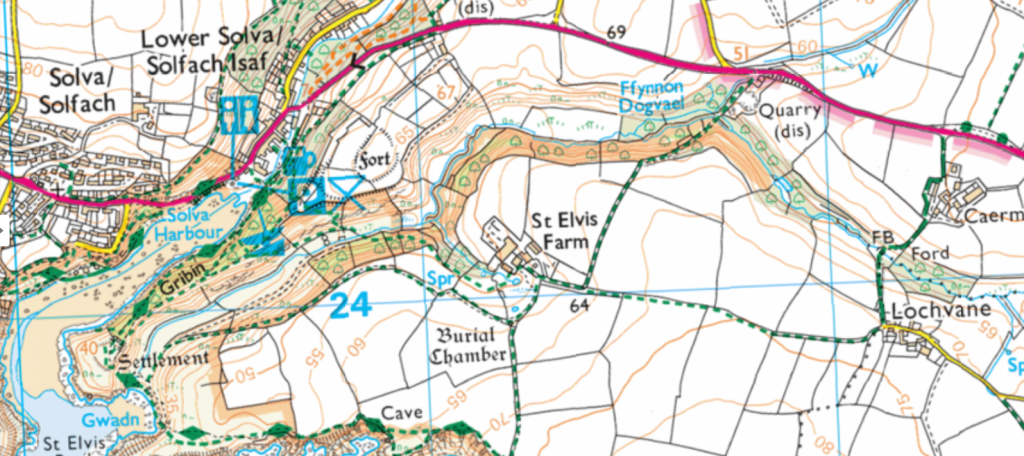
Map courtesy of Ordnance Survey © 2025 Microsoft via Bing Maps
 CoralJackz - That History Couple
Leave a comment