
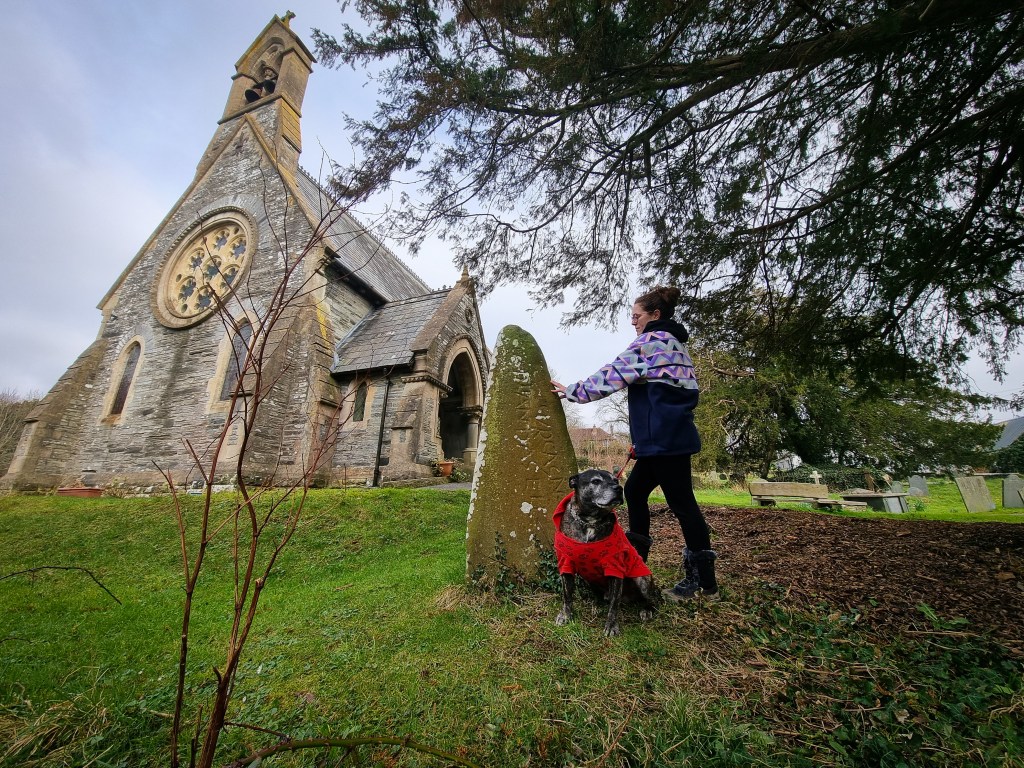

The Gellidydwyll Stone. Inscribed Stone in Cenarth. Carmarthenshire, Wales.
This stone now stands in St Llawddog’s Churchyard in Cenarth. The Latin inscription is thought to date to the 6th century and translates to ‘Curcagnus, son of Andagelli’. In 1743 this stone was recorded as standing on the roadside adjacent to Temple Druid, around 20 miles away.. It was then moved to a field on the Gellidywyll estate in Cenarth. Then, in 1893 moved to its current position in the churchyard.
This stone is also thought to be related to two stones which are now in St Mary church in Maenclochog. The names are thought to be from the same family..
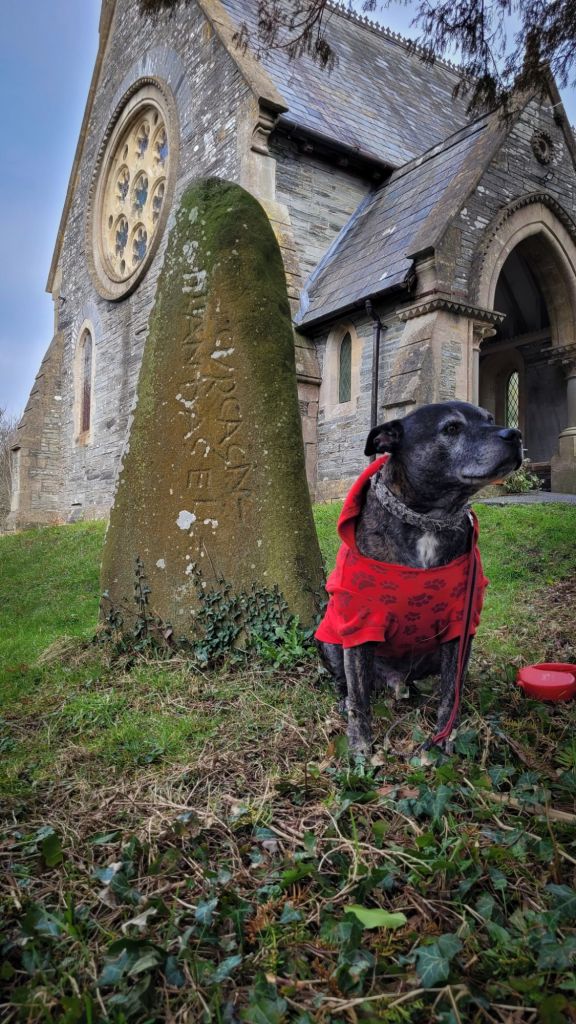
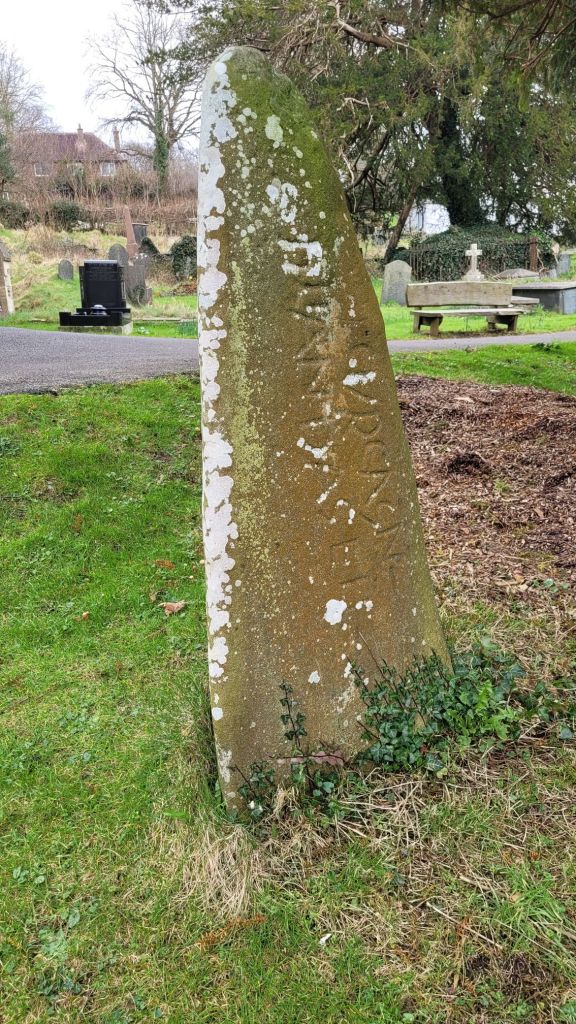
The earliest record of this stone that we could find is from 1743. In 1896, in The Archaeologia Cambrensis, this old record is mentioned:
“The Gelli-Dydywll Stone – Curcagni fili Andagelli – “On a stone 6ft long on the roadside by Mr. William Lewis’s house, called Bwlch y clawdd, in ye parish of Maen Clochog, in Pembrokeshire, I found this inscription A.D. 1743”. In a notice of this inscription in the Gent. Mag. For 1776, it is said that the stone then stood on the lawn of Capt. Lewis’s house in Carmarthenshire.” – https://journals.library.wales/view/2919943/3010814/65#?xywh=-931%2C219%2C4349%2C2264
Coflein description of the stone:
Maenclochog 1, a roman-letter inscribed stone, was first noted in 1743 when it lay on the roadside adjacent to Temple Druid (then Bwlch y Clawdd). The stone may have originated from St Teilo’s Church Llandilo, some 400m to the south-east. Alternatively it may indicate the early medieval reuse of Temple Druid enclosure, which has been interpreted as a henge monument. It was later moved to Gellidywyll, Cenarth, where it stood on the lawn, and in 1893 was moved to St Llawddog’s Church, Cenarth where it stands in the churchyard to the south-west of the church.
The stone is a smooth, rounded, rounded boulder of pyroxene-rich dolerite with visible pale green amphibole ? probably glacially transported from the Preselis or the Fishguard Volcanic Group. Measurements are given as 146cm height x 68.5cm > 23cm width x 46cm > 17.5cm diameter. The Latin inscription, which reads vertically downwards, is thought to date to the late 5th or first half of the 6th century. It has been translated as `of Curcagnus son of Andagellus?. The inscription is thought to have been partially recut.
Sources include:
Edwards, N. 2007, Corpus of Early Medieval Inscribed Stones and Stone Sculpture in Wales – https://coflein.gov.uk/en/site/304128

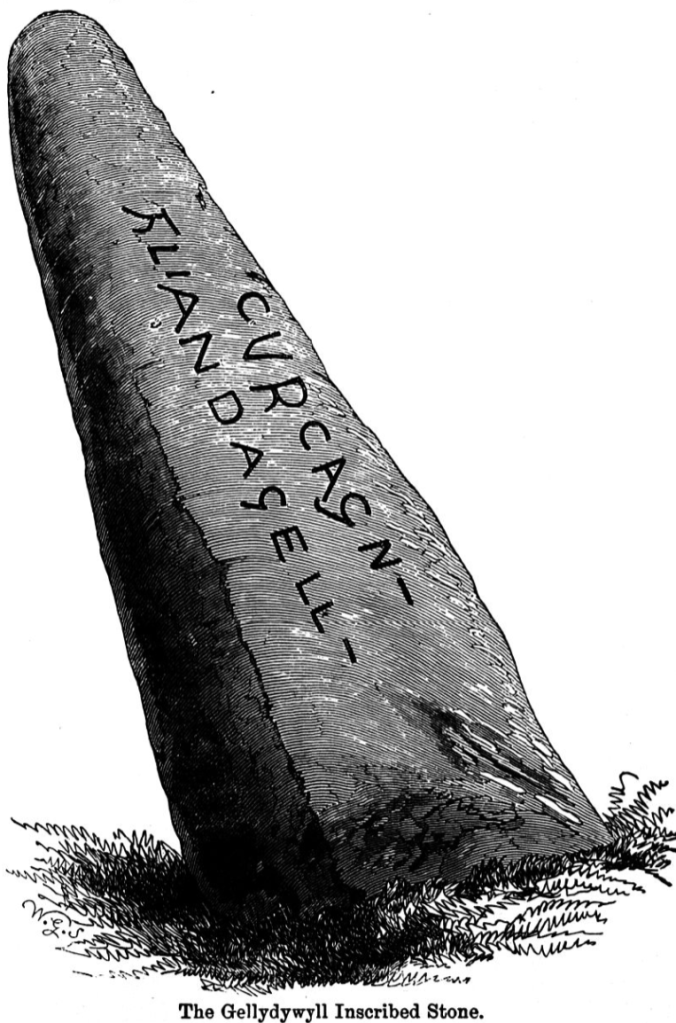
The following is a record from 1894 of the stone being moved to its currrent position, as well as an illustration from Archaeologia Cambrensis:
“Removal of Gellydywyll Inscribed Stone to Cenarth Church-yard. –
The Rev. D. H. Davies, Local Secretary of the Cambrian Arch. Association for Cardiganshire, in a letter to the Carmarthen Journal, dated Oct. 16th, 1893, records the fact that the Gellydywyll inscribed stone has been removed, for the better preservation, into Cenarth Churchyard, by the direction of the Earl of Cawdor. The monument in question has already been described by Mr. G. E. Robinson in the Arch. Cam. (1876). The inscription, which is debased Latin capitals, reads
CVRCAGN
FILI ANDAGELL
The first name, Curcagnus, occurs also on the missing stone at Llandeilo Fawr in Carmarthenshire, and the second name, Andagelli, is found on the Ogham inscribed stone at Llandeilo in Pembrokeshire.
The Gellydywyll Stone originally stood in a field called “Parc maen-llwyd” (ie “The Grey Stone Field”), near Cenarth Church. Many years ago a former owner of Gellydydwyll had the pillar taken thence in order to place it over the grave of his favourite charger, near the mansion. Mr. John Morgan of Cenarth remembers being told by an aged labourer that he had assisted at the removal. It is even now believed that the stone is nothing more than the tomb-stone of a horse ; and as a proof of this the credulous inhabitants point to the word FILI as being obviously equivalent to filly.” – https://journals.library.wales/view/2919943/3009803/83#?xywh=-1180%2C1435%2C4349%2C2264
The following is from ‘A history of Wales from the earliest times to the Edwardian conquest’ by Sir John Edward Lloyd, published in 1911:
“At the east end of the ruined church of Llandeilo, near Maenclochog, was discovered in 1889 a bilingual inscription to the memory of ‘Andagelli fili Caveti’, but this man’s brother (presumably), named ‘Coimagni fili Caveti’ was commemorated by a Latin inscription only, which came to light at the same time, after having been long built up into the churchyrad stile. A third stone, now in the churchyard of Cenarth, but originally found in the same neighbourhood, records, in Latin capitals only, the name of a third member of this family, one ‘Curcagni fili Andagelli’. Moreover, it is quite unusual to find names which from their occurrence in ogams are known to be Goidelic also figuring in monoglot Latin epitaphs. Anglesey, where no ogams have as yet been discovered, furnishes two good instances in the ‘Cunogusi’ of the Bodfeddan stone and the ‘Maccudecceti’ of that at Penrhos Lligwy…” – https://archive.org/details/historyofwalesfr01lloyuoft/page/114/mode/2up?q=+CURCAGNI
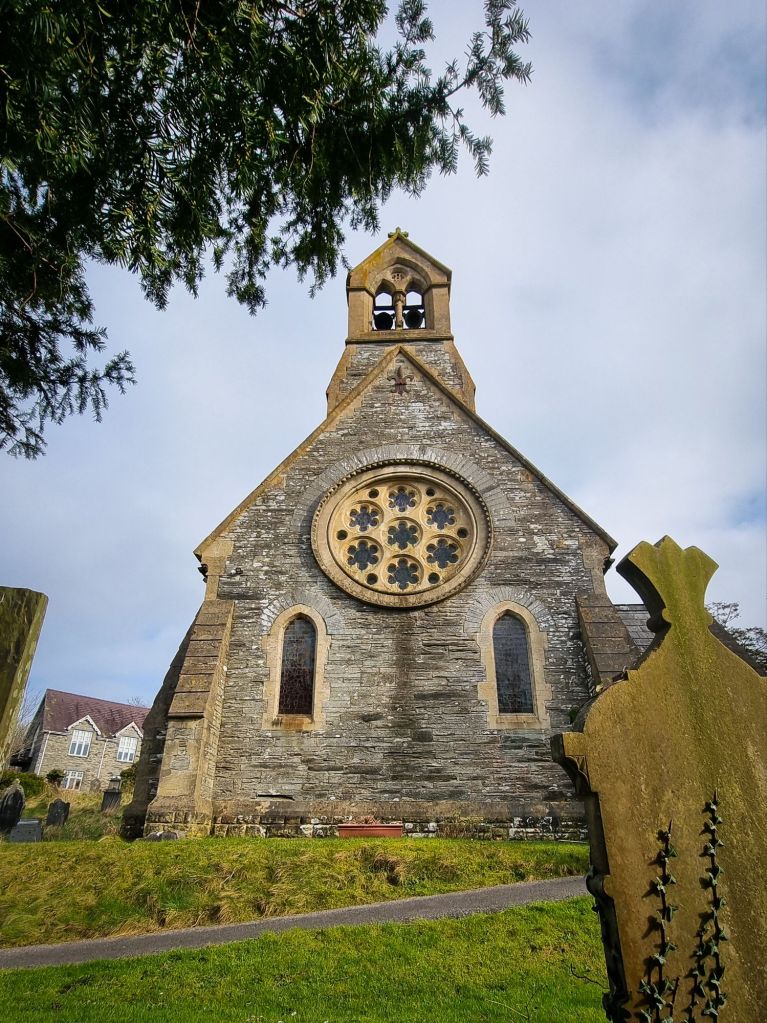
St Llawdog’s Church was a medieval parish church. It was rebuilt in 1872. The medieval church may have been sited immediately south of the present building. In 1844 it was described as some 50ft long and 25ft broad, with 230 sittings. In 1855 it was described as being comprised of nave, chancel and transeptal south chapel. The chancel arch was descibed as pointed, with a projection in its south wall. There was also a pointed west door and a western double bellcote.
 CoralJackz - That History Couple
Leave a comment