


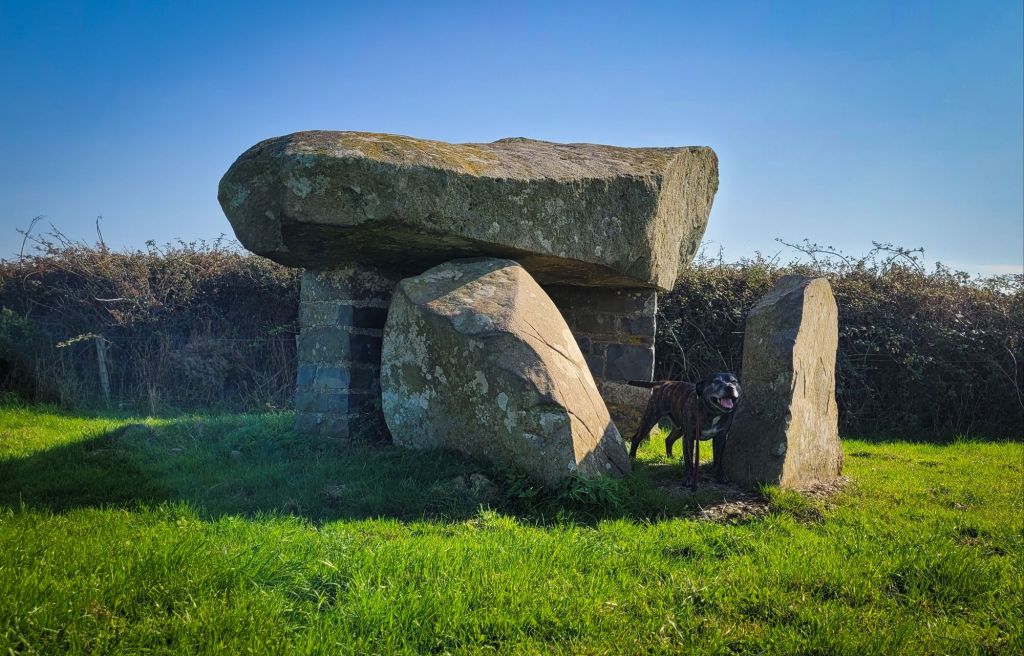
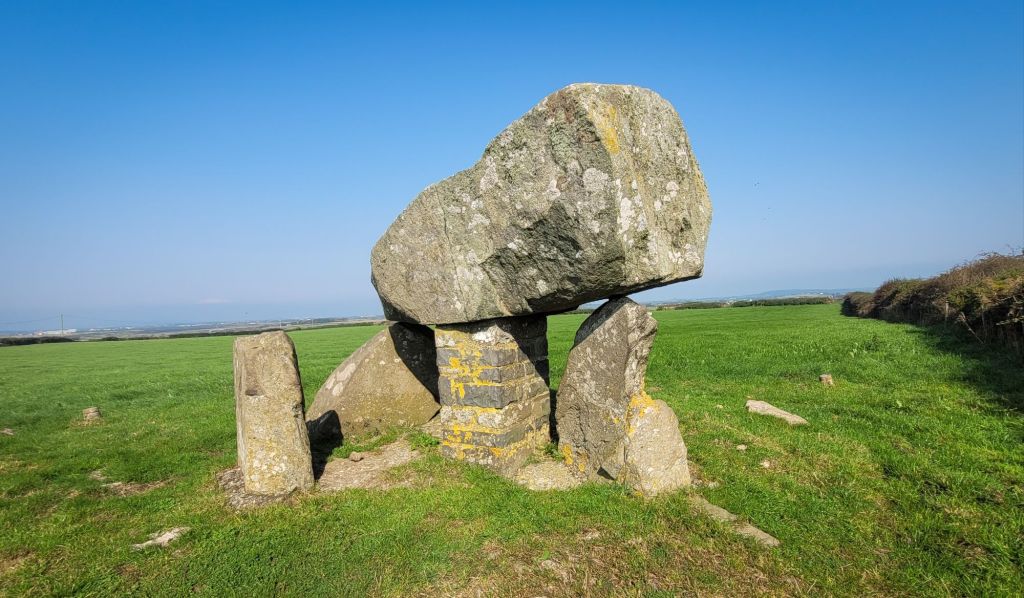
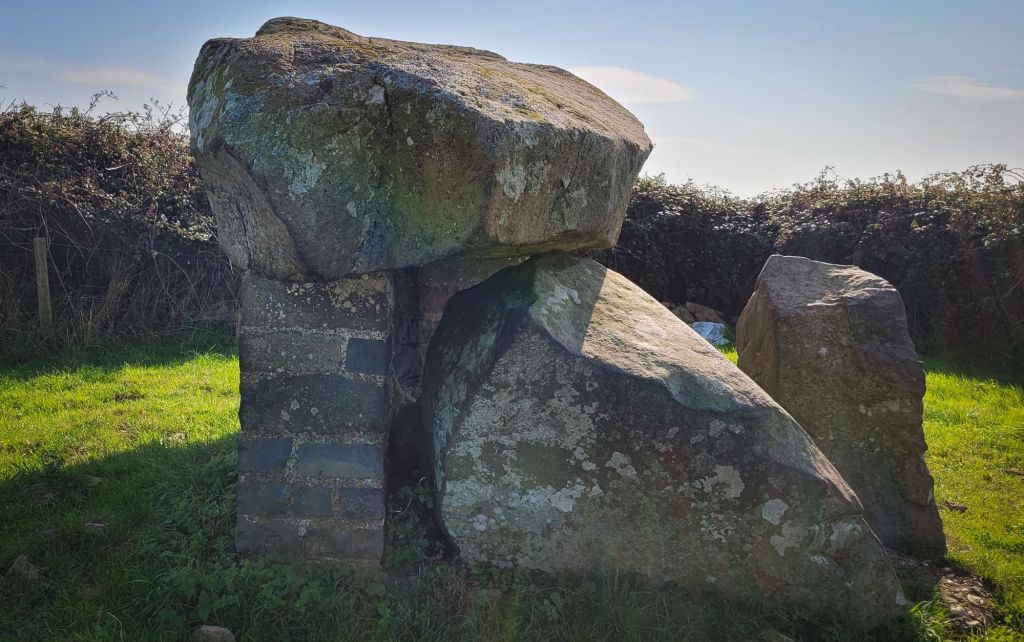
A number of descriptions of this monument have been put on record.. dating as far back as 1802. The site was once described as a ‘double cromlech’ but has since been subject to heavy damage. At present form the monument consists of a 12ft by 5ft capstone partially held up by brick supports which were added after excavations in the 1930s..
The earliest mention and drawing of the site:
In 1899 the expatriate Welsh scholar Edward Owen wrote from his sanctum in the India Office to J. Lloyd Griffith, treasurer of the Cambrian Archaeological Association, noting the recent cataloguing of British Museum Additional Manuscript No. 33636, a volume which he predicted would be of ‘considerable interest to Anglesey antiquaries’. This was one of a series of volumes in which the Reverend John Skinner, Rector of Camerton in Somersetshire described the tours which he undertook over many years in various parts of England and Wales, around the turn of the 19th century. Skinner was well antiquated with well known antiquarian Sir Richard Colt Hoare and sometimes toured with him, though seemingly not in Wales.
The writings on Anglesey were bequeathed to the British Museum in October 1839, on condition that they remained unopened for 50 years. The illustrations are described by Owen as ‘very roughly coloured, and poorly executed’ but nevertheless he emphasised their importance ‘as denoting the former character of churches that have since been subjected to restoration’.. and of course, showing us how some of ancient Anglesey monuments looked back then. Skinner’s narrative and illustrations are valuable today for conveying glimpses, sometimes our only glimpses, of monuments now either vanished entirely or heavily altered.
The following is quoted from ‘Ten Days’ Tour through the Isle of Anglesea, December, 1802’ by John Skinner:
“Hence continuing our walk to the north-ward we passed through the parish of Llanfaelog and about half a mile beyond the church came to a very perfect cromlech. The cap stone is rather of an oblong shape and measured sixteen feet long, six wide, and three thick. It only rested upon three supporters each about three feet high although there were four placed in the ground. Near the cromlech were lying two large stones, the one seventeen feet long and three thick..” – https://dn790000.ca.archive.org/0/items/tendaystourthrou00skin/tendaystourthrou00skin.pdf

In the 1936 excavation report, the author mentions Skinner’s account, noting: “His sketch shows the monument from the south. The capstone of the second chamber later noticed by Longueville Jones is shown on the ground in two pieces in a position to the south-east of the surviving chamber. The pieces, if they really belonged to one stone, have been slewed round to rest side by side with the broken ends pointing east. There is also thought to be a hint of a mound under these two stones in the drawing, but it is at best only a trifling relic of the cairn which must have stood on this site. No trace of it remains at the present day, though several large stones built into the adjacent modern field banks may be pieces from this broken capstone.
H. Longueville Jones, 1863 & sketch:
The next records we have of the Ty Newydd cromlech is from Harry Longueville Jones, a Welsh archaeologist and artist. He describes a ‘double cromlech’.. He also provides us with two sketches of the cromlech, and in the second account describes his shock at how much the site had changed since his previous visit.
The following is quoted from ‘On the cromlechs extant in the Isle of Anglesey’:
“A remarkably fine remain of this nature is the cromlech at Llanfaelog of which we append a representation; the cromlech still standing is composed of one flat on several upright stones; the flat top being about 12ft. by 9ft. in breadth, and from 2 ft. to 3 ft. in thickness. By its side lie the fallen remains of a much larger cromlech, the upper stone of which is not less than 15 ft. in length; underneath the upright one are still to be seen numerous small stones, and the ground rises gently toward the upright supports on all sides; but on referring to Pennant, vol. ii. p. 238, we find him saying (in speaking of cromlechs) “others again are quite bedded in the Carnedd or heap of stones, of which instances may be produced in Llanfaelog, in this island, in that of Arran, and in the county of Meireonedd.” If then this cromlech could have been so stripped of its covering since the end of the last century, what may we not expect to have taken place in other instances?” https://en.wikisource.org/wiki/Archaeological_Journal/Volume_3/On_the_Cromlechs_extant_in_the_Isle_of_Anglesey

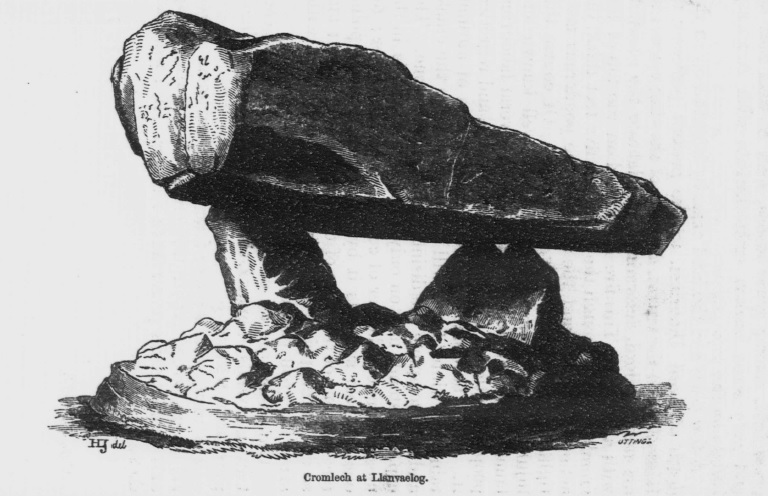
And then his account from Arch Camb. Which includes another sketch:
“In 1844 I visited [Anglesey] and took a drawing of the double cromlech at Llanvaelog, one of the best in the island. One cromlech was erect; the other by its side, thrown down: or rather, I should say that the two constituted the remains of a large chambered mound – perhaps of a cromlech with a passage, as at Bryn Celli in the same island.
The cap-stone of that which was erect measured thirteen feet and a half in length by about five feet in depth and width at the thickest part. The cap of the fallen one was broken in two, but when entire it was not less than fifteen feet long. Fortunately this drawing remains in my portfolio; and it shews the importance of preserving memorials of these early monuments, whenever opportunity offers, made with all possible care; for since then the fallen cromlech has utterly disappeared; and the upright one has been so seriously damaged, that its destruction will now be the work of only a few winters – all through the sheer stupidity of men!
I had occasion to pass by the spot last summer, and on going to renew my acquaintance with this venerable monument, found nothing more remaining than what is represented in the accompanying engraving. An “improving tenant” had come upon the farm. He wanted to repair his walls; and though the native rock cropped out all around, he found it more convenient to blast the fallen stone, the very existence of which was probably unknown to either the landlord or his agent. Hence the fallen one disappeared. The tenant, however, seems to have been in some degree aware of the importance of the erect cromlech; for he cut a kind of trench all round it, and by subsequent ploughing has left it standing on a kind of low mound. Formerly it stood in a grass field, among gorse bushes, with no wall near it, and only some broken embankments with Anglesey hedges on the top.
A few years ago the land came by inheritance, on the death of Lord Dinorben, to the present possessor of Kinmel; and the tenant, desirous of shewing respect to his new landlord, determined to celebrate the occasion with a bonfire. This fire he lighted on the top of the cromlech; and though the stone was five feet thick, the action of the fire and the air split the ponderous mass right through the middle, crossways! Of course this injury was not intended; but it was well known and lamented in the neighbourhood, – for several labouring people mentioned the circumstance to me, and regretted it. As it now stands, the combined action of autumn rains and winter frosts will infallibly enlarge the crack, and will complete the disintegration of the stone. The cap, too, stands now on only three stones, and is in the most imminent danger of coming down altogether, for one of them supports it by an extremely small point, very near one of the sides of the triangle of gravity; and so fine is this point, that it is a wonder how it can withstand the great pressure bearing upon it.
The stones are all of a metamorphic character, containing crystals of quartz, chlorite, and feldspar; almost granitic in texture.
Ten men, with three or four horses and some powerful levers, would repair this cromlech in a single day, and guarantee its preservation for ages. But will they do so?”
H.L.J. Oct. 25, 1863. – https://journals.library.wales/view/2919943/2919953/49#?cv=49&m=94&h=llanvaelog%20cromlech&xywh=-637%2C0%2C3209%2C3338
1872:
From ‘Annals and Antiquities of the counties and county families of Wales” by Nicholas Thomas (1872):
“Looking towards Aberffraw, near the shore, at Tynewydd, Llanfaelog, a double cromlech can, or rather, could be seen: one has been used up, the other has been broken. An “improving” tenant made hedges of the first; and a worshipping tenant, apparently believing in the fitness of what he considered an “altar” to the occasion, made a bonfire on the second to celebrate the coming of age of his landlord, and thus split the ponderous mass (5 feet thick and 13 1/2 feet long) in two. The stone is of the metamorphic rock of the country.”-
1912 & photo:
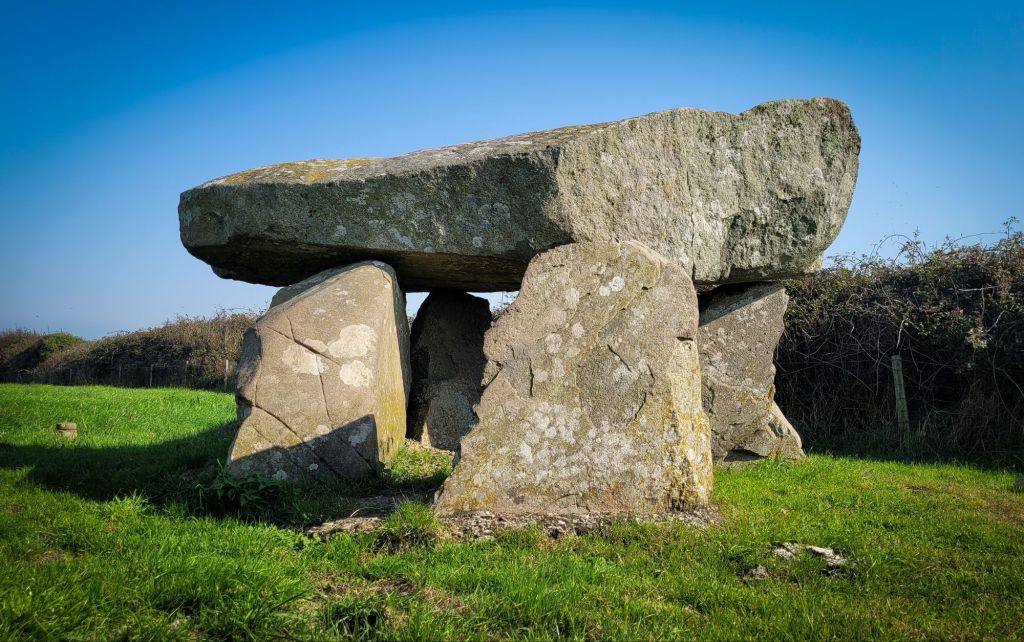
“The capstone and one support are of Ordovician pebbly sandstone. The second support is granite and the third dolerite. The fourth upright has vanished. It is very difficult to find the orientation of this dolmen. Sir Norman Lockyer at first believed that it was to the sunrise at the Winter Solstice, but he thinks it quite possible that an alignment to the Summer Solstice may be the correct one ‘ “no other astronomical alignment”, he says, than a solstitial one “is suggested by the arrangement of the stones”. – https://journals.library.wales/view/1386666/1390508/56#?xywh=-966%2C1019%2C4202%2C2187

Excavations:
In August 1936 the site was excavated by Charles Phillips. Mr Phillips noted that the monument had been under the protection of the Office of Works for some years, and the rapid increase in the size of the crack during the previous two years had made preservation work imperative. The capstone received temporary support from a girder while this work was done, and this was thought to be a good chance to study the chamber and its contents, if any.
The following is quoted from the excavation report of Ty Newydd from the Arch Camb. ‘An examination of the Ty Newydd chambered tomb’ by C. W. Phillips:
“When the work began, the chamber was buried in a small mound to within a foot of the underside of the capstone, and, although some of it was original cairn, the greater part of the top consisted of material recently dumped there by the Office of Works to give further support to the monument.
Before any of this top dressing was removed, the upper part of what looked like a large stone could be seen in the chamber area, and it was expected that this would prove to be one of the support stones missing from the south side. The expectation was fulfilled and after the upper part of the filling had been removed, a large stone was found resting flat in the chamber and covering a good deal of it.
This stone was a pebbly sandstone and it had clearly reached its position with base slewed round (E. fig 1) towards the end stone of the chamber as a result of attempts to overturn the capstone. On the lower edge of the latter, close to the point where it must have rested on this stone, tool marks of comparatively recent date are plainly visible. After this fallen stone had been moved out of the chamber, the contents and floor were carefully examined.
It was found that a practically uniform layer of fine black earth containing much charcoal was covering the whole floor, the extent of which will be seen on plan, Fig 1. It seldom exceeded 2 inches in thickness, except in one or two minor instances where it was filling up slight depressions in the barren soil underneath. Scattered freely through this deposit were three beach pebbles and 110 pieces of broken white quartz of varying size, a familiar accessory to Bronze Age sepulture.
No trace of human remains was found either burnt or unburnt, and the only animal vestige was a very old and decayed limpet shell. Five small flint flakes were found scattered in the deposit, three showing clear traces of fire, and there was also a small lump of flint from the beach. The only stone objects of importance were the remains of a fine barbed and tanged flint arrowhead greatly damaged by fire (Fig 3), and a tiny chip from a polished flint axe with dense white patina.
Nine small fragments of pottery were also found in two groups, all from the same type of pot. The fragments are too small to give a decisive clue to their age and character, but they come from thin vessels of a fine light-buff coloured, smoothly-surfaced ware, with little or no backing and now very friable. One piece belongs to a rim of the thin rounded form normally associated with beaker, and there is good reason to regard all the pottery as belonging to this class. One piece shows a trace of what may have been the impress of a fine cord.
So far as they go, the finds can be referred with reasonable safety to the earlier part of the Bronze Age.
A small surviving piece of the walling of the passage was found in situ, as well as a small relic of dry stone walling between stones A and B. At the entrance to the chamber there was a small patch of earth fired to a bright red colour on the same level as the carbon stained floor. The surviving trace of the passage consisted of a slab of dolerite of roughly square section. This was 2 ft long, and had broken into two nearly equal pieces in situ. The outermost end of the slab was comparatively freshly broken also.
It is clear from the present arrangement of the stones that the whole monument has leaned over towards the north. Stone A has gone right away from its original perpendicular position, crushing the dry stone walling between it and stone B, which in its turn has fractured in the middle and leaned northward, becoming practically useless as a support and stone C is the only one which appears to have kept its original position. Under the circumstances, it is remarkable that the capstone has not fallen, since it has been carried at least two feet out of its original position and only received support from two stones of any value, one of which is also out of position. The danger of collapse has now been removed by the insertion of two built up stone pillars by the Office of Works.
With regard to the cairn which must have once covered the two burial chambers on this site, a trench which was driven out from the base of the chamber along a line passing between stones B and C showed conclusively that the whole had been cleared away, and that ploughing had taken place to within a few feet of the monument in recent times..
..Within the memory of old men still living in the district, the chamber stood in a small enclosure about 100 ft in diameter, surrounded by a hedge bank. All trace of this has dissapeared, and some of the large stones now visible in the straight modern field banks close by may have come from the destroyed chamber. It is the original size of the cairn, but the present state of the ground gives no hope of recovering any more evidence than can be got by clearing the chamber.”
Excavation report Arch Camb Page 93- https://journals.library.wales/view/4718179/4737216/116#?xywh=-2696%2C-221%2C8408%2C4378
Cup Marks:
“The publication of Megalithic Enquiries (Powell et al. 1969) revealed the significance of the rock art from the two Ynys Môn passage graves (mentioned above), as well as reporting on nine shallow cupmarks on the capstone of Ty Newydd (Ynys Môn) and the 115+ cup- marks on the capstone at Bachwen (on the Llyn Peninsula).” –https://www.rockartscandinavia.com/images/articles/a19nash.pdf
Access:
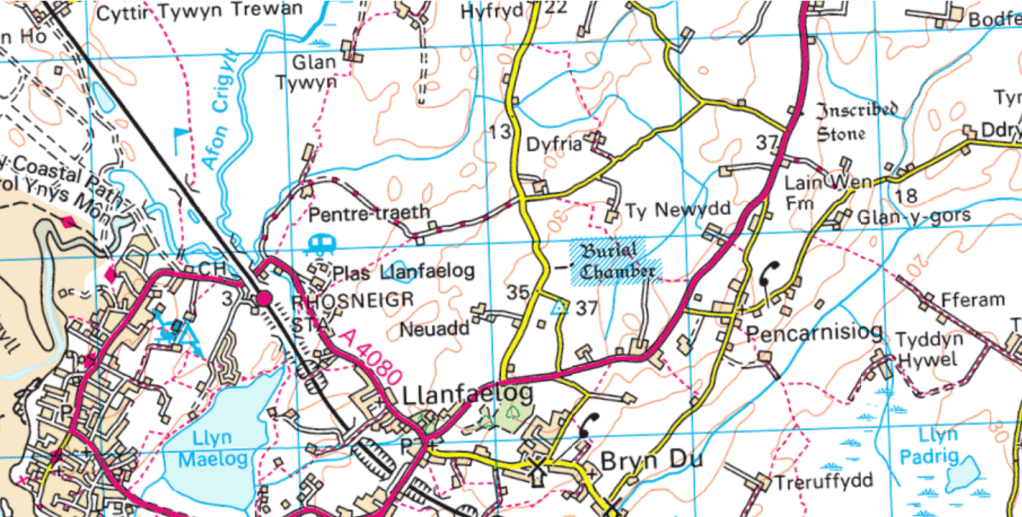
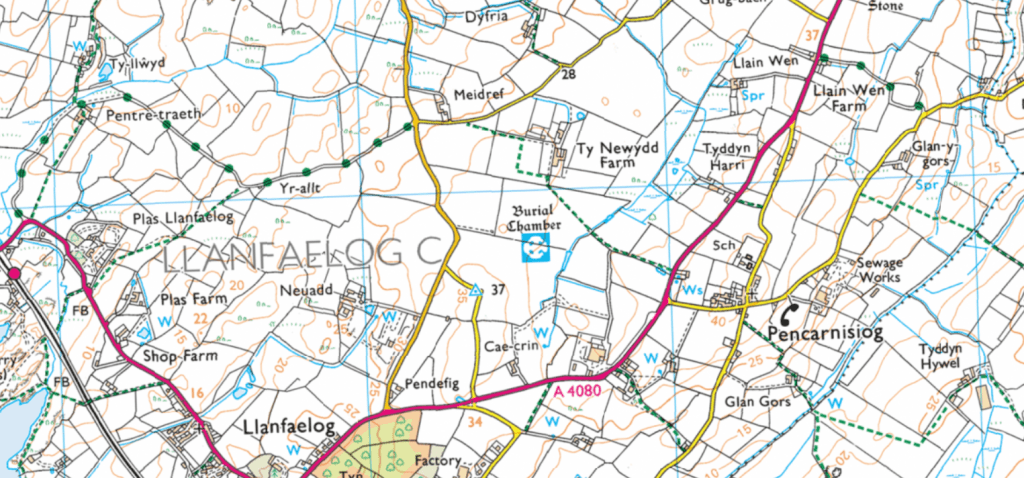
This cromlech is easy to access and a very short walk, signposted from the road with a public footpath leading to it.
Here is our video covering the history and archaeology of Ty Newydd –
 CoralJackz - That History Couple
Leave a comment