
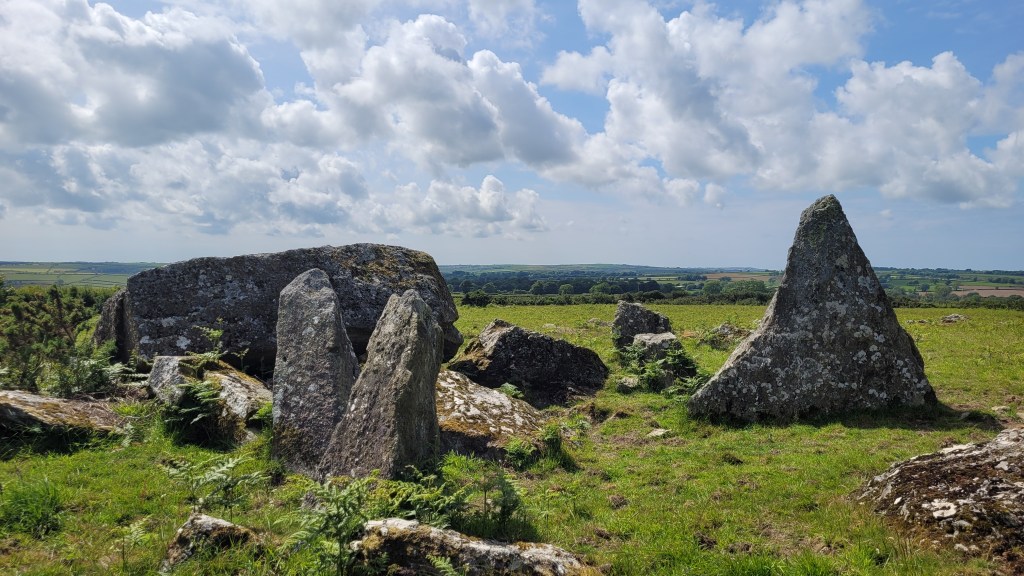

Garn Turne is a neolithic monument in Pembrokeshire, Wales. In old records the site also goes by Carn Turne, Garne Tarne and Old Coldstone. This is one of three cromlech remains which are clustered around the Hamlet of Colston. The others being The Altar and Parc-y-Llun.
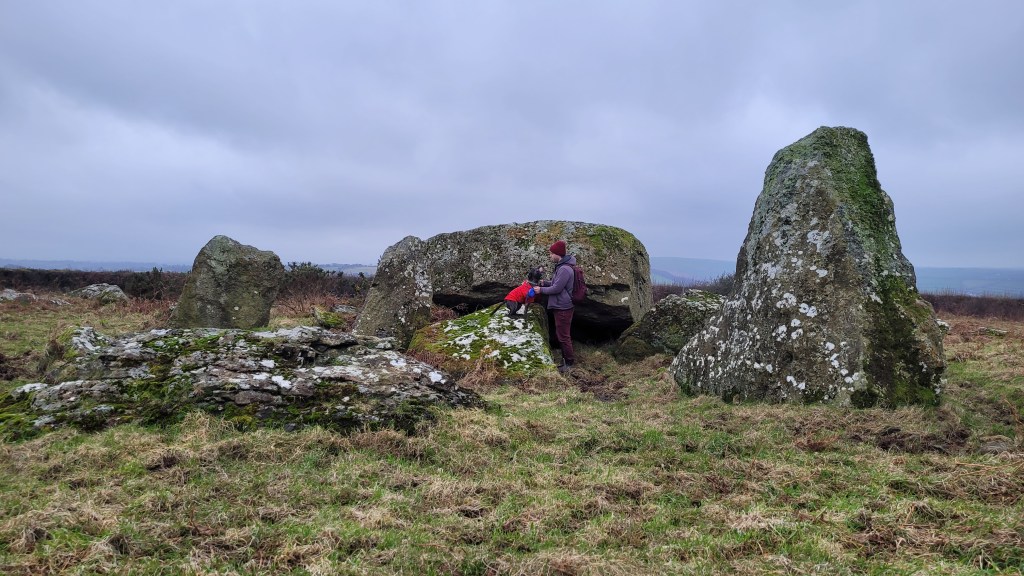
The fallen capstone of the cromlech itself is 5m by 4m and thought to weigh over 60 tonnes..and would have been supported by a series of now partially collapsed and damaged uprights. But almost more impressive than the huge capstone, are the massive uprights in the forecourt. The capstone opens out to what appears to be a “V” shaped forecourt area. This is fairly uncommon and has led to the site often being compared to Pentre Ifan and the Irish Court Tombs of southern Ireland. This architectural trait, endorsed by Grimes as the ‘Pentre Ifan type’ describes the forecourt area as an ‘asymmetric funnel-shaped upright forecourt’.

Excavations:
Garn Turne was excavated in 2011, directed by Vicki Cummings and Colin Richards, as part of the Great Dolmens Project.. Garn Turne was chosen as their first site for investigation. A key reason stated being that Garn Turne is “a monument which appears to have collapsed during construction.” and would offer excellent potential for identifying construction processes.
The following is a quote from an article on past.com, “In the summers of 2011 and 2012 we opened a large trench at Garn Turne, which revealed multiple phases of activity, including the remains of at least two dolmens. When we first arrived on site, the monument’s forecourt – an open area perhaps for assembly – appeared to have a natural outcrop in the middle of it, an arrangement unparalleled at other dolmen sites in Britain or Ireland.
Our investigation revealed that this ‘outcrop’ was in fact a quarried stone, sitting on the edge of a pit – probably its source – that contained traces of intense burning. Charcoal from this area was radiocarbon dated to 3702-3639 BC. The stone, which we named the Floss Stone after a dog belonging to one of the diggers, was partly set on a rammed-stone platform that had been cut by another large pit, which lies directly in front of Garn Turne Major and probably once housed its capstone. Radiocarbon analysis of burnt hazel found in this second pit suggests the dolmen was constructed in c.3787-3656 BC or 3761-3643 BC. Stratigraphically there is evidence that the Floss Stone was quarried and moved before Garn Turne Major’s construction – perhaps it was initially intended to be part of the monument, or played a role in the building process, but it could have been a special, sacred stone in its own right.
This was not the only activity pre-dating Garn Turne Major, however: we also found evidence of a smaller dolmen, dubbed ‘Garn Turne Minor’, directly to the north-west. Prior to excavation, only its capstone was visible, but our trenches revealed a number of collapsed orthostats alongside this. It seems that the monument had once stood in a large pit, much like Arthur’s Stone on the Gower, but at a later date, after it had collapsed, the dolmen was surrounded with a platform of stones and soil, hiding the pit and toppled uprights.
Garn Turne Major’s forecourt, constructed partly in the remains of the massive quarry pit in front of the monument, was apparently added at a later date. Analysis of this layer of the pit yielded dates in the Late Neolithic or Early Bronze Age (2464-2210 BC, and 2618-2470 BC). Another radiocarbon date from higher up in the pit is from the Iron Age (800-547 BC), which – together with the discovery of iron slag – suggests that the dolmen had a long and eventful use in prehistory.” – https://the-past.com/feature/how-to-build-a-dolmen-exploring-neolithic/
To read the full excavation: https://www.academia.edu/6438381/DSR_excavations_at_Garn_Turne_Pembrokeshire_2011
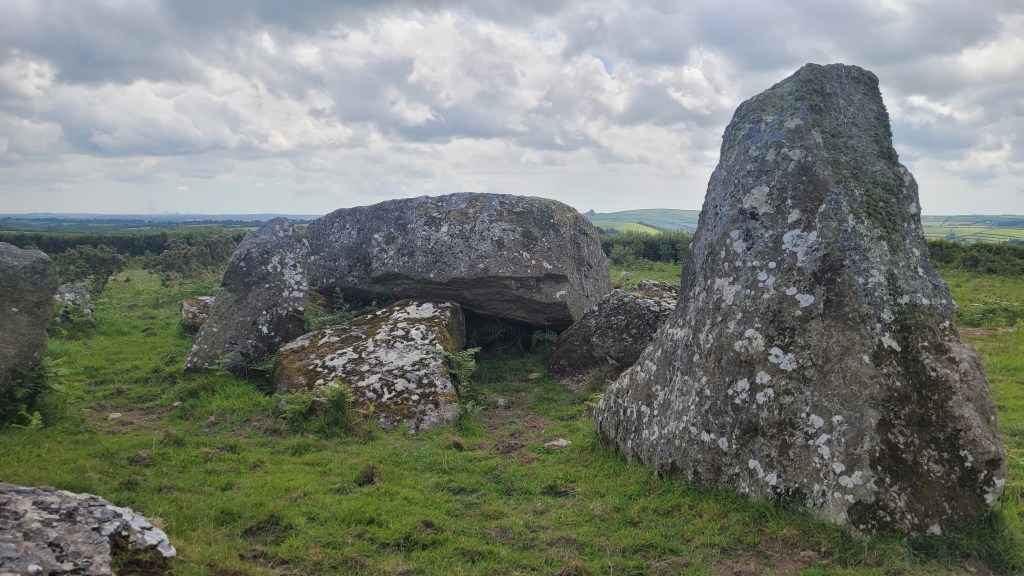
In 1981, Rees, on an inspection of the site in 1981 for CADW, noted a possible long cairn amongst the natural rock outcropping. Also in the neighbouring fields a cairn has been cleared and used to reinforce turf boundaries.
Rock Art at Garn Turne
In 2005 cup-and-ring marks were discovered on the capstone as well as cupules of varying size on the rocky outcrop.
The presence of rock art on top of the capstone suggests that at least the upper section of the capstone was exposed. A similar hypothesis has been promoted for nearby Pentre Ifan (Parker Pearson 1991)
From George Nash: “Cup-and-rings are found in abundance across the Neolithic and Bronze Age Atlantic zone of western Europe, usually carved on rock-outcroppings. In Wales there is increasing evidence that these images along with single and multiple cupules are being used to statement megalithic monuments. The cup-and-ring, located on an enormous capstone of Garn Turne is the first to be found on a Neolithic chambered monument in Wales. It provides possible evidence for stratigraphic use of the monument and is one of an increasing number of monuments that hitherto were considered to be absent of art..
..Recent research in Wales by Darvill and Wainwright (2003) and Sharkey (2004) suggests that up to forty-five sites possess rock art either within, outside or more usually on the top of capstones or on the sides of standing stones (Table 1). It is not clear if the art and the erection of the monument are contemporary. However, in the case of cupules appearing on the capstones of Neolithic burial monuments, it is more than likely that the art follows the construction and Neolithic use. This sequence, recognised long ago by Daniel (1950:115), appears to indicate cupules as being primarily a Late Neolithic/Early Bronze Age phenomenon in this region. However, the dating of these enigmatic designs remains nearly impossible and their position within the chronology difficult to place…
…The presence of cupules and now, the first cup-and-ring on a megalith in Wales suggests that the capstones on many monuments were exposed rather than covered by earth or cairn. The exposure or part-exposure of the capstone may have been a deliberate architectural trait, designed along with the careful selection of stone, based on geology, shape and size.
Barker (1992: 29) does not entirely agree that this monument is a portal tomb, rather, that it may be an earth-fast type. However, many of the earth-fast monuments within this region are located and constructed very differently (Figs 4and 5). Furthermore, these monuments are small and unimposing. Others have suggested that the southern part of the monument, which incorporates the chamber and capstone, may have been part of a long cairn. There is certainly evidence for this at the western end of the monument, to the rear of the capstone.
…Recent unpublished research by Kate Sharpe has questioned the authenticity of some cupules, suggesting that many may be simply natural depressions. I am therefore mindful of the geology of the immediate area. But I will argue that enhanced natural cupules including the Garn Turne cup-and-ring are as important as those fully gouged by human agencies. Natural or otherwise, these visual symbols are within context. On an entrance upright at the Cotswold-Severn burial monument of Stoney Littleton, south-west England, for example the builders have carefully chosen a limestone block that has a large fossil ammonite embedded into the outer face(Fig. 7). This naturally created design clearly forms an archaeological context with the burial monument. Likewise, part of the Garn Turne cup-and-ring may be natural and the stone may have been selected for this reason. Dispersed across the upper surface of the capstone is evidence of natural circular depressions formed from the exfoliation of clasts.
The partly gouged ring measures approximately 14 cm in diameter whilst the cupule is 5 cm in diameter. Due to the hard and unstable geology of the rock, the ring has been partly gouged. A small, unclosed area of ring extends over a hard intrusive vein. Visual inspection and the removal of lichen from this area does, however, show some working. The cupule may have initially formed from a natural spherical depression, the result of a loosened clast, that was later modified by the artist. Despite the natural elements of the art and although covered with lichen, the cup-and-ring is clearly defined. A further cupule is located on the northern side of the capstone that is slightly smaller and less defined and again may be the natural result of a weathered-out clast.”
-CUP-AND-RING PETROGLYPH ON THE NEOLITHIC CHAMBERED BURIAL MONUMENT OF GARN TURNE, PEMBROKESHIRE, SW WALES, GEORGE NASH
https://www.academia.edu/1079811/Rock_art_at_Garn_Turne_Pembrokeshire
Here is our video we made covering the history and archaeology of Garn Turne, as well as the other cromlechs nearby:
 CoralJackz - That History Couple
Leave a comment