
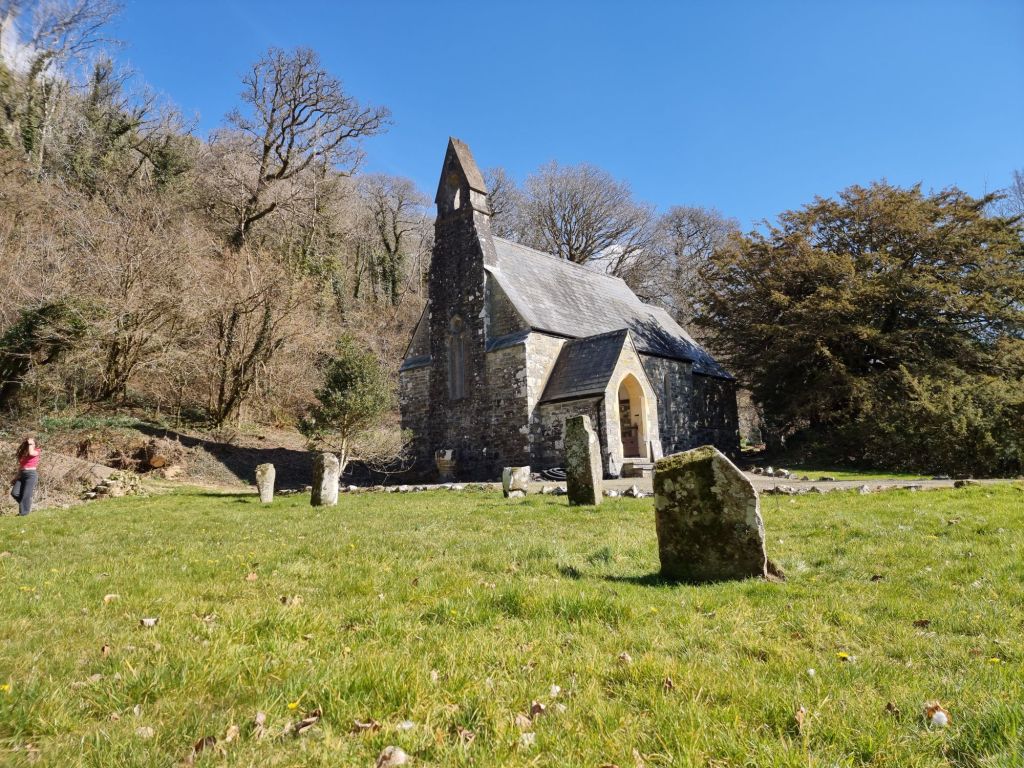

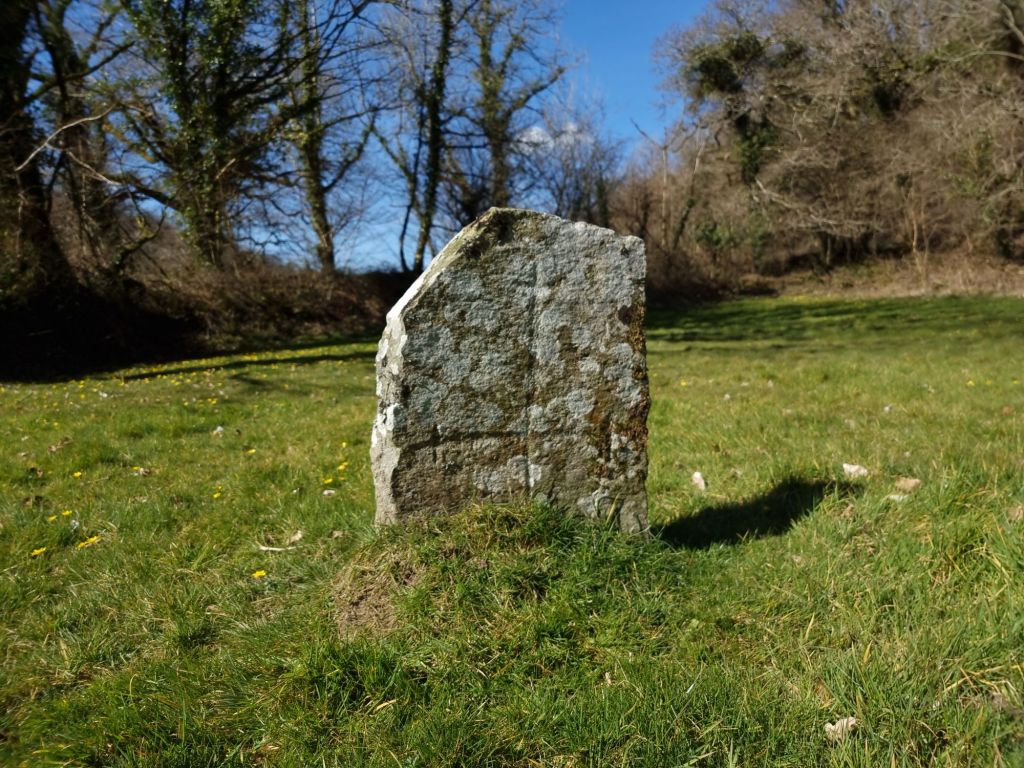
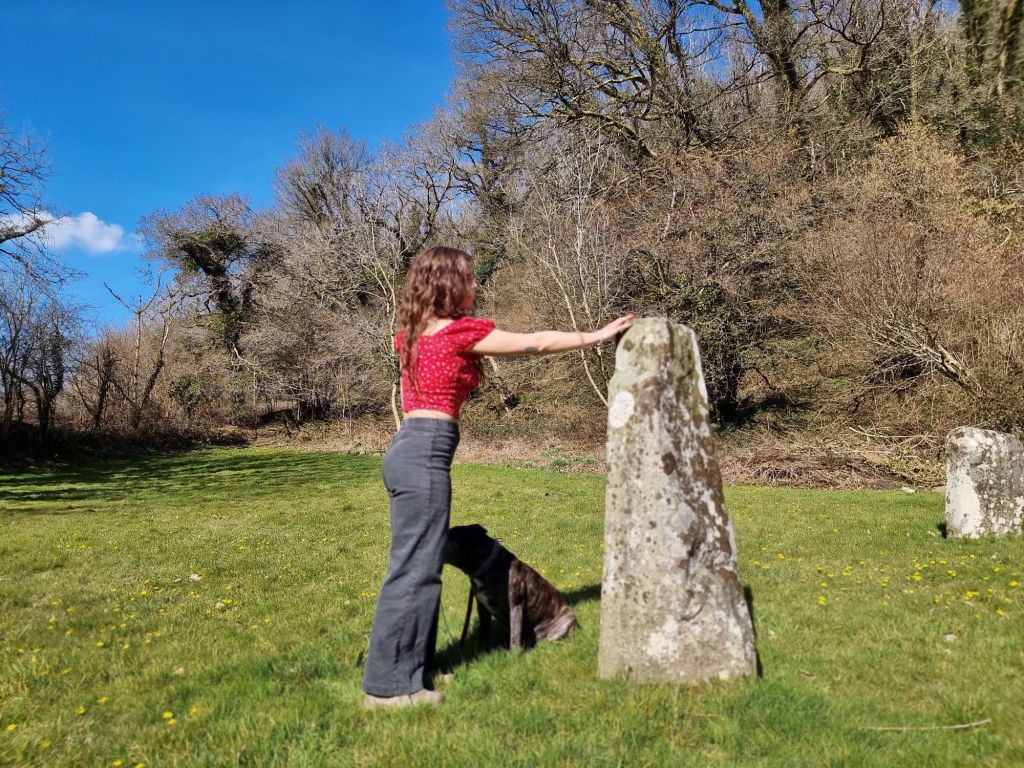
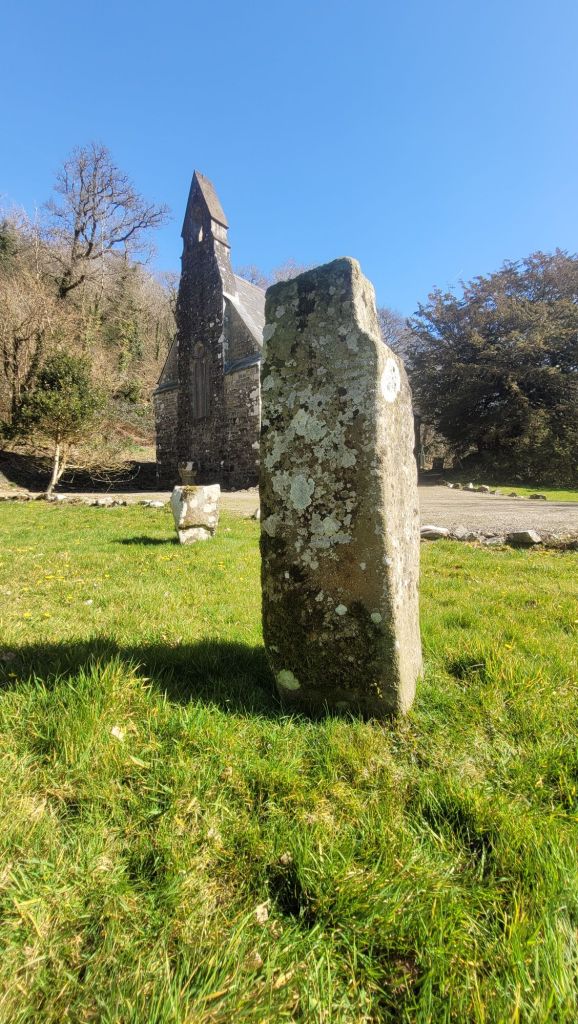
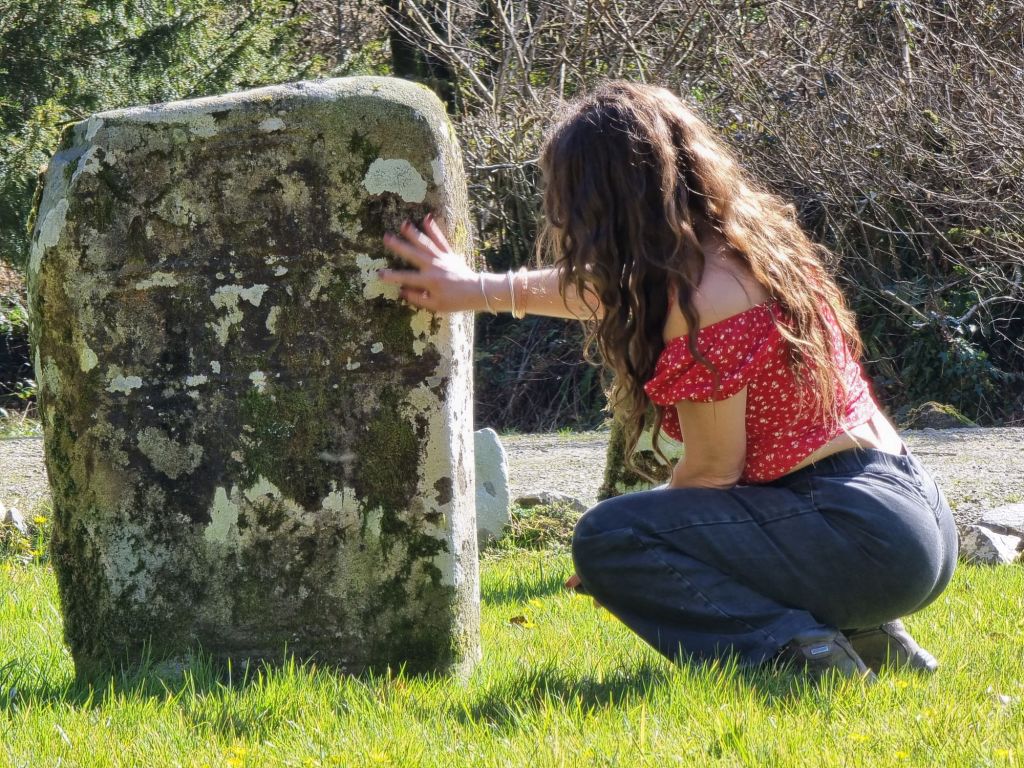
In St David’s Churchyard stands what are marked on OS maps as the ‘Pillar Stones’.. a group of early-christian inscribed stones.
A medieval church at this site was demolished in 1864 and entirely rebuilt in the 19th century.
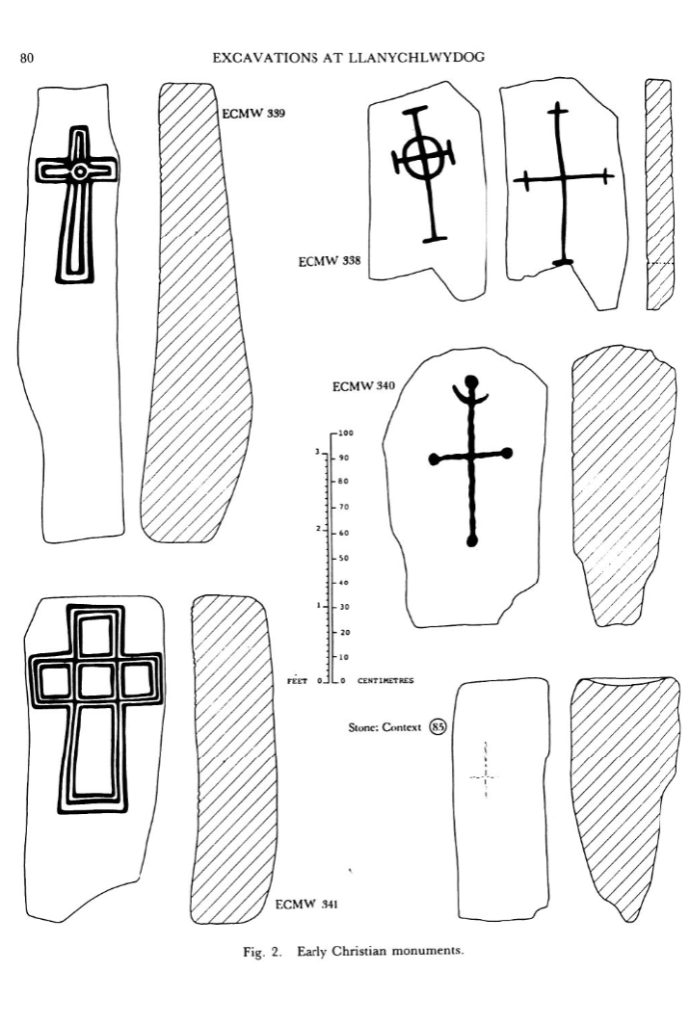
The church is now in private ownership, but before the building was converted, permission was granted for excavation by Dyfed Archaeological Trust in 1984-1985. Excavations revealed a number of cist burials, one of which was cut by the wall of the medieval church. Human remains within another cist were radiocarbon dated to 890+60 AD. A fifth inscribed stone, of uncertain date, was found in the same soil as the cist grave, as well as a fragment of a Roman dolphin brooch.
To read the full excavation report by Kenneth Murphy in Archaeologia Cambrensis 1987: https://journals.library.wales/view/4718179/4749748/90#?xywh=-2751%2C-203%2C7765%2C4043
Nearby are many prehistoric structures such as the stones at Parc y Meirw, thought to be the longest stone alignment in Wales.. As well as many standing stones and ruins of neolithic cromlechs. No doubt, this area has a rich history.
Richard Fenton, A Historical Tour Through Pembrokeshire, 1811:
“The church is said to have been founded by Clydawc, a regulus of the country, who were murdered in the neighbourhood as he was pursuing the chase, whose grave, by tradition, is marked by two upright stones still visible in the churchyard.”
From Archaeologia Cambrensis 1883 ‘Fishguard Meeting Report’: “The first halt was made this morning, in a drenching downpour, at the little church of Llanychllwydog. The church has lately been rebuilt, and has a chancel, nave, and south porch, so that we miss the curious features of the older church with its south chapel, the broad passage connecting in with the chancel and the stone altar at its junction with the nave, as it appears in the engraving in the Journal for the year 1865, p.182. Only two sculptured stones are mentioned in the account given by the Rev. H. Longueville Jones, as “nearly buried in the growing soil, and commonly said to have reference to the Saint’s Grave-one of them bearing a cross cut in low relief, and of a design not hitherto observed in Wales.” There are, however, three other stones, and the character of the crosses is different in each case. In one, the arms and stem are composed of ribbed lines ; in another, the limbs form crosslets ; in a third, they terminate in the T, and the fourth, with its termination, has a circle at its intersection.” – https://journals.library.wales/view/2919943/3005600/92#?xywh=69%2C156%2C2097%2C2181&cv=92
When we visited, we were unaware the church itself is in private ownership, but we believe the churchyard may be able to be visited without permission..
 CoralJackz - That History Couple
Leave a comment