
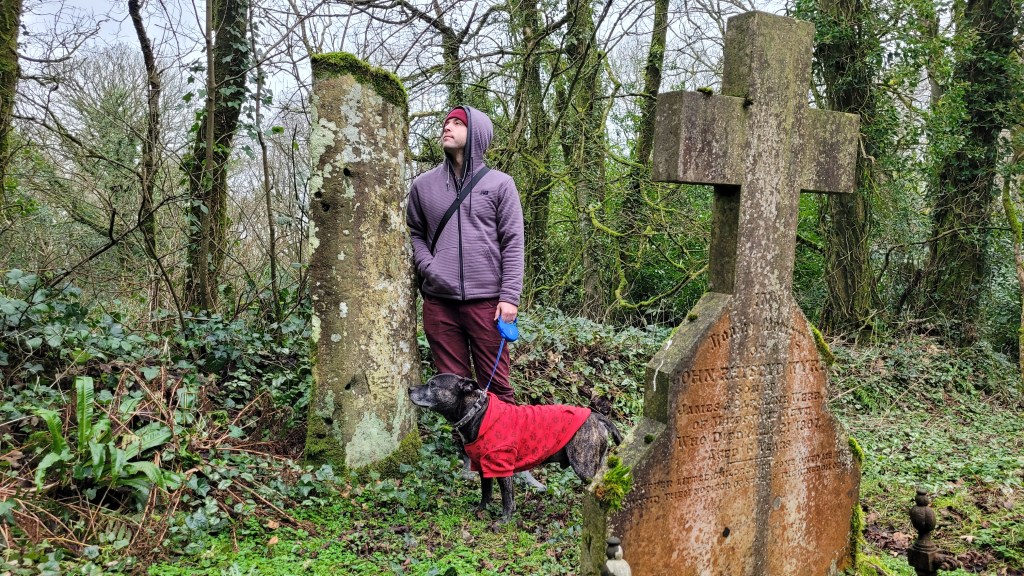

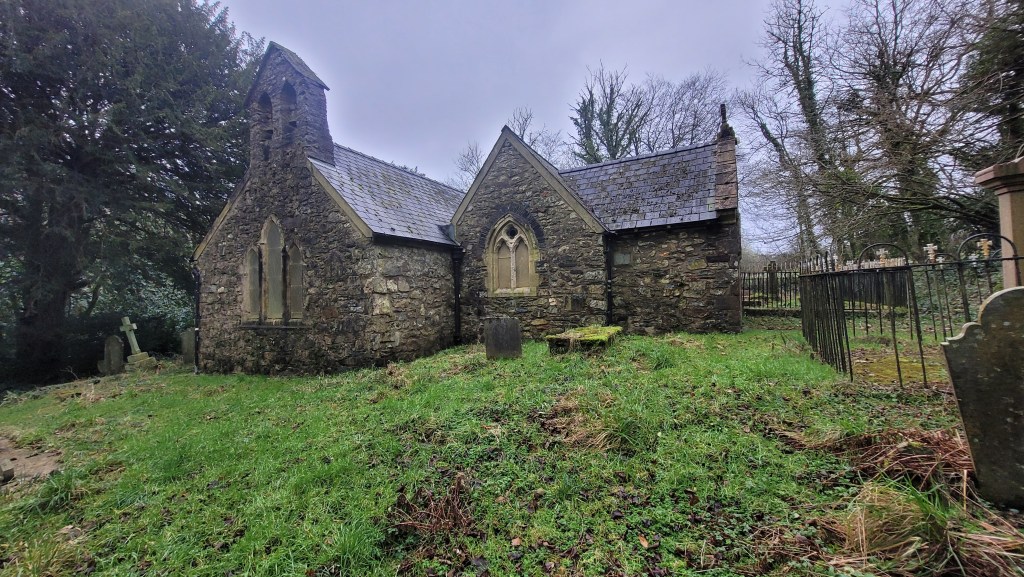
St. Dogwell’s in Pembrokeshire sits just 2 miles from Casblaidd (Wolf’s Castle), where folklore tells of the last wolf in Pembrokeshire having been killed there. Local lore also states that St. Dogwells was the birth and resting place of Owain ap Gruffydd – known as Owain Glyndwr, the last native Welshman to hold the title ‘Prince of Wales’, declared by the people of Wales in the late Middle Ages.
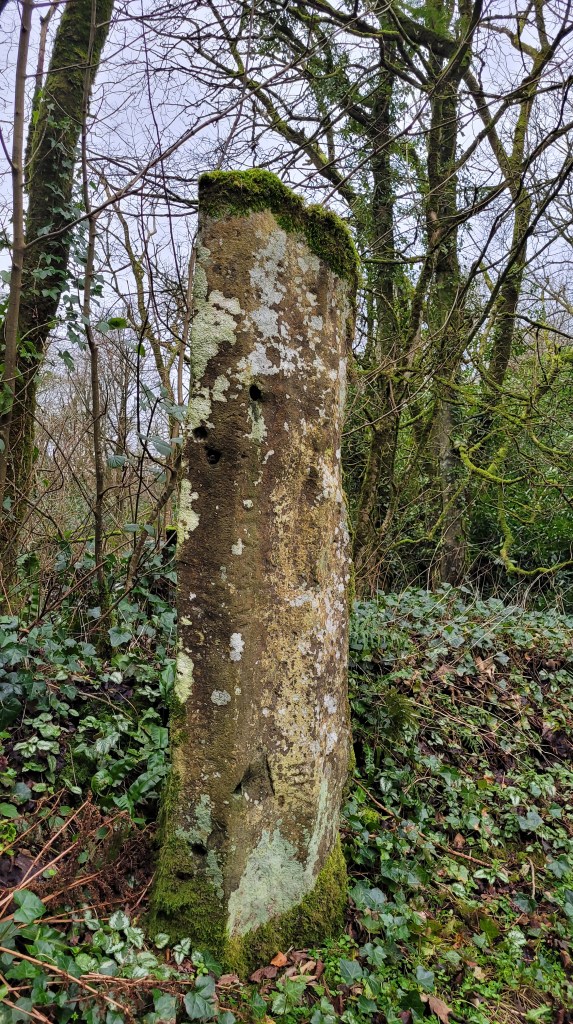
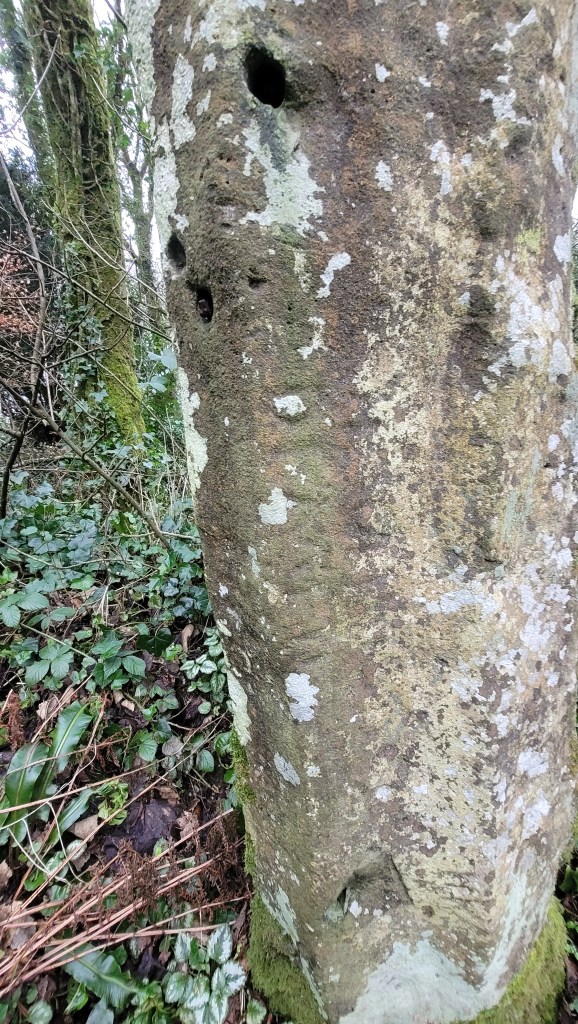
The churchyard is also home to an ogham and roman-letter inscribed pillar. The pillar was discovered in 1875 on the east side of Treffgarne Gorge (around 3km south of the church) where it was being used as a gatepost beside the road. You can still see the Latin inscription, which reads vertically downwards as “HOGTIVIS FILI DEMETI – Hogtivis son of Demetus”. The ogham markings are positioned along a ridge on the face, rather along the edge of the stone and is thought to date to the end of the 5th century.
The following is from ‘A Topographical Dictionary of Wales’ by S. Lewis published in 1833:
“The parish of St Dogwells is noted, on traditional authority, as the birthplace and place of burial of the distinguished patriot and chieftain, Owain Glyndwr, who is said to have been born at Little Trefgarn and to have been interred at the small village of Wolf’s Castle, both situated within it’s limits..”
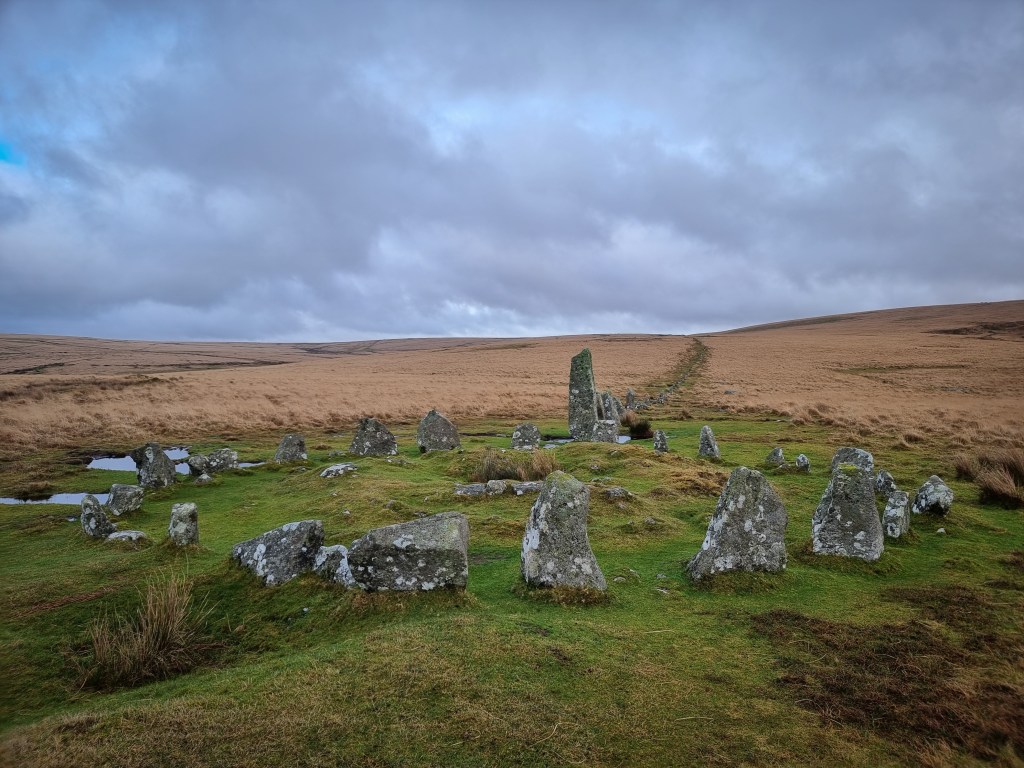
He goes on to say.. “Within the limits of the parish are, a cromlech, and other remains of antiquity, some of which, supposed to have been Druidical altars, are at present little more than an indiscriminate heap of stones…”
These cromlechs that he refers to are Garn Turne, The Alter and Parc y Llyn.
The following is from ‘Saints and stones : a guide to the pilgrim ways of Pembrokeshire’ by Damian Walford Davies and Anne Eastham:
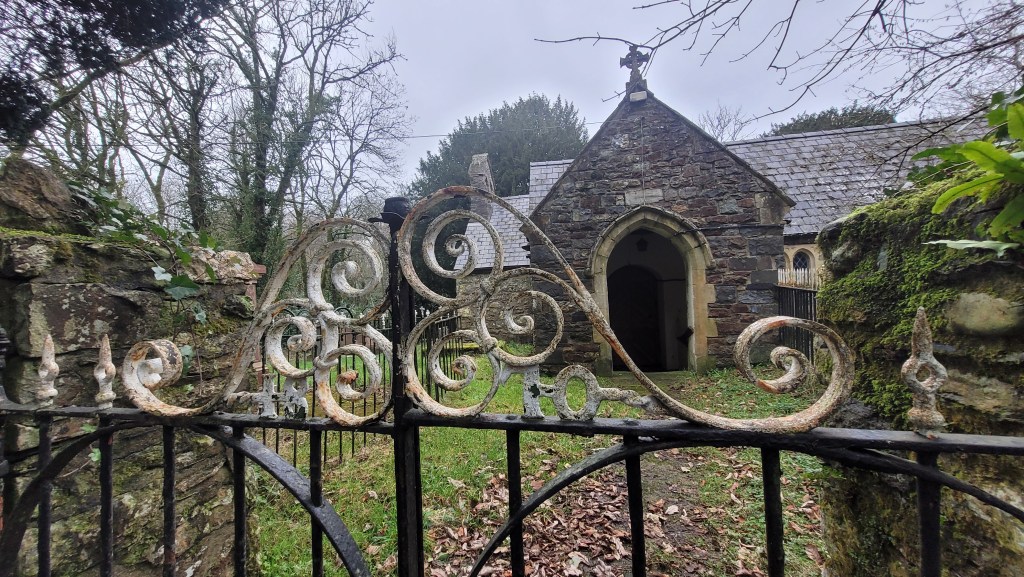
“Less than 1ml west of Garn Turne rocks, the church of St Dogwells, or Llantydewi as it was known in medieval ties, stands in a tree-ringed glade above the rocky falls of the Anghof river which joins the Cleddau at Wolfs Castle. Richard Fenton records a village in the fields opposite the church, but, though the ground is uneven, no surface traces remain. In 1254, the benefice was appropriated to the chapter of St Davids Cathedral. The nave and chancel, with a bellcote on the west end, are separated from a south aisle by low arches whose capitals are decorated with a twisted cord pattern and animal-headed motifs similar to those at Llawhaden. At the east end of the south aisle, a mortuary chapel was established in 1328 by Sir Richard Symond of Sealyham in return for the services of two priests who were required to say Masses for his soul and that of Eleanor his wife.
The church was restored in 1872 and tiles were laid to cover memorials on the floor. At the same time, the body of a tiny child was found buried in the west wall with a little cross and green stone amulet. Memorials in the south aisle and the stained glass windows commemorate members of the Tucker Edwards family from Sealyham, across the lane from the church. The Tuckers were first recorded at Treffgarne early in the 15th century and by the middle of the 16th century owned Sealyham estate. In the 18th century, Admiral Thomas Tucker supposedly killed the pirate Blackbeard in the West Indies – an interesting fact in view of the origins of the notorious Bartholomew Roberts in nearby Little Newcastle. Tucker’s great niece married an Edwards, taking on both names. It was here that Captain John Tucker Edwards in the 19th century bred the famous Sealyham terriers. After the death of his nephew in 1902, the estate fell into debt and in 1920 the house was sold to the King Edward VII National Memorial Association, becoming a hospital for tuberculosis sufferers. In 1988 it *was made an Activity Centre popular with educational and youth groups and holiday makers.
In 1814, Joseph Harris (1775-1825) -author, editor and hymn writer, who was married in this church – launched the first weekly newspaper in Welsh, ‘Seren Gomer’. Despite efforts to keep it going, the newspaper failed after 85 issues and Harris had to sell, but J. D. Lewis, who established himself as a printer in Llandysul in 1892, held Harris in such admiration that he named his business ‘The Gomerian Press’. Now called Gomer Press, the business exists to this day.
The stone which stands on the west side of the churchyard recalls an older period of parish history. The inscription in Latin script reads HOGTIVIS FILI DEMETI- Hogtivis son of Demetus’. The stone was originally used as a gatepost at Little Treffgarne to the south, reputedly the birthplace of Owain Glyndwr. According to legend, Glyndwr lies buried behind Allt-yr Afon in Wolf’s Castle. A photograph exists of another cross stone, attatched to a pigsty in Wolf’s Castle village, but this has disappeared.” – https://openlibrary.org/books/OL3648329M/Saints_and_stones
In the video below, we start our walk at the Hogtivis Stone, and head over to the nearby neolithic cromlechs. Check out the video to learn more –
 CoralJackz - That History Couple
Leave a comment