
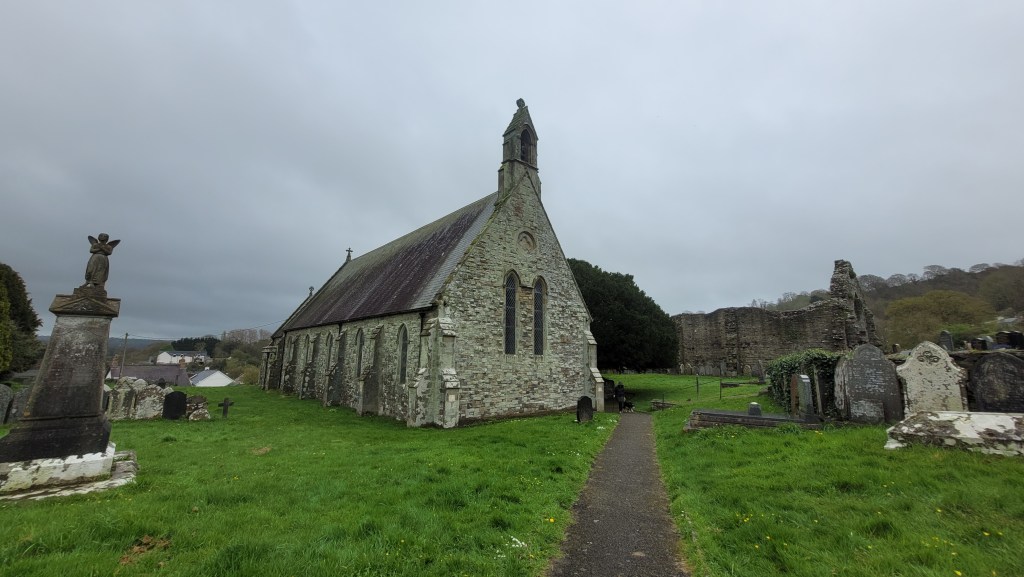

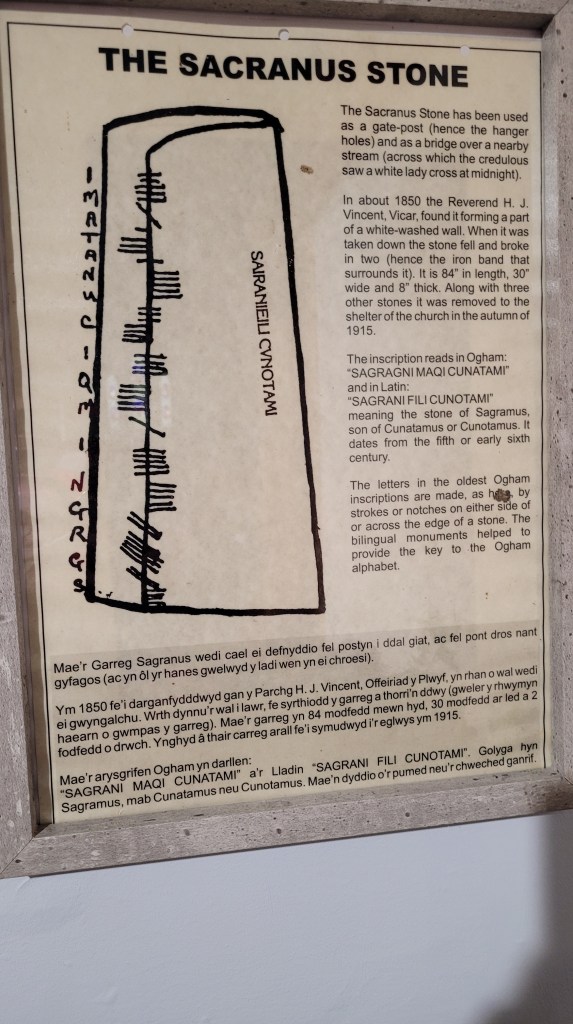
The Sagranus Ogham and Latin inscribed Stone – St Thomas Church – St Dogmaels.
Pembrokeshire, Wales

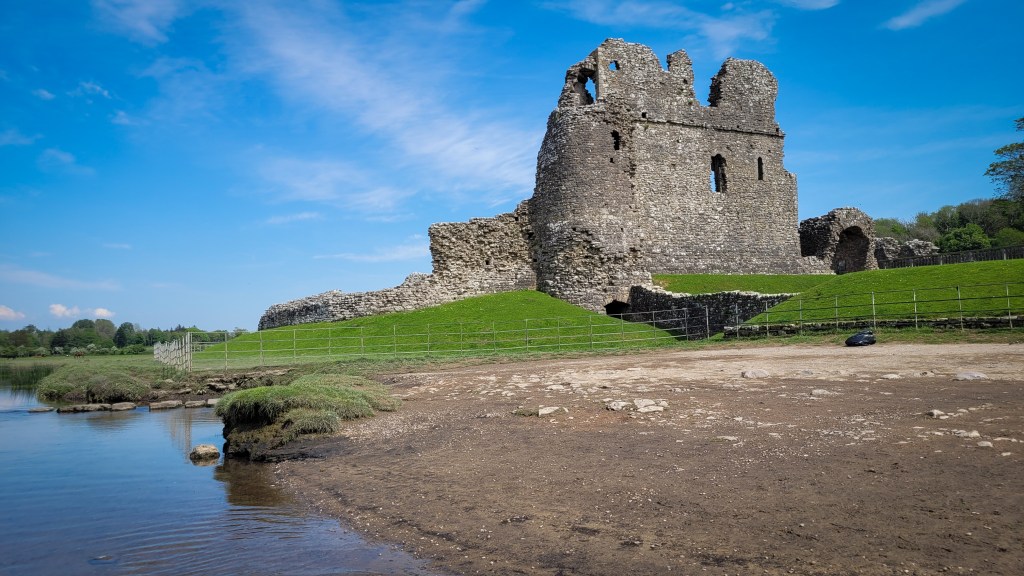
The present church of St Thomas the Apostle is a modern construction, having been built within St Dogmaels Abbey precincts in 1847 using materials from the ruined buildings. Within the church is the Sagranus Stone, inscribed in both Latin and Ogham and dating from the fifth century, which, according to Cadw, helped provide the key to deciphering the Ogham alphabet.
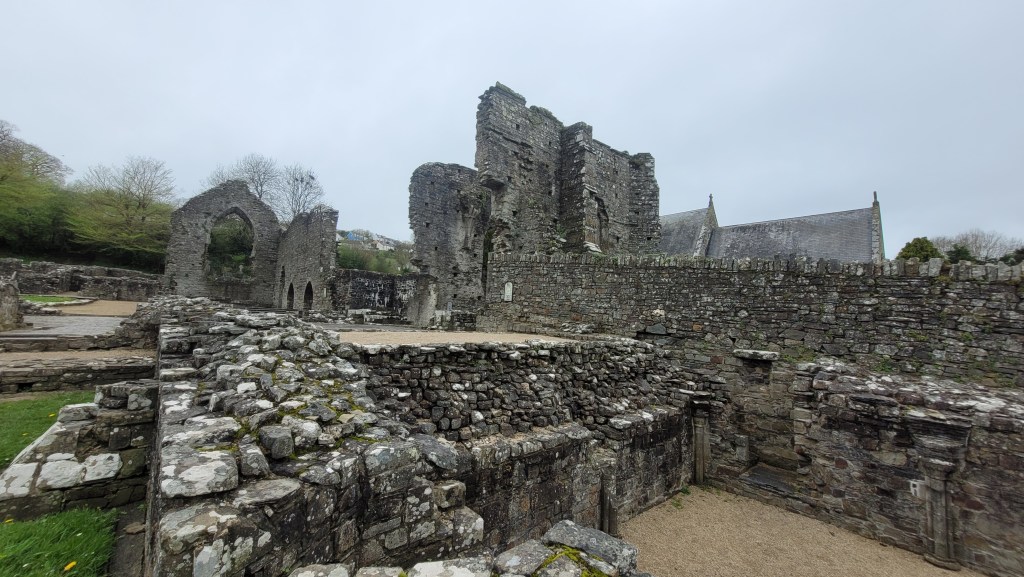
From The Journal of Antiquities website:
‘The stone stands in the west end of the nave of St Thomas’ parish church and it has for some time now been recognized by scholars of Early Christian inscribed stones as being of great importance. It is a 7 feet high dolerite pillar-stone and is thought to date from the late 5th or early 6th century AD, that being the immediate years following the Roman retreat from Wales. This ancient stone probably came from the original cell (llan) of the Celtic monastery. There are two holes in the slab which means that in the past it was used as a gate post, and it may even have been in use as a sort of stepping stone over a stream; maybe this caused the stone to be broken into two pieces. But as a bilingual inscribed stone with its Ogham cipher inscription of notches or strokes on its edges and the Latin (Roman) inscription on its face – it’s safety is now assured. Back in 1848 the strokes on the ancient pillar-stone enabled scholars and historians to de-cipher (interpret) the Ogham alphabet. Ogham was the early Goidelic/Gaelic) language of Ireland. Both inscriptions, once they are translated, read as the same.
HMSO/DoE (1975) says that: “1 Rough pillar stone of the early sixth century……. On the face is an inscription in two lines of Roman capitals, running downwards: SAGRANI FILI CVNOTAMI. On the dexter edge is an inscription in Ogham characters, which reads: SAGRAGNI MAQI CVNATAMI. Both indicate that the stone was set up to mark the grave of the local chieftain, Sagranus, the son of Cunotamus. Ogham is a cipher, in which strokes arranged in relation to a vertical stem—in this case the angle of the stone—are used to represent the letters of the Latin alphabet. The system, which was evolved in Ireland, is found on a number of early inscriptions in Wales where it is generally employed, as here, with a Latin transliteration.”
In Folk-lore and Folk-stories of Wales, by Marie Trevelyan (1854):
“The Sogranus Stone at St, Dogmells, Pembrokeshire, was formerly used as a bridge. On the “three spirit nights” it was frequented by the devil, and at midnight in winter a white lady haunted it.” – https://archive.org/details/afl2317.0001.001.umich.edu/page/127/mode/1up?q=tinkin&view=theater
Other stones in the church:
The following information is from Nancy Edwards’ A Corpus of Early Medieval Inscribed Stones and Stone Sculpture in Wales Volume II South-West Wales – Quoted from https://howardwilliamsblog.wordpress.com/2015/11/14/st-dogmaels-stones/
St Dogmaels 2 (P111) – This is a fragment of a low relief encircled Maltese cross with mouldings a central low boss, regarded by Edwards (2007: 463) has very competently sculpted. It perhaps served as a focus within the monastic grounds. Uncertainly dated, Edwards opts for 8th or early 9th century.
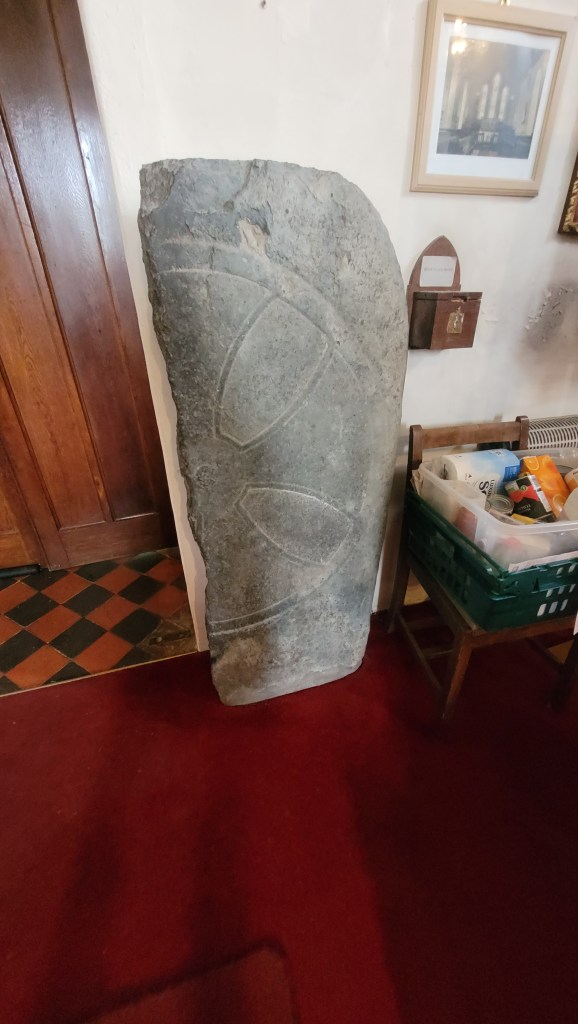
St Dogmaels 3(P112) – Later re-shaped for building, this is an encircled cross with a stem, half way down which is a double scroll. Nancy Edwards suggests that it might represent a flabellum (liturgical fan) and if so, this is an association with watchfulness and fidelity (Edwards 2007: 466). Rendered on a stone, it might hint that this monument had a role as a grave marker or other station in the cemetery/monastic grounds. Again, Edwards dates this to the 8th or early 9th century AD.
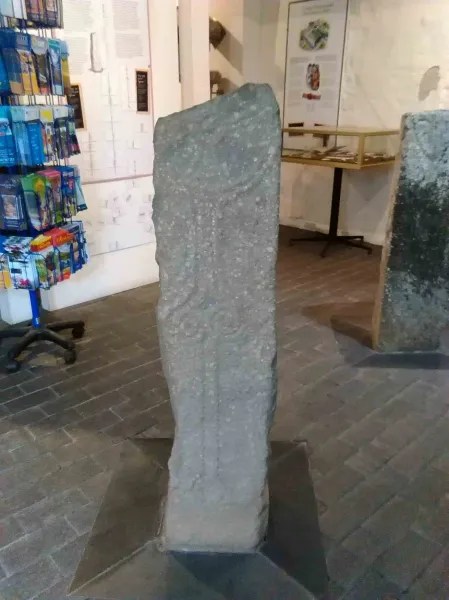
St Dogmaels 4 (P113) – Likely serving a similar role to St Dogmaels 3, it is likely to represent an upright monument dated to the 8th or early 9th century AD. Note: it is now upside-down in the church, so the stem is pointing upwards, not downwards as it appears on the photograph of St Dogmaels 3. I must confess that I am also cynical regarding whether St Dogmaels 3 and 4 could have securely and safely stood upright with such shallow footings; might they instead represent recumbent monuments?
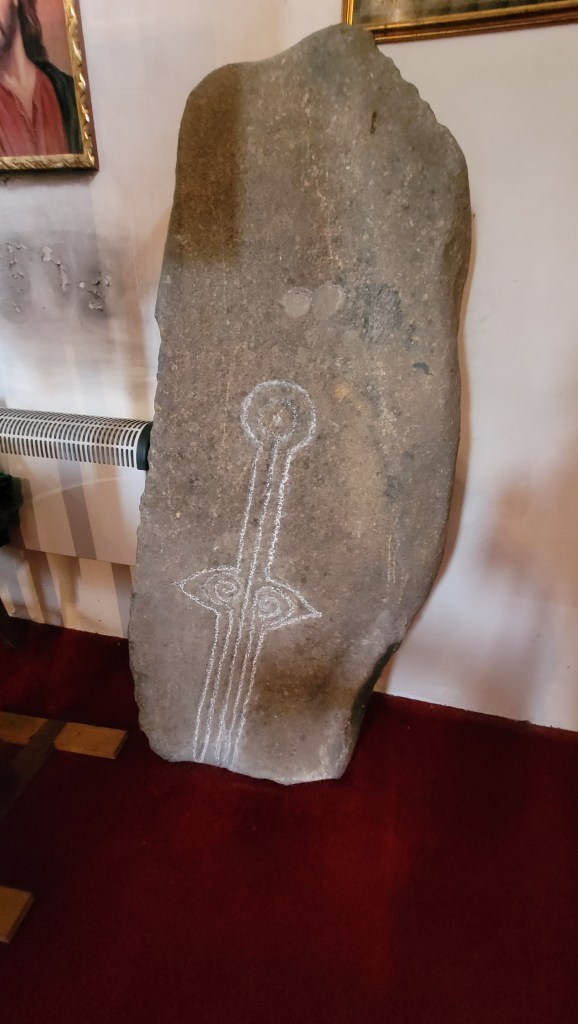
St Dogmaels 5 (P114) – This is a deeply incised linear Latin ring-cross. Simple and therefore of uncertain date, Edwards again opts for 8th/early 9th century in date.
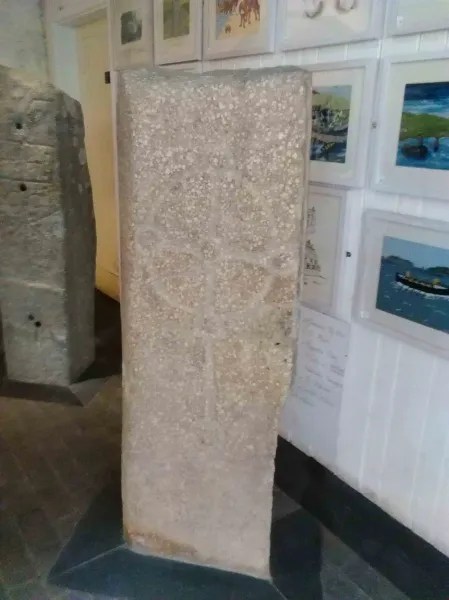
Two more early medieval stones, St Dogmaels 7 (P116) and 8 (P117) are in the National Museum of Wales, Cardiff.
St Dogmaels 7 (P116) has a smaller but comparable Maltesee cross to St Dogmaels 2 and a human figure beneath it – presumed to be the crucified Christ. It is dated again by Edwards to the late 8th/9th centuries.
St Dogmaels 8 (P117) is the only monument, bearing a Latin cross, dated by Edwards to the Viking Age (9th or early 10th centuries).
There are other stones in display in the coach house that are of uncertain date, one of which I add below (P118). Obviously reused as a gatepost (Edwards 2007: 523-24) with quasi-heraldic designs. There is a further undated monument (P115) that is a rectangular sectioned pillar with a lozenge-shaped design that might be later medieval.
 CoralJackz - That History Couple
Leave a comment