
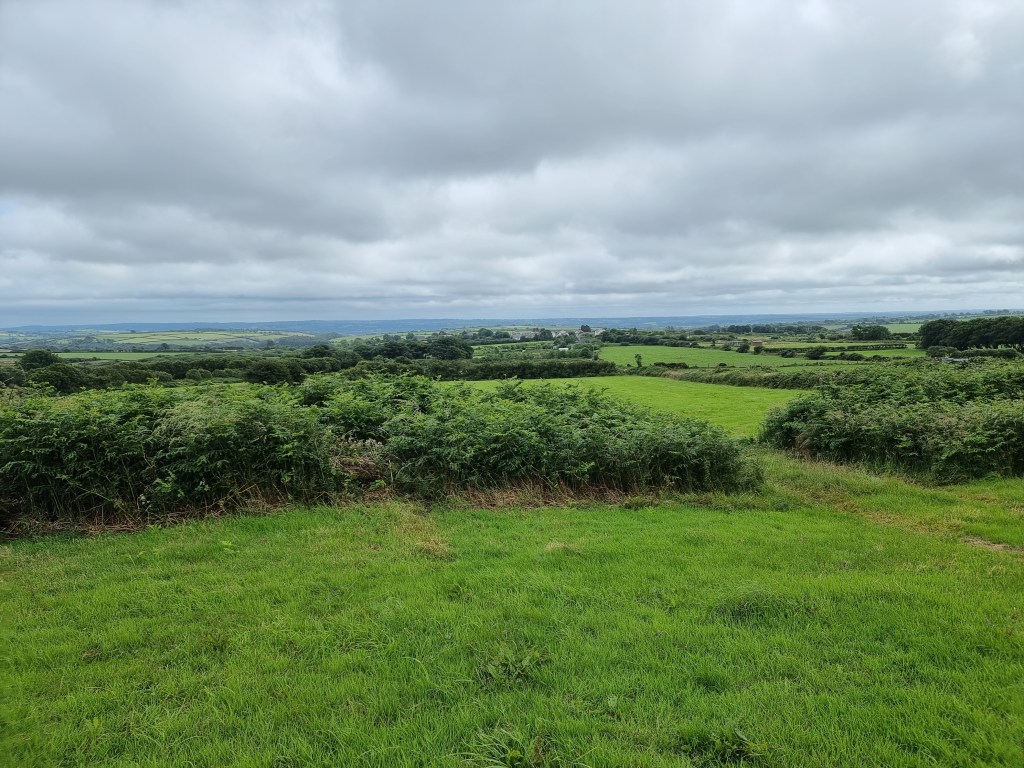

Between the villages of Maenclochog and Rosebush is the Eithbed prehistoric ruins. In these fields there were once three stone cirlces as well as three cromlechs. Sadly, at the start of the 20th century, the monuments were destroyed by new land owners in an attempt at clearing the fields of stone.
The following is from 1911, published in Archaeologia Cambrensis by The Rev. W. Done. Bushell, F.S.A. We have also included the images in the publication:
“Eithbed (Gorse-Grave). -We now proceed to the Eithbed circles situated in the parish of Maenclochog (Ringing Stone), about a mile and a-half to the SSW of Prescelly Top. Before, however, we consider them in detail, a lamentable story of devastation has to be told. There were at Eithbed until very recently three circles ; and probably three cromlechs also were associated with them. They are now no more. The largest..[continued..]

..was destroyed, we know not when or how ; and as an illustration of the way in which we are liable to lose all touch with such remains, we may remark that whilst we find this circle duly given in the earlier edition of the 25in Ordnance Map, it is entirely absent from the later edition issued in 1908.[continued..]
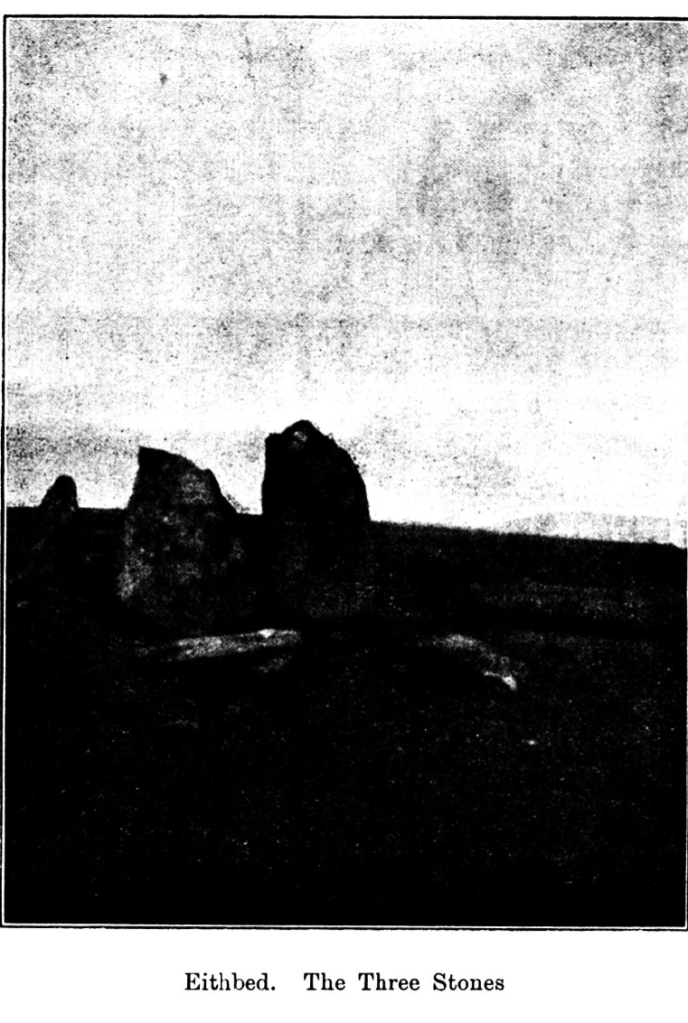
..The circle, or rather oval, for it is not accurately circular, may itself however still be traced in situ. It is marked C on the plan. It has an average diameter of no less than 150ft, and it contains a spring which may perhaps have been regarded as a holy well. Its abnormal magnitude reminds us of the great circle at Dale ; and, like that circle, it may have served as a gigantic dial. Its size would have contributed to the accuracy of any observations made. Two other circles, which are marked A and B on the plan, have both of them been wilfully destroyed, A in the winter of 1905, and B as lately as the summer of 1909. These circles, with the accompanying cromlechs, must have formed a very noble and important group before they were thus demolished. [continued..]
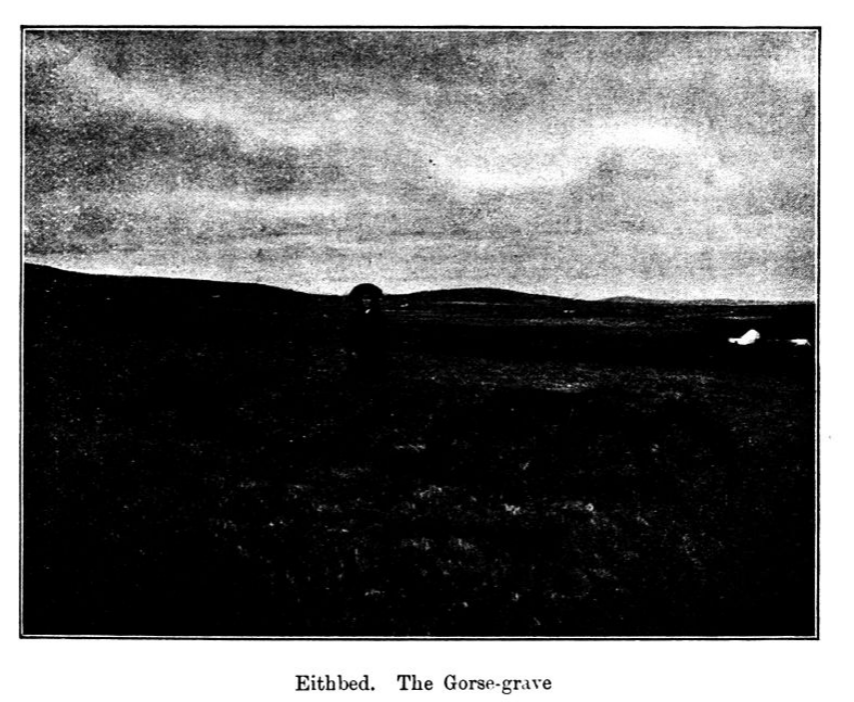
..Very little of them however now remains. Nor could I even determine certainly the position of A ; for whilst the site of a circle is indicated on the Ordnance Map a few yards to the west of B, the only circle besides B which is mentioned in the Archaeological Survey of Pembrokeshire is placed considerable further north ; and neither position of A could be traced with certainty upon the ground itself. But I am glad to say that in 1907 I saw what then remained of the circle B, and of the cromlechs mentioned in the Archaeological Survey.
I also took a photograph of three standing stones the the centre of B. These stones were ranged up side by side at right angles to a line drawn from them to Prescelly Top, the line coinciding also with the axis of what is presumably a barrow, and which is possibly the Eithbed or Grose-grave which the name of the place implies. Such barrows, it may be remarked in passing, are found in Cornwall in connexion with stone circles, as in the case of the Merry Maidens near Penzance. The cromlechs were in a straight line drawn from the centre of the circle B, with an azimuth of about 14° west of north. This gives a highly elevated sky-line ; but I suspect that these three cromlechs faced towards the south, where, at some distance, there are numerous outstanding stones. Indeed I have found that in Pembrokeshire the cromlechs were for the most part orientated so as to command the most extensive view attainable. This seems indeed to have been a primary consideration with the cromlech builders.
But to return to Eithbed. There were also in 1907 at the centre of the circle B many prostrate stones, which, as at Dyffryn, had at one time formed a central cromlech, or perhaps an inner ring. There was also, though in an incomplete condition, an outer ring. All this I saw in 1907. Last year I paid another visit to the spot, but all, alas, had vanished, uprights and prostrates, all alike, with the exception of a few poor remnants of the cromlechs, and some outstanding stones towards the south. The stones belonging to A had, as I knew, been carried off in 1905 to build a wall ; but in 1910 I found that those belonging to B, which I had seen and measured, although somewhat hastily I fear, in 1907, had also, only sixteen months before, that is to say in the summer of 1909, been broken up, and carried off to build an ugly house which stands close by, a veritable moment of shame.
However, the destroyer probably did not know what he was doing. A relative of his, who was present when the deed was done, and who himself assisted at the demolition, told me without reserve exactly what had taken place, nor did it seem to him that there was anything demanding much apology ; but it remains that thus before our very eyes these interesting vestiges of prehistoric man have, like so any others, perished out of the land.
The general configuration of these monuments is shown by the plan. The circle A, however, to which I have assigned its place in accordance with the Archaeological Survey, is, I think, more probably due west of B, as indicated in the Ordnance Map. The Gorse-Grave, if it be a grave, is 20ft by 7ft. It was opened by my son, Mr. Warin Foster Bushell, on April 26th, in the present year. He found within it, on the level of the external surface of the ground, a pavement of flat stones of no great thickness roughly fitted together, and, underneath the pavement in the centre of the barrow, a small amount of black ashes. The stones had been roughly shaped and were of considerable size, some of them being nearly two square feet in area. The alignment also of its axis is important, pointing as it does direct from B to Prescelly Top. Its azimuth is 27°, which, with a due allowance for refraction, and for elevation of the sky-line, which is a little more than 5°, gives us a declination of nearly 38°, which was that of Arcturus about BC 1230. Capella also had this declination about BC 750. The date BC 750 must however be ruled out ; it is too late to be taken into account, when, as in the present case, a more appropriate earlier date presents itself ; the later date finds little or no support in face from observations made elsewhere, which in most cases point to earlier epochs than BC 1000. We may therefore perhaps assume, at least provisionally, that the line along the axis of the barrow was laid down about BC 1230, with especial reference to Arcturus as a clock-star, and therefore that the circle B was possibly built around that time. We may add that the existence of three circles in immediate contiguity suggests, as in the case of the Hurlers and elsewhere, adjustments rendered necessary by precision.
There were also other possible sight-lines with azimuths of 161 1/2°, 163 1/2°, and 277° respectively, the last two pointing, therefore, very nearly south and west. The other two give, with a sea-horizon, south declinations of 36° 12′ and 36° 42′ respectively, but I cannot assign to them any important astronomical significance. And there is apparently through X another sight-line, with an azimuch of 123°. This gives for a sea-horizon a south declination of about 20°, suggesting therefore Sirius about BC 2400, and Rigel about BC 1850 ; but X may have been originally only one of the stones of an outer circle, and may or may not in that case have been meant to give a sight-line from the centre of B.
Was there at B a central cromlech? There was a suggestion of this when I visited the site in 1907, and this appears to be the view which Messrs. Green and Laws have taken in the Archaeological Survey. If so, we have another instance of that combination of the circle and the cromlech which we find elsewhere ; and, having regard to the possibly sepulchral character of cromlechs, it may be well to add that I was told by the young man who had been present at the demolition that the destroyers in 1909 had come upon a very definite circle of ashes of a red colour, 10 in. thick.
We now turn eastwards, but before we leave these interesting monuments it may be well to quote ver batim what Messrs. Green and Law say of them in the Archaeological Survey;
“There are remains of three cromlechs here, ranged slightly north-west to south-east in a line. The north cromlech is fallen down, but there are remains of two uprights standing. The capstone is lying on the ground, and measures about 10ft 6in long and about 6ft wide. The middle cromlech has one leg standing, and the remains of another upright, but the capstone has dissapeared. The capstone of the south cromlech is lying on the ground and measures 6ft by 5ft. There are three uprights standing (one 6 ft high) and another lying down. The circle, which is situated some 20 yards frmo the north cromlech, is about 18ft in diameter, and lies just west of the north cromlech. There is a fine view.”-https://journals.library.wales/view/4718179/4723583/304#?xywh=19%2C1516%2C1927%2C2004
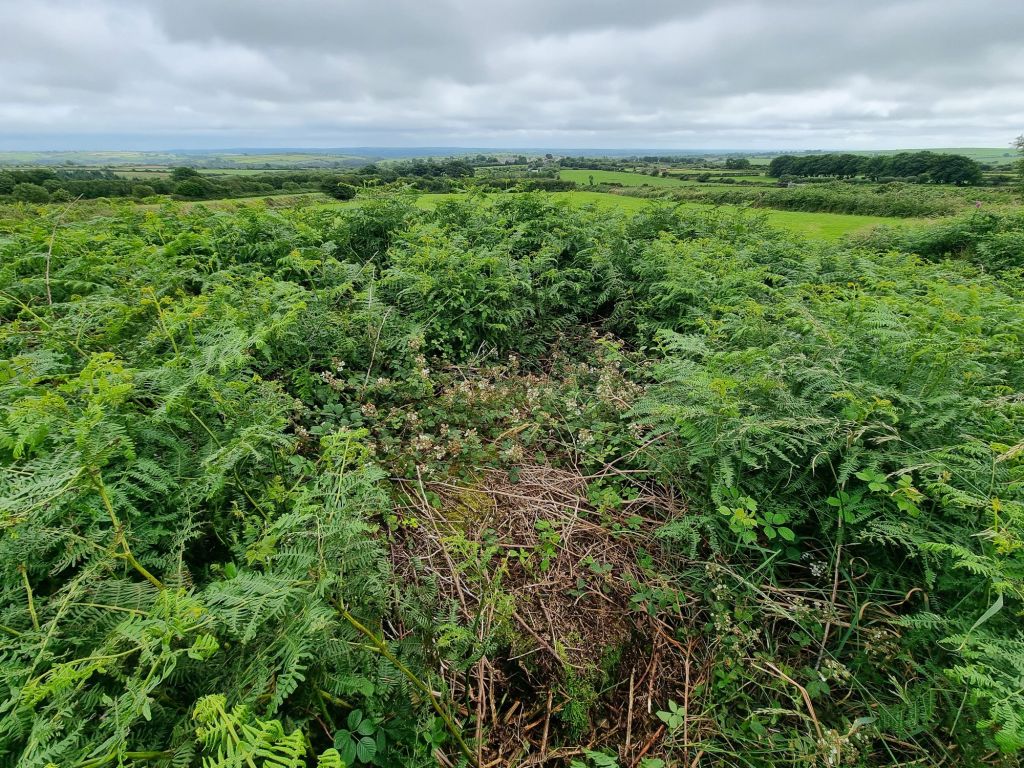
The following is also from 1911 and describes the destruction:
“Stone Circle, Maenclochog. – Your Committee have to report with regret that a very perfect circle has been entirely destroyed near this village at Eithbed West. The place, formely part of the Picton Estate, changed hands last year, and the owner, Mr. Davies, wishing to clear his land of stones, and in entire ignorance of the existence of prehistoric remains there, carted the whole thing away. He also completed the destruction of the neighbouring Cromlechs, part of which had been taken in 1907 to build a wall at Maenclochog. The circle and Cromlechs are fully described in the Archaeological Survey. – https://journals.library.wales/view/4718179/4723583/160#?xywh=120%2C1517%2C1723%2C1792&cv=159
Below is the OS map from 1888 which labels the remains of a circle and cromlechau. From The National Library of Scotland – https://maps.nls.uk/geo/explore/#zoom=16.2&lat=51.92393&lon=-4.79276&layers=257&b=1&o=100

 CoralJackz - That History Couple
Leave a comment