
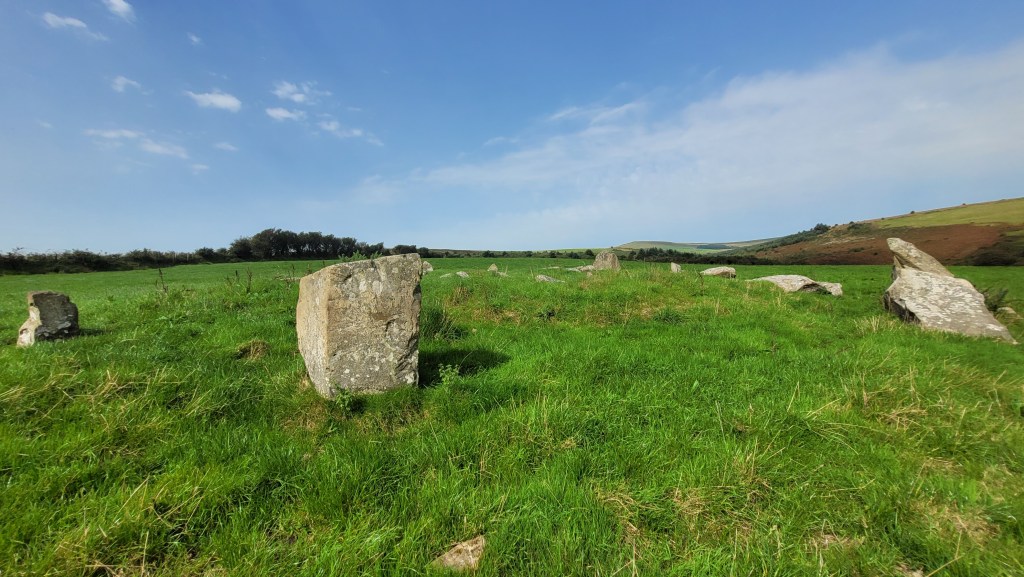

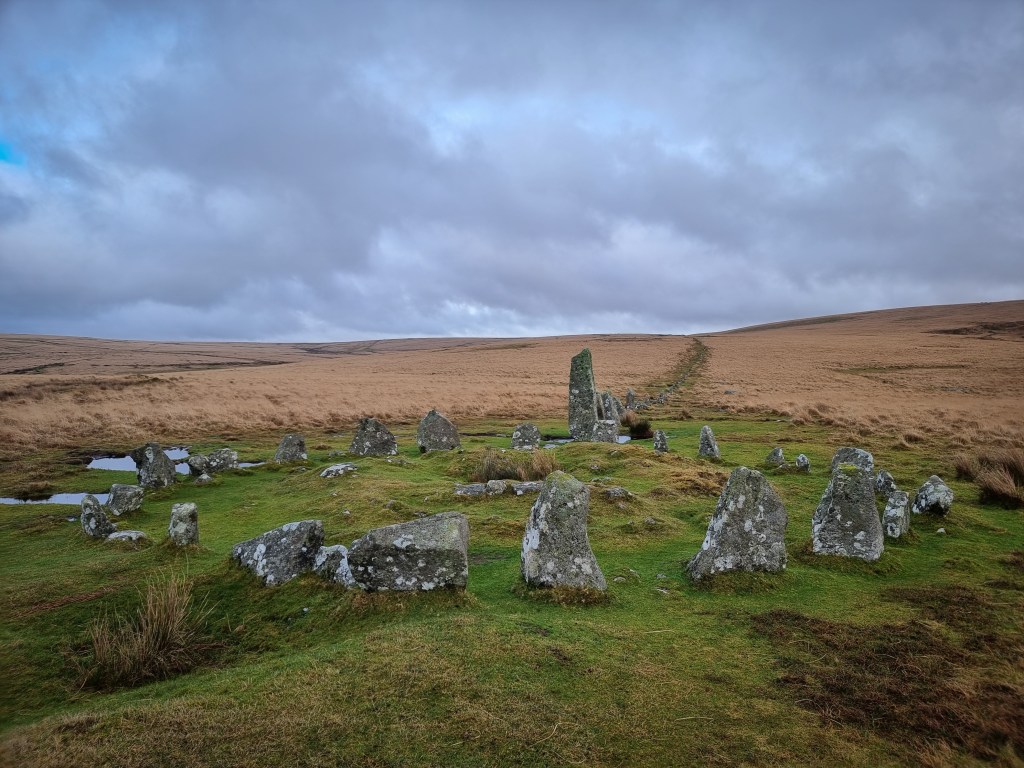
Bronze Age circle in Henry’s Moat – Pembrokeshire, Wales.
Otherwise known as Dyffryn Synfynwy or Garn Ochr Cairn.
On one of our visits to this site, we spoke to a local farmer who said that around 60 years ago, a farmer was caught demolishing the stones. One of the stones that was broken was cemented back together..
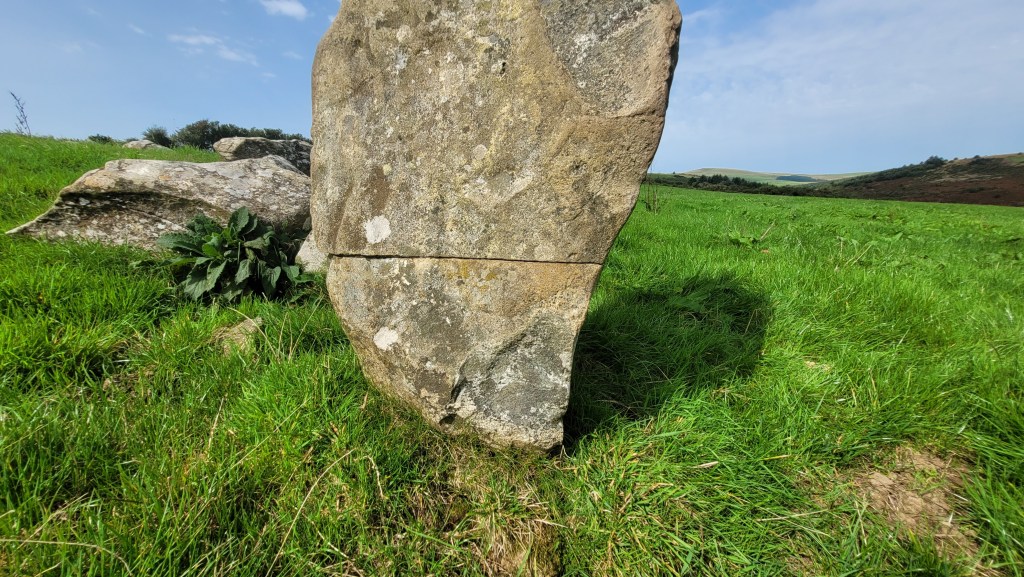
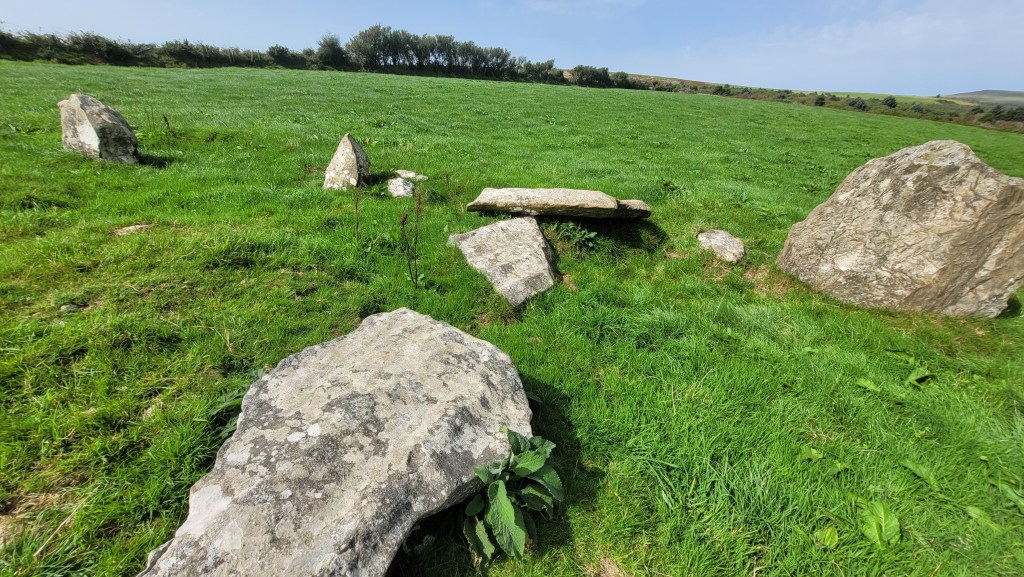
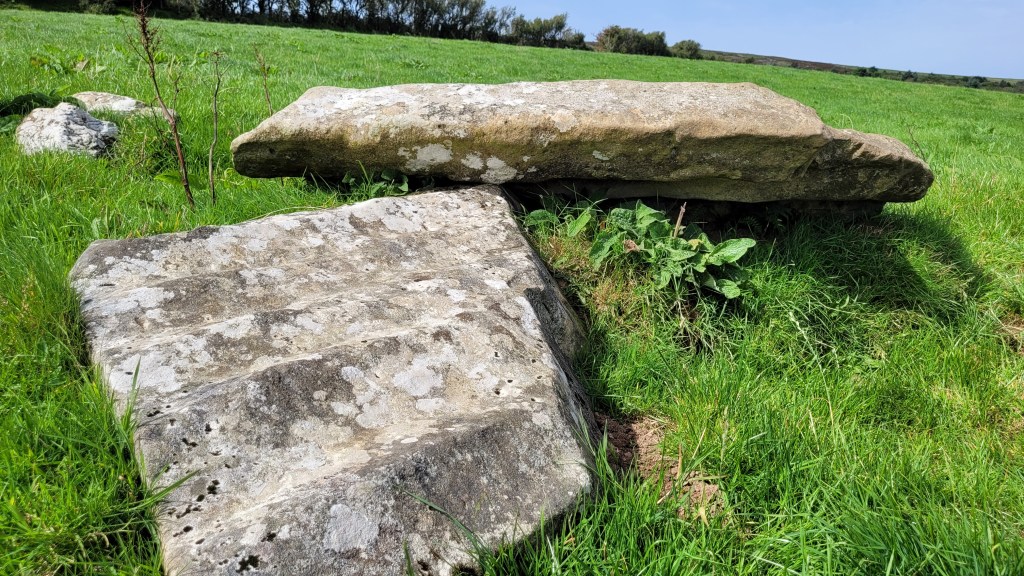
Coflein describes the site as: “Garn Ochr Cairn is a greatly disturbed and much denuded round cairn some 21.3m in diameter and surviving to only 0.5m high. It was contained within a ring of thirteen ORTHOSTATIC – earthfast – stones, although only ten remained in 1966, two of which were prostrate. The stones are up to 2.0m long.” – https://coflein.gov.uk/en/site/304440/
Richard Fenton briefly mentions the site in his ‘Historical Tour Through Pembrokeshire’, in 1810:
“..a little to the left of the spring and ruins I have visited, at the foot of a heathy unenclosed tract on the edge of the hill above a wild mountain stream, there is a very considerable Druid Circle with most of the upright stones that form it in their original situation, another proof of what I have laid down as a remark generally applicable, that whenever such relics of ancient superstition occur, you are sure to find a stone with a cross on it, a chapel, or some Christian institution near to sanctify, as it were, a spot polluted with profane rites.” (He is referring to the nearby St Byrnach’s Well)
Glyn Daniel mentions the site in ‘The Prehistoric Chamber Tombs of England and Wales’, 1950:
“Dyffryn Stones. O.S 6” N.E. Parish of Henry’s Moat. A fine round barrow with a diameter of 65ft. and an orthostatic revetment consisting of thirteen megaliths ; it may well contain a burial chamber. (RCAM Pembs, no. 313; MS V, no. 40, where it is listed as a ‘Cairn Circle’.)
Twelve yards to the north-east of the Dyffryn Stones are three megaliths – one erect and two prostrate. The latter were erect within living memory and they may all have formed part of a burial chamber since demolished. (RCAM Pembs, no 313)” – https://archive.org/details/prehistoricchamb0000glyn_c3m5/page/99/mode/1up?q=dyffryn+stones
The following is from 1911, published in Archaeologia Cambrensis by The Rev. W. Done. Bushell, F.S.A. They also provide images:
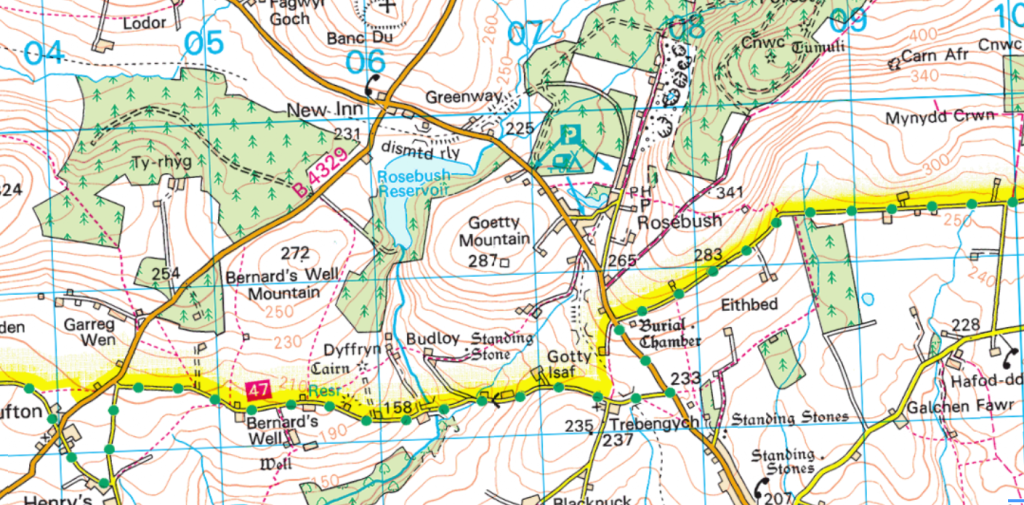
“DYFFRYN SYFYNWY (Syfynwy Valley). – We begin then with the Dyffryn Circle, which lies to the south-west of Prescelly Top, about a mile and a-half from Rosebush Station, near a farm which bears the name of Budloy. It is on the western bank of a considerable stream known as Afon Syfynwy (Winding River), which flows into the eastern Cleddau at Egremont.
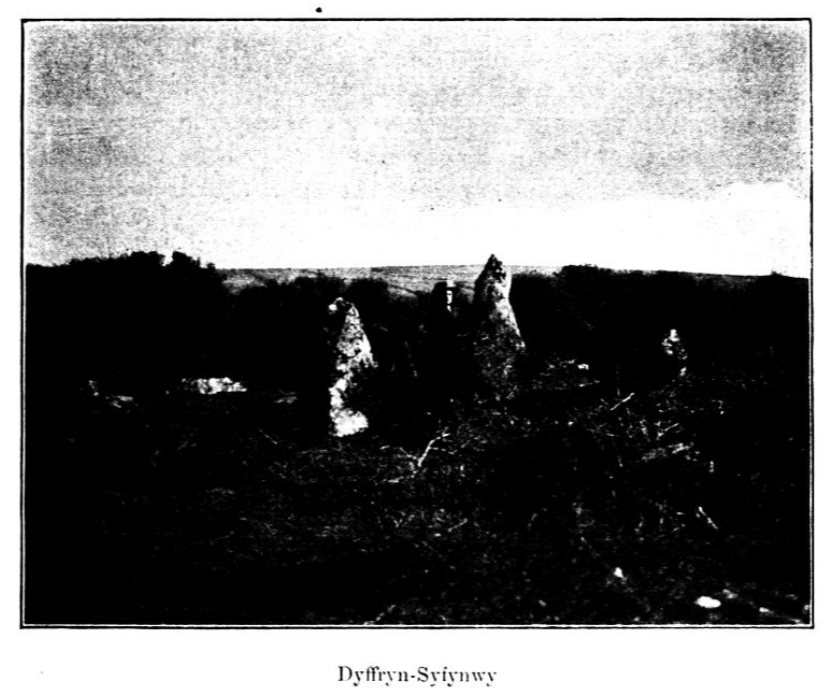
It is a fairly well preserved and beautifully situated circle, of which about ten or twelve stones remain in situ undisturbed. They are most of them of no great size ; there are, howver, thee which are respectively 4ft, 4 1/2 ft and 6ft high above the present surface of the ground. They form a circle as they stand, but there seems to have been also an inner structure which was possibly a cromlech or a smaller circle ; it is now represented by a heap of stones, a sort of platform 1 1/2 ft to 2ft high. This platform is however much obscured by vegetation, and until the growth is cleared away, we cannot know with certainty what is hidden by it..
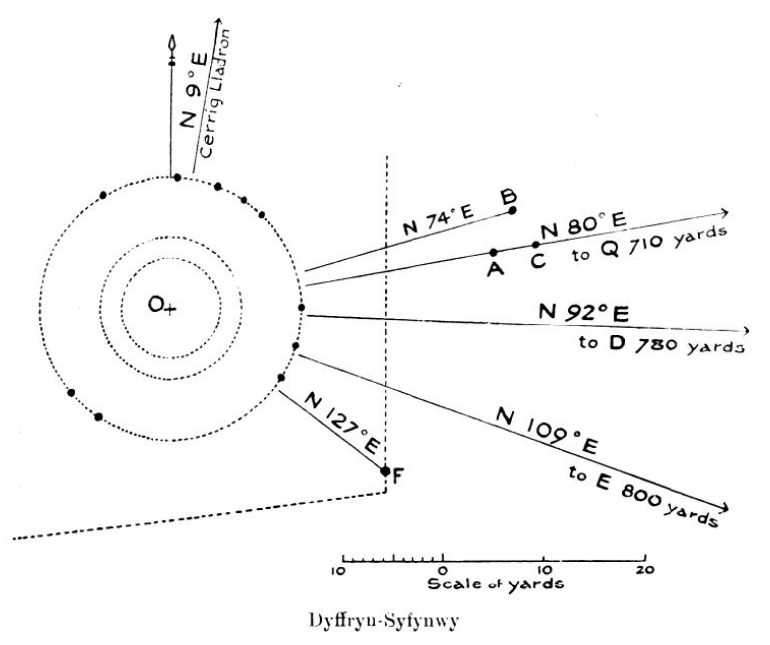
..Towards the east, and in the immediate neighbourhood, are three great stones marked A, B, and C on the plan, of which B only now remains upright. The others have fallen, but have not been otherwise disturbed and are in line with a distant maenhir Q, whos azimuth, measured from O, the centre of the circle, is 80°, the elevation of the sky line being about 2°. The distance of Q from O is about 710 yards. There is also a conspicuous summit known as Cerrig Lladron (The Robber’s Crag) with an azimuth of 9°. The azimuth also of Prescelly Top, which, however, if visible at all, is not conspicuous, is given by the Ordnance Map as 54°. The outstanding maenhir F, which is of considerable size, is prostrate ; its azimuth is 127°. The Budloy maenhir Q is a noble stone ; it is some 7ft high above the ground, and has a horizontal section of about 3 square feet. It is worked with a tool on the western side, which is toward the Dyffryn Circle..
..Of the various possible sight-lines that through Q was probably the most important. We will therefore consider first what we are able to infer from it. We find them, after due allowance for refraction, that the apparent azimuth of 80°, with a sky line elevation of 2°, corresponds to a true or sea-horizon azimuth of about 78°, that is to say, that a star whose sea-horizon azimuth on rising was 78° would first come into sight immediately over the Budloy stone ; and, further, it will be found that such a star would have a declination of 7° 18′. Now this at present time is the declination of the sun on April 9th, nor has the declination on that day very greatly altered during the last 4000 years. But we have no reason to believe that his rising either on or near that day was regarded as of any special importance ; it is, in fact, half-way between two critical epochs, namely, the vernal equinox and Beltane-tide. We therefore turn to the stars, and there we find that Aleyone, the brightest of the Pleiades, possessed this declination of 7° 18′ about BC 1700, and that then at Beltane-tide she rose about one hour and forty minutes before the sun, and therefore might have been useful as a warning star to herald the approach of dawn. Now the connexion of the Pleiades with these stone circles has been well established by a series of observations made in Cornwall and elsewhere ; and we may therefore hazard a conjecture that the sight-line O A C Q may have been laid down about BC 1700, with an especial refrence to the Pleiades ; and that this may therefore very possibly be about the date of the erection of the circle itself.
Now let us turn to the sight-line which is given by the summit of Cerrig Lladron. The azimuth found was 9°, with an estimated sky-line elevation of two or three degrees. These figures give us a circumpolar declination of about 39° 30′, which is BC 1500 was the declination of Arcturus, well known to us as a favourite clock-star in prehistoric times.
Again, there are other sight-lines given by the outstanding stones D, E and F, their azimuths being 92°, 109° and 12..Of the various possible sight-lines that through Q was probably the most important. We will therefore consider first what we are able to infer from it. We find them, after due allowance for refraction, that the apparent azimuth of 80°, with a sky line elevation of 2°, corresponds to a true or sea-horizon azimuth of about 78°, that is to say, that a star whose sea-horizon azimuth on rising was 78° would first come into sight immediately over the Budloy stone ; and, further, it will be found that such a star would have a declination of 7° 18′. Now this at present time is the declination of the sun on April 9th, nor has the declination on that day very greatly altered during the last 4000 years. But we have no reason to believe that his rising either on or near that day was regarded as of any special importance ; it is, in fact, half-way between two critical epochs, namely, the vernal equinox and Beltane-tide. We therefore turn to the stars, and there we find that Aleyone, the brightest of the Pleiades, possessed this declination of 7° 18′ about BC 1700, and that then at Beltane-tide she rose about one hour and forty minutes before the sun, and therefore might have been useful as a warning star to herald the approach of dawn. Now the connexion of the Pleiades with these stone circles has been well established by a series of observations made in Cornwall and elsewhere ; and we may therefore hazard a conjecture that the sight-line O A C Q may have been laid down about BC 1700, with an especial refrence to the Pleiades ; and that this may therefore very possibly be about the date of the erection of the circle itself.
Now let us turn to the sight-line which is given by the summit of Cerrig Lladron. The azimuth found was 9°, with an estimated sky-line elevation of two or three degrees. These figures give us a circumpolar declination of about 39° 30′, which is BC 1500 was the declination of Arcturus, well known to us as a favourite clock-star in prehistoric times.
Again, there are other sight-lines given by the outstanding stones D, E and F, their azimuths being 92°, 109° and 127° respectively. For D the sky-line elevation is 1. For E it is small or even negative ; but I did not measure it ; the stone itself has dissapeared ; our only witness to it is the Ordnance Map. The figures for D give us the sunrise at the vernal equinox ; D is however a small stone, being barely 3ft high, and although it is certainly visible from the circle, yet its connection with it is perhaps a little doubtful. From E, allowing for a slight elevation of the sky-line, we infer a southern declination of about 11° 30′. a declination which would of itself suggest a Aquarii, a Ceti, and a Scorpionis (Antares) in BC 1100, BC 1150, and BC 1650 respectively. I do not find however that the first two of these would be of any use as warning stars.
The Ordnance Map gives 780 and 800 yards respectively for the distances of D and E from O. The distance of F however is only 27 yards ; it is now prostrate, but is a fine stone, and would, with a sky-line depression of 2°, and a small allowance for refraction, and for the change in the obliquity of the ecliptic, give us, and with considerable exactitude, the sunrise at the winter solstice. The elevation or depression of the sky-line, however, I unfortunately did not measure.
Another sight-line which may also possibly have an astronomical significance is F A B, of which the measured azimuth is 22° with a sky-line elevation of 3°. These figures will be found to give a declination of 37°, which is that of Arcturus about BC 1100. This might suggest, of course, a later re-arrangement rendered necessary by the precession of the equinoxes ; it would however be rash to accept such a date for a conservative restoration without more accurate observation made with a theodolite or otherwise ; nor does F occupy the centre of the circle, which was no doubt the usual point of observation.
This may perhaps suffice for the Dyffryn circle. I have discussed the astronomical significance of its sight-lines at some length because the circle is a very definite one, and it so happens that the Ordnance Map enables us, as is not always the case, to check the azimuths measured on the spot. And it is certainly significant to find suggestions not only of Arcturus and the Pleiades, but of the sunrise at the winter solstice, and also at the vernal equinox.” – https://journals.library.wales/view/4718179/4723583/304#?xywh=-813%2C378%2C3850%2C2004

Here is the video we made exploring Dyffryn Syfynwy:
 CoralJackz - That History Couple
Leave a comment