
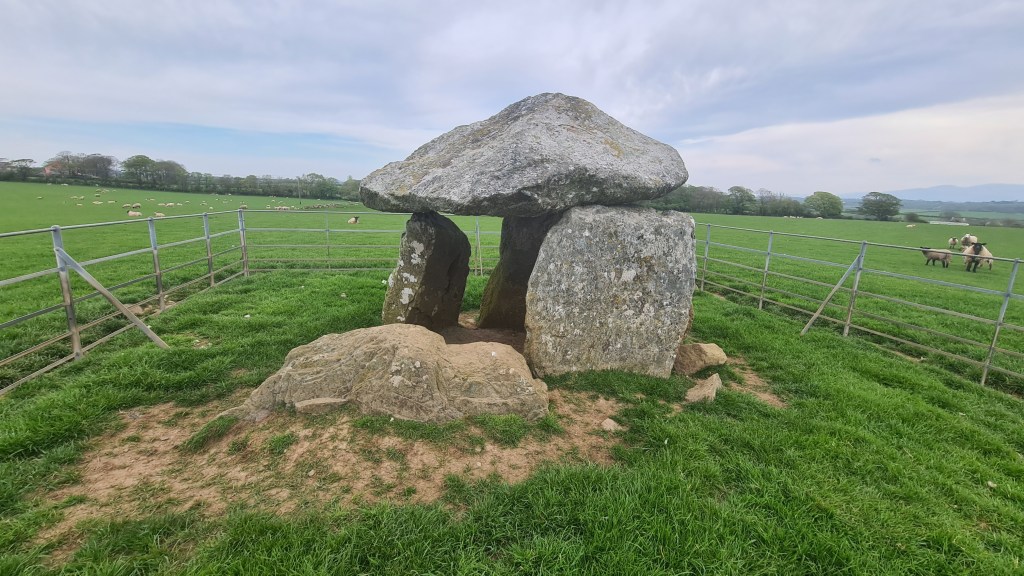

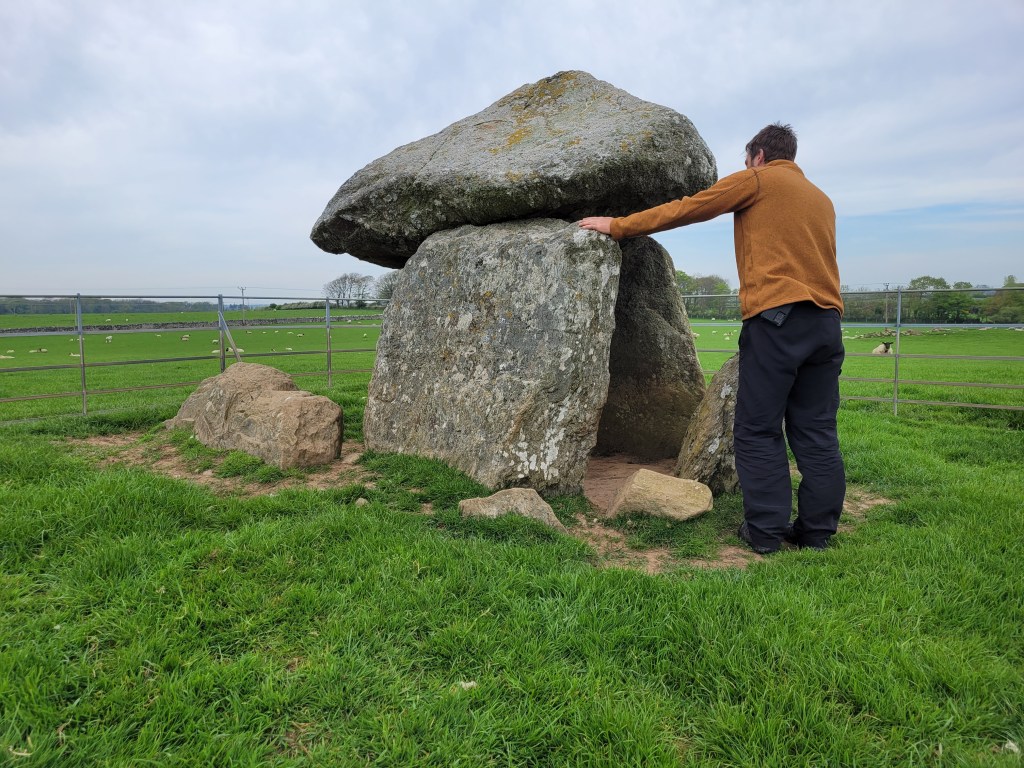
On Bodowyr farm on the Isle of Anglesey, Wales is Bodowyr cromlech, sometimes known as the ‘mushroom cromlech’.
The oldest record mentioning Bodowyr Cromlech is from Camden’s Britannia, volume 4, Wales, published in 1610:
“In Bodowyr, which lies
on the northside of the same round fort, at a further distance, we find a remarkable
cromlech, which several, as well as myself, suppose to be another kind of sepulchral
monument since the time of heathenism. These (for we have several others in the
island) are composed of three or four rude stones, or more, pitched on end as
supporters or pillars, and a vast stone of several tons laid on them as a covering; and
are thought to have received the name of cromlecheu, for that the table or covering
stone is on the upper side somewhat gibbous or convex: the word crwm signifying (as
you know) crooked or hunch-backed, and Llech any flat stones. This cromlech at
Bodowyr, is more elegant than any monument I have seen of its kind: for whereas in
all others I have noted, the top-stone as well as the supporters, is altogether rude and
unpolished; in this it is neatly wrought, considering the natural roughness of the
stone, and pointed into several angles, but how many I cannot at present assure you.”- https://www.exclassics.com/camden/camdenv4.pdf

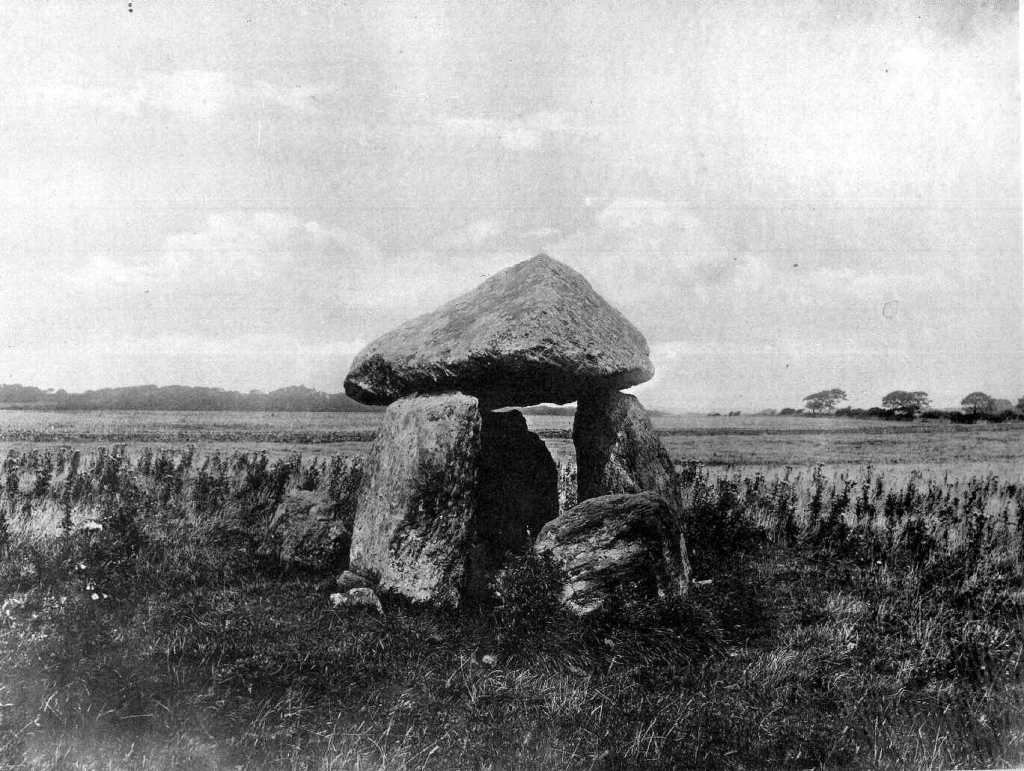
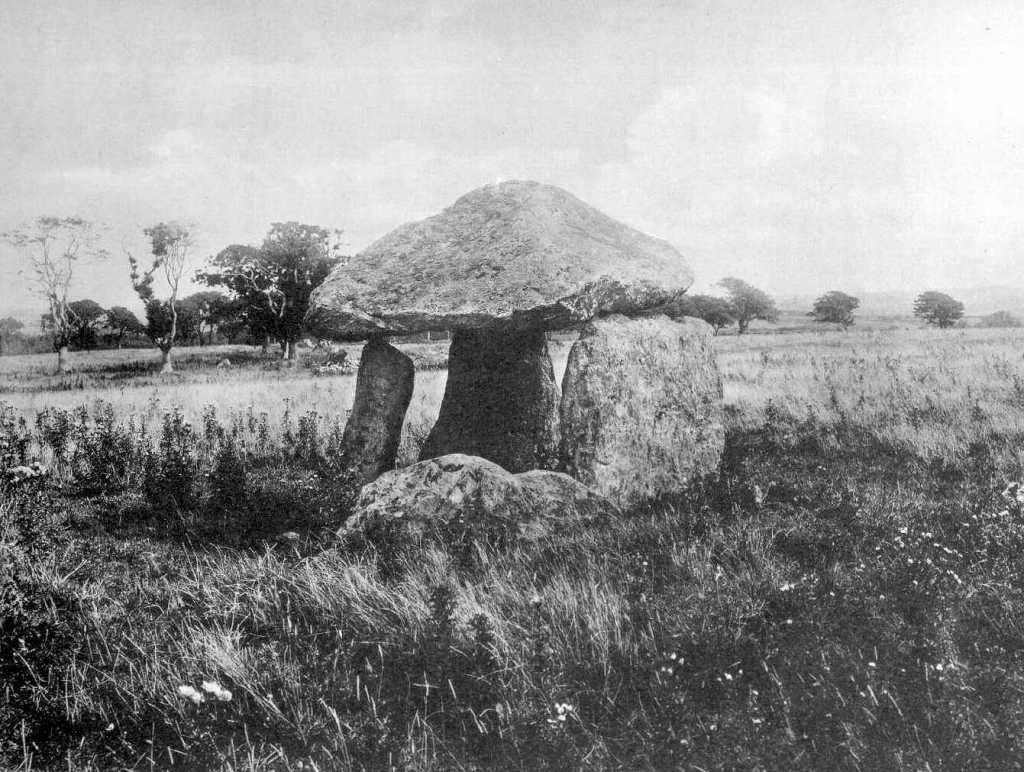
The following photographs are from ‘Portfolio of Cromlechs in Anglesey and Caernarvonshire’ by J.E.Griffith 1900, with the accompanying text:
“This Cromlech stands in a field on Bodowyr farm, on the right hand of the road that leads from Felin Bodowyr to Llangaffo. It is one of the prettiest Cromlechs in the whole island. The capstone is four sided, and pyramidal in form. The north-east measures four feet six inches; the south-east, six feet three inches; the north-west, seven feet; and the south-west, six feet; and it is seven feet six inches in height from the ground. There are five supports, but two have fallen down, and are lying on the ground, and the capstone at present rests upon three only. (See Arch. Camb. 1869 and 1878).”
Coflein description of the site:
“The Bodowyr Burial Chamber is a megalithic monument now consolidated for public viewing. It consists of five upright orthostatic stones, one now fallen, which define a polygonal chamber. Three of the stones support a mushroom shaped capstone about 2.5m by 1.9m and up to 0.9m thick. The chamber would have lain within a cairn or mound of which there is now no trace. It can be identified as a Neolithic ritual or funerary monument.” – https://coflein.gov.uk/en/site/93830/

The following is quoted from Archaeologia Cambrensis, July 1869 (as well as illustrations provided):
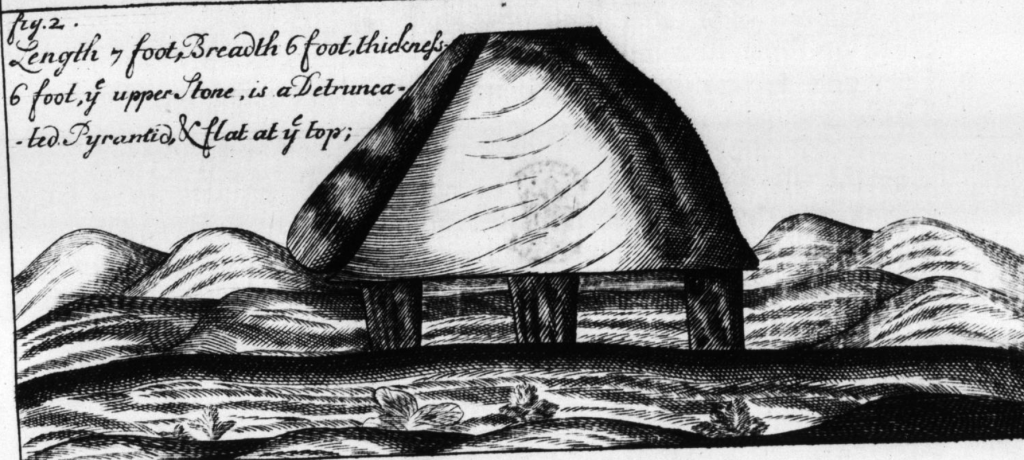
“This is mentioned by Rowlands (Mona Antiqua, second edition, p.93), who describes it as “A pretty cromlech standing at the top of a hillock at Bodowyr”. He also gives a drawing of it (plate v, fig. 2), and the following dimensions, -“length, 7ft ; breadth, 6 ft. ; thickness, 6 ft.”; and adds, “ye upper stone is a detruncated pyramid, and flat at the top.” The capstone is four-sided : the north-west side, which is the longest, measures 7ft. ; the south-west side, 4 ft 6 ins. It has a pyramidal appearance when looked at from the south-west, but is certainly not “very flat at the top”. There are five supporters standing ; but the capstone at present rests upon three only, which are shaded in the accompanying ground-plan. From the smallest of these a piece has been detached, and now lies beneath the cromlech. The total height above ground is 7 ft. 6 ins.
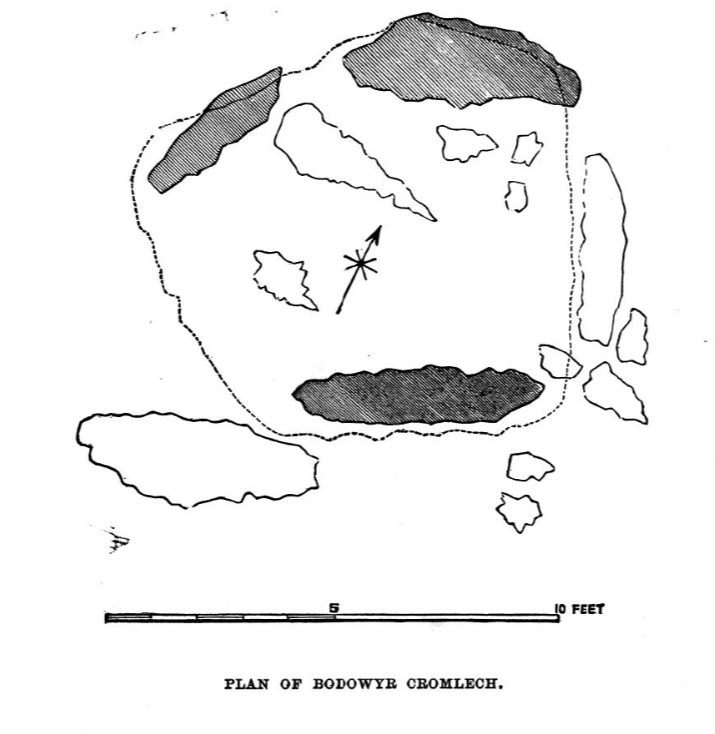
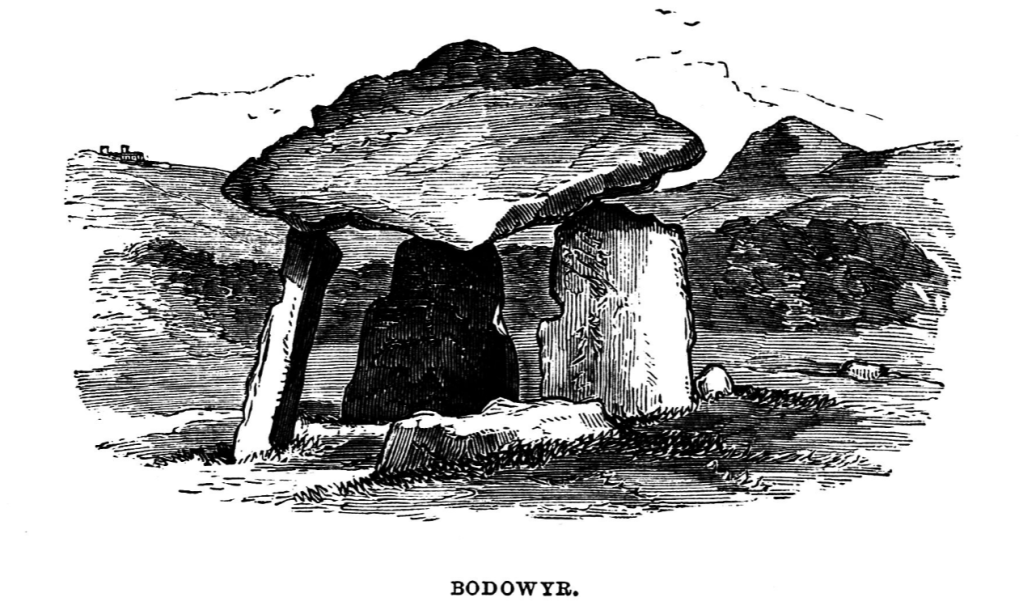
Several fragments of stone, all of which are marked in the ground-plan, are scattered about under and around the structure. Most probably these were originally used to close up the sides of the chamber. Miss A. Llwyd, in her History of Anglesey (4to, 1833, p. 287), describes the capstone as being “supported by four upright stones”; so that, if she observed correctly, one supporter must have given way after she wrote. Rowlands further remarks that “there is also, on a rising part of the ground there” (Bodowyr), “the highway leading through it, the remains of a small crique” (Mona Antiq, plate v, fig. 3) ; and on another part of the ground there appear the marks of a carnedd, the stones of which, in times past, have been disposed of into walls and buildings.” I have been unable to find the remains of either of these.”
– https://journals.library.wales/view/2919943/2998683/63#?xywh=-699%2C407%2C3809%2C3913&cv=62
In Mona Antiqua by Henry Rowlands (1723), we are provided with an illustration. He describes the monument as “a pretty cromlech standing at the top of a hillock at Bodowyr”. He also mentioned a “small cirque” nearby and the remnants of a cairn from which the stones had mostly been removed for use as building stone. – https://archive.org/details/bim_eighteenth-century_mona-antiqua-restaurata_rowlands-henry_1723/page/3/mode/1up
The History of the island of Mona, or Anglesey by Angharad Llwyd – https://archive.org/details/b22010580
How to access the cromlech:
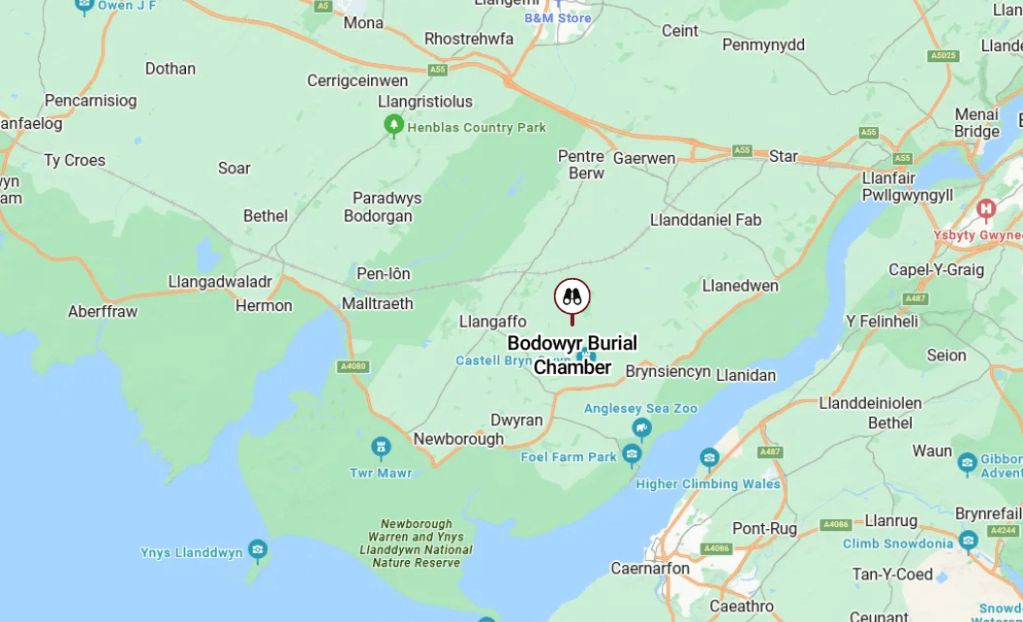
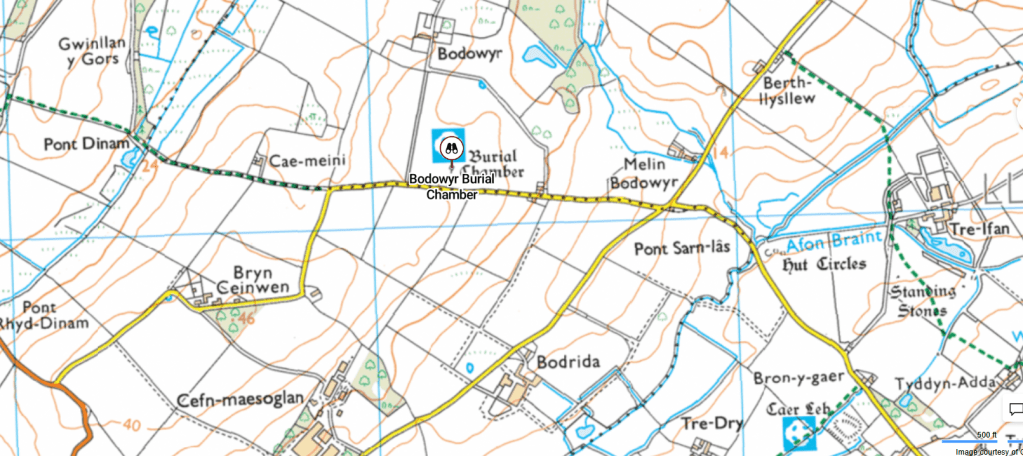
The entrance to the field is located next to the road. Public access is allowed and the monument is a short walk across a sometimes muddy field.
Below is the OS Map Courtesy of Ordnance Survey ©2025 Microsoft –https://www.bing.com/maps/?cp=53.187761%7E-4.344067&lvl=11.6&style=s
 CoralJackz - That History Couple
Leave a comment