
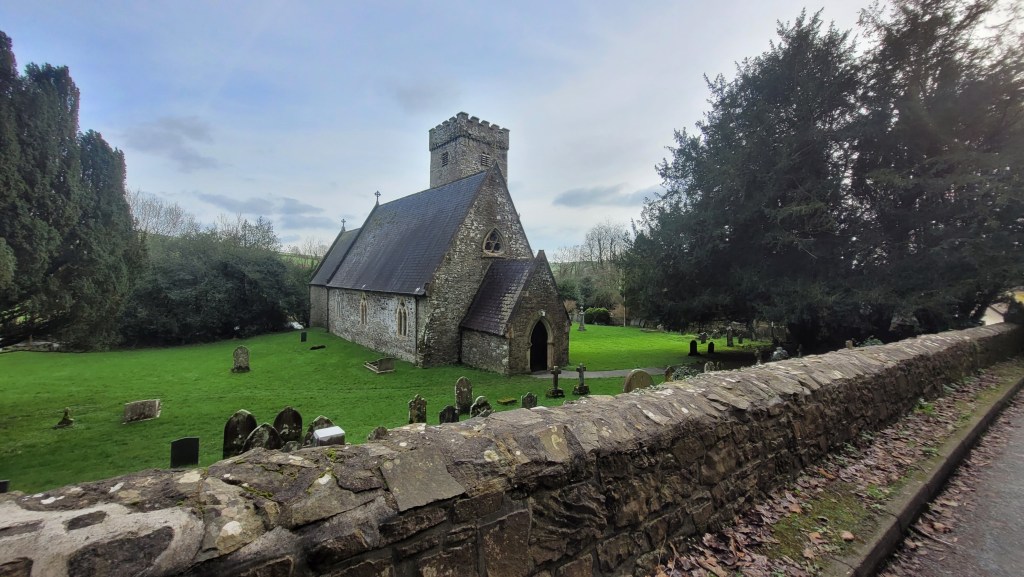

In the village of Llawhaden in Pembrokeshire, Wales is St. Aidan’s Church. Llawhaden has a fascinating history and if you would like to learn about the medieval castle and chapel, here is the link to that post – https://thathistorycouple.co.uk/2025/07/18/llawhaden-village-castle/
At the back of the church is an early medieval inscribed stone. Here is a description from Corpus of Early Medieval Inscribed Stones and Stone Sculpture in Wales, by Nancy Edwards, 2007:
“Llawhaden 1 is built into the external east wall of St Aidan’s Church, Llawhaden. A small fragment, part of the carving, of it is in Scoton Manor Museum, Spittal, Haverfordwest. It was first noted in its present location. The church was mentioned as a bishop house in a Welsh Law text thought to date to the ninth century and the pillar is the only archaeological evidence that indicates the significance of the church. It is thought to have functioned as a free-standing cross.
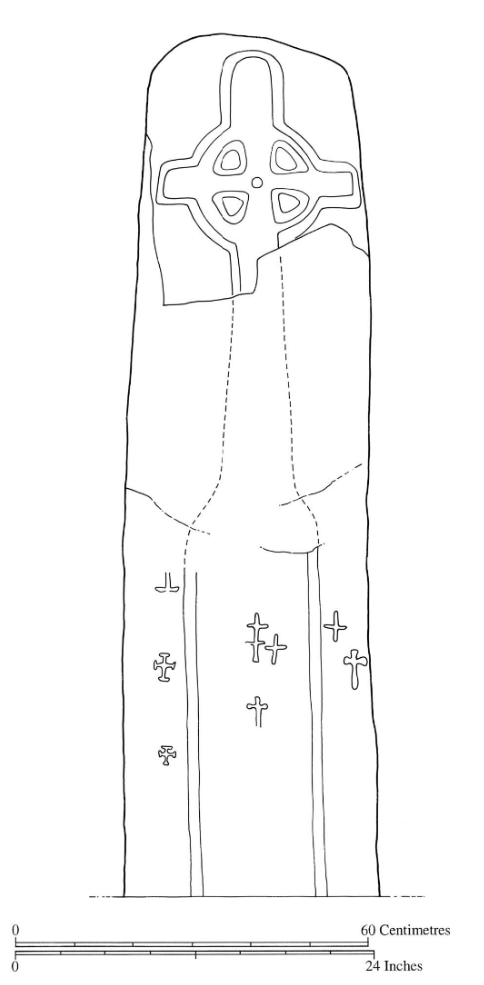
The stone is an incomplete pillar and base, of fine-grained, grey, micaceous sandstone. It is in very poor condition and most of its carved surface, face A, has recently flaked away. The remaining carving is very weathered. The length of face A was carved in low relief with a Latin ring-cross, thought to be ninth-century in date. There are several small, simple, lightly incised graffiti crosses towards the base of face A. They may be ninth century (although they may be later) and probably functioned as votive crosses carved by pilgrims.”
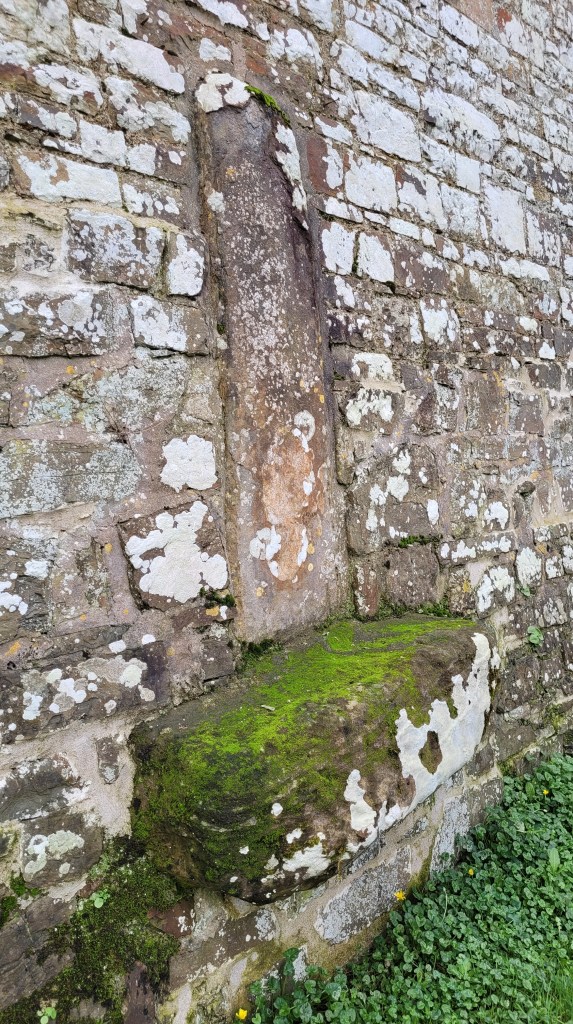
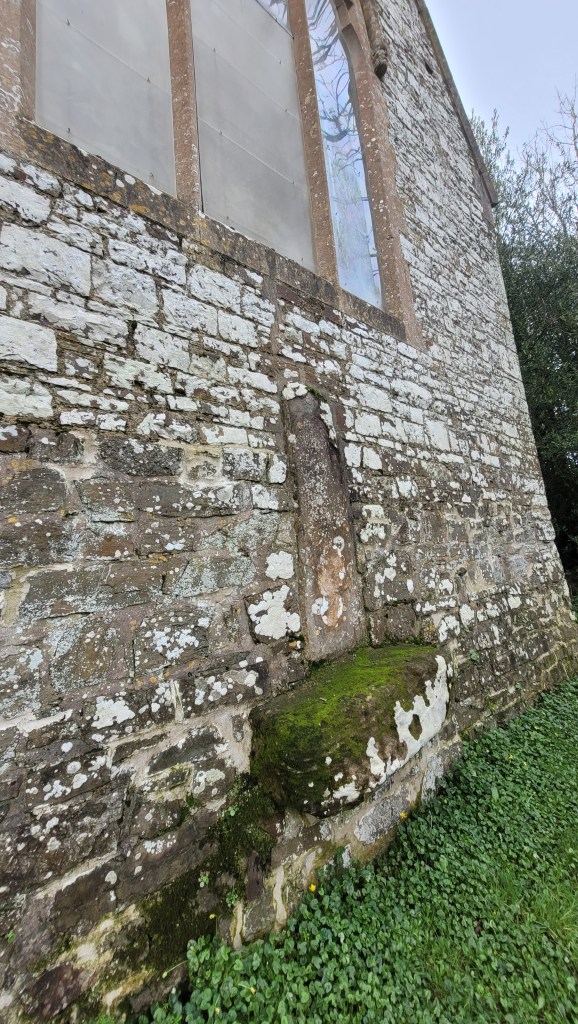
Helen Milne writes in ‘St. Aidan’s Church, Llawhaden – Archaeological Desk-Based Assessment’ (2007):
“A small amount of physical evidence supports the idea of an early foundation. An inscribed stone (PRN 3583) of 9th or 10th century date is built into the east wall of the chancel. Ludlow (2003) considers that this stone could be located close to its original position. A further early medieval inscribed stone is set in the west wall of Llawhaden House (PRN 6660). This may have been removed from its original position when Llawhaden House was built in the early seventeenth century. Masonry from the castle, and perhaps also from the church, was incorporated into the house.
Further circumstantial evidence may also support an early foundation date. It has been suggested that the regular rectangular shape of the churchyard may be late pre-conquest in origin (Ludlow, 2003). The church lies only a short distance south of the main Roman road running west from Carmarthen (proximity to a Roman road was often a factor in the distribution of early Christian sites). This evidence supports the theory that the Christian establishment here pre-dates the Norman period, and Ludlow (2003) asserts that there is a high probability St. Aidan’s church has early medieval origins..”
You can read a lot more detail about the church here – https://walesher1974.org/herumd.php?group=DAT&level=3&docid=301373067
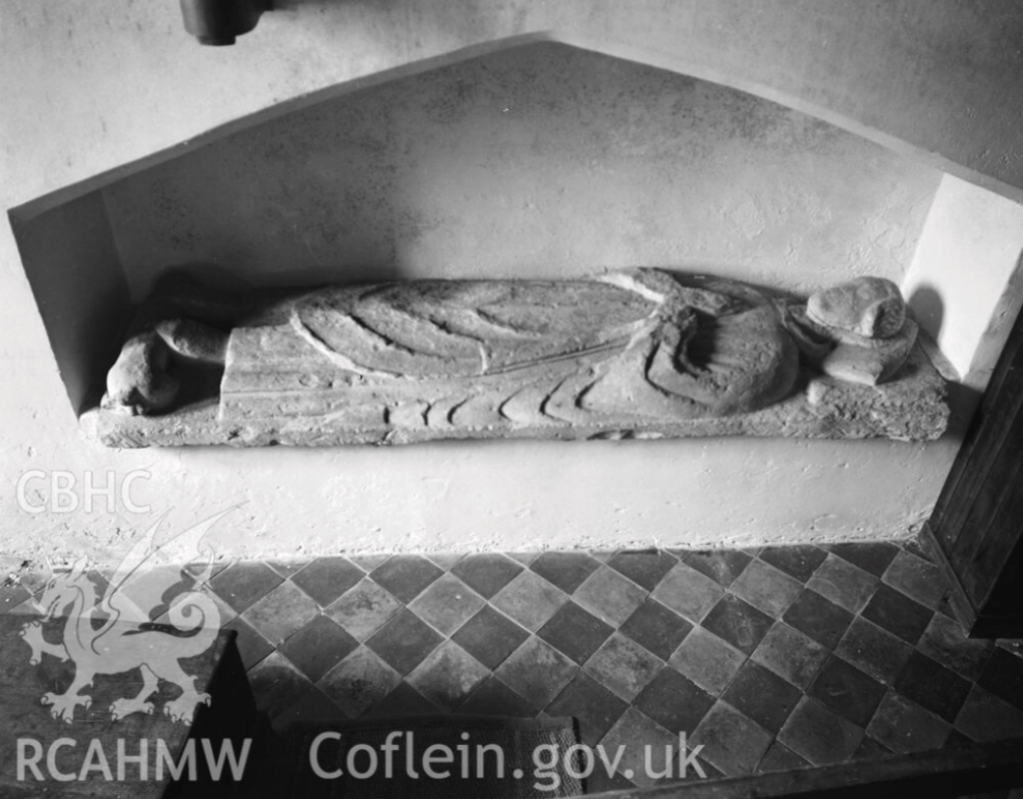
The following description of the church is from Coflein – https://coflein.gov.uk/en/site/400271/ – They also provide these photographs dated 1941:
“St Aidan’s Church is situated within a rectilinear churchyard, delineated by a road on its west side and the Cleddau ddu/Eastern Cleddau river on its east side. The site is adjacent to the former Roman road which runs west-east from Carmarthen. Llawhaden was mentioned in a Welsh Law text thought to date to the ninth century as a bishop house. The church is some 140m east of Llawhaden Castle (NPRN 94109), which is thought to be a reused Iron Age enclosure. The church was mentioned as being dedicated to St David in a mid-twelfth-century poem. At this time it was an important prebend of St Davids Cathedral. There is an inscribed stone (NPRN 415026) in the church.

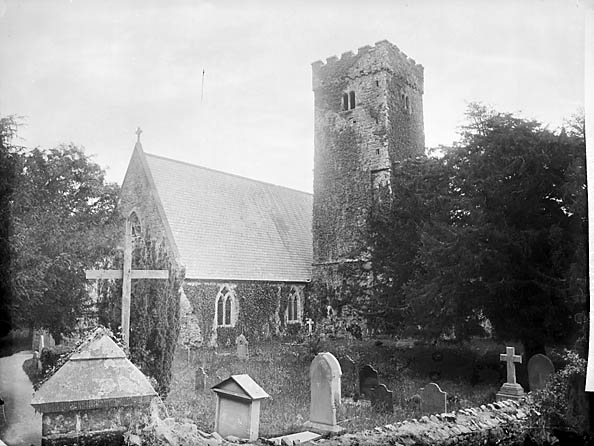
The church is a grade 2 listed building, of medieval date with an unusual double-towered form, retaining significant early fabric and including good interior details. Constructed of lime rubble, it consists of 3-Byed nave, 3-bayed chancel, 2-bayed vestry (formerly a south chapel), south transept with skew-passage and 2-storeyed south tower above (absorbing part of an earlier 3-storeyed tower) and west porch. The nave is thought to date to the twelfth century. The chancel may be fourteenth century and is pierced by a sixteenth century window. The south transept and skew passage are also thought to be fourteenth century. The vestry (former south chapel) is thought to be seventeenth century in date. The arcade separating it from the chancel is of two arches with a round column and moulded caps to the column and responds. The column cap is of conical cushion form with a cable moulding similar to that on the font. The east respond has grotesque carvings, including a two-headed animal in which the heads share one eye, and another face at the rear. The church was restored in 1834, when it was reroofed, its walls were repaired, and a gallery was added. The church was again restored in 1861-2. The vestry was reroofed, the west porch and west door were largely rebuilt, the chancel arch was rebuilt, and the church was refenestrated, reroofed, refloored and reseated. The gallery was removed and the tower parapet was rebuilt.” – https://coflein.gov.uk/en/site/400271/
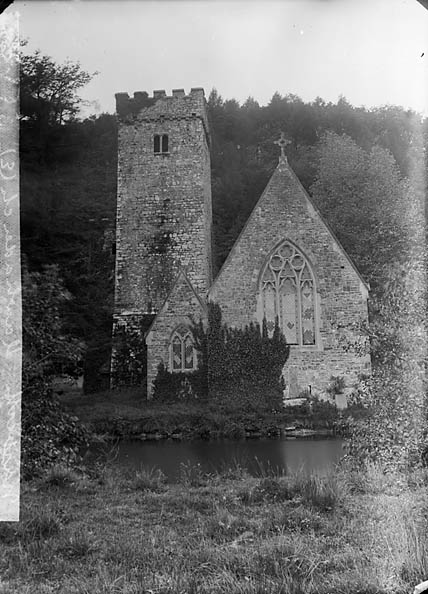
The following photographs were taken in 1885 by John Thomas –
The church is mentioned in Nooks & Corners of Pembrokeshire, by H. Thornhill Timmins, published in 1895:
“Descending by a steep, hollow lane to the banks of the Cleddau, we linger long about the old bridge and castle-mill to enjoy the placid beauty of the landscape, whose rich, subdued tints are enhanced by the radiance of a mellow autumn afternoon.
Looking upstream, the church forms the central feature of a pleasant, restful prospect; the picturesque tower reflected in the clear waters of the Cleddau, which rushes onward to tumble with refreshing roar over a weir close at hand. Amidst the hanging woodlands which clothe the castle hill, we catch a glimpse of that ancient fortalice; while lowing of kine comes pleasantly to the ear from the deep water-meadows down the vale.
We now bend our steps towards the parish church, noticing a simple wooden cross beside the wicket-gate, whereon is hung a lantern to guide the footsteps of the benighted flock, during the long, dark evenings of winter.
Llawhaden Church stands somewhat remote from the village, in a sequestered nook where the castle hill and the Cleddau leave scarce sufficient room for the little church to stand; insomuch that its chancel gable well-nigh overhangs the stream. Dedicated to St. Hugo, the sacred edifice contains the mutilated effigy of an ecclesiastic, commonly supposed to represent the patron saint, but more probably intended for Adam Houghton, Bishop of St. Davids, and co-founder with John o’ Gaunt of St. Mary’s College in that ‘city’.
Houghton distinguished himself by enacting a statute to regulate the scale of wages, and the price of beer, on behalf of his faithful ‘subjects;’ while tradition avers that, having been excommunicated by the Pope for some misdemeanour or other, this intrepid prelate retaliated by excommunicating the Holy Father himself!
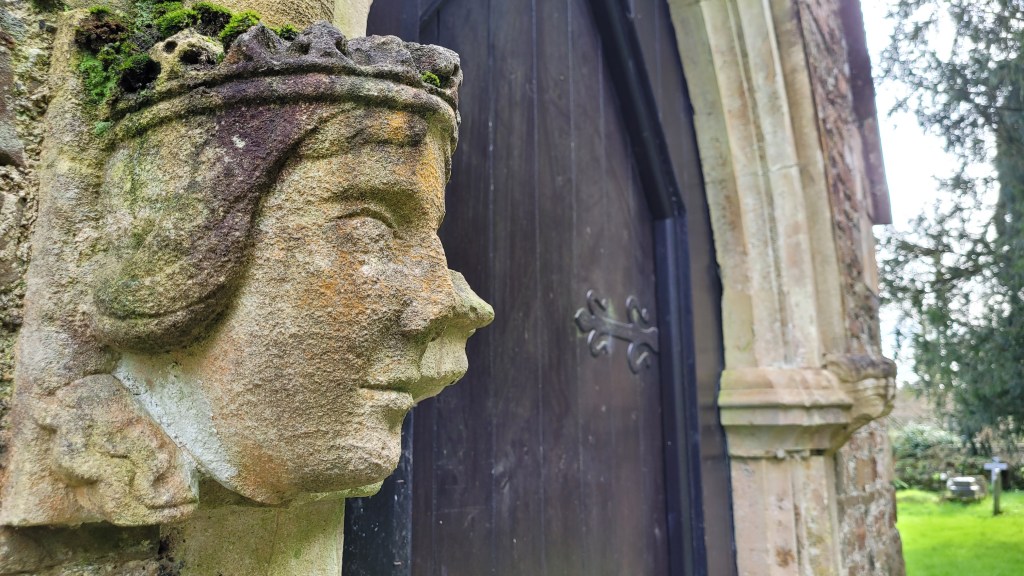
Inside the church we notice several curiously-sculptured corbels; besides a two-three quaint epitaphs reciting, in rather questionable English, the virtues and graces of certain local worthies.
The semi-detached tower presents a picturesque appearance, having, attached to its southern face, a square-shaped turret which, curiously enough, looks older than the tower itself. The internal construction of this tower is somewhat peculiar, and its belfry contains a triplet of sweet-toned bells.
It is, perhaps, worthy of note that Llawhaden is supposed to derive its name from St. Aeddan, a Pembrokeshire man by birth, and a disciple of St. David himself.
Having inspected an ancient cross, built into the eastern gable of the church, we now retrace our footsteps to the bridge, where, after searching for some time in vain owing to intervening foliage, we at last pitch upon a suitable spot for a sketch of that time-worn structure.
This done, we reluctantly turn our backs upon pretty Llawhaden, and fare away in the direction of Narberth, playing hide-and-seek with our shadows as they lengthen under the westering sun. Groups of lads and little lasses, homeward bound from school, linger in twos and threes by the rough laneside, where the bramble brakes are thickest; purple lips and stained pocket-handkerchiefs showing the blackberry season is now in full swing..”
– https://www.gutenberg.org/files/40270/40270-h/40270-h.htm#ILL_127
The following is quoted from A Historical Tour Through Pembrokeshire, by Richard Fenton, 1811:
“Under the richly-wooded precipitous steep on which the castle stands is the parish church of Llewhaden, in a narrow vale, shut in with woods, and placed on the margin of the river Cleddau, which here begins to assume a very dignified appearance, wide, deep and yet clear, as if conscious of its approach to the majestic tide of Milford, which insinuates itself almost thus far to meet it. And here, on looking up the river towards the church, the bridge, the mill, the mansion of Talybont, and other pleasing features, most happily unite to form a beautiful landscape.
The church, more from its situation as forming an ingredient in this charming view than from any thing in its form, dimensions, or architecture, that it can boast of to recommend it, becomes an object of notice. To raise it above the level of the ordinary churches it has the inescapable badge of those found in the Englishery of this county, a tower to give an air of dignity to its exterior, a building of after growth, and springing from a more ancient one ; and within, to excite the attention of the antiquity, only one solitary old monument, under a plain canopy, bearing the recumbent effigy of a priest, well executed in Nolton stone, though now shamefully blunted with whitewash, like all his sculptured fraternity, and said to be that of St. Hugo, to whom the church is dedicated. It occupies a small aisle to the south of the chancel, and separated from it by two very singular arches resting on a plain round pillar. In the chancel there is a small mural tablet of freestone, to commemorate a former chancellor of St. David’s, of the ancient house of Henllys, by the escutcheon it bears, charged gules a boar argent, chained to a hollybush proper, (that is, vert, or green,) armed and unguled or, the chain and collar of the last, with the following epitaph:-

There is a large tomb railed in, just without the chancel, thus inscribed:-
UNDERNEATH AND ROUND THIS PLACE LIE THE FAMILY OF THE HAWKWELLS.
The church is a vicarage, the rectorial tithes formerly belonging to the prebend of Llewhaden, together with the demense of St. Kenox, having been annexed to the chanellorship by Bishop Beke, which are now held under lease from that dignitary by J. Herbert Foley, Esq. of Ridgeway.
At St. Kenox was wont to reside occasionally, during the time he was chancellor of St. David’s, the celebrated Rees Pritchard, author of a book called Llyvyr y Vicker, or the Welsh-man’s Candle, who, on the rocky mount near the house, since used as a winnowing bank, was often known to preach to an audience so numerous that no common church could contain them ; for such was his popularity, and so impressive his manner as a preacher, that once, when he came to keep residence at St. David’s, he was obliged to have a temporary moveable pulpit in the church-yard, the nave of that cathedral, spacious as it is, not being large enough for his overflowing congregation, for which, such was the fanaticism of the times, he was libelled in the spiritual court, an anecdote I had from the great grandson of one of his auditors, amongst whose memoranda this curious particular was noted. On the occasion of this memorable sermon these Welsh lines were in everybody’s mouth:-
Yr Vicker O Llanddyvry
Naeth bregeth yn Tyddewi ;
Ny fy yn y byd erioed y gwell
Y aeth ymhell trwy Gymry.
Of this great and good man’s life I reserve the most remarkable circumstances for the county of Carmarthen, that gave him birth, and shall not presume to rob it of that boast by a species of biographical forestalling.
The mansion of Talybont, almost facing the church, on the opposite bank of the river, now belonging to John Meares, Esq. was first built and inhabited by a family of the name of Hawkwell, who being in some employ under Bishop Barlow, and his confidential instrument during his rapacious prelacy, became possessed of much property in this country, the reward of faithful attachment to his reverend master, who settled him first at St. Kenox for the convenience of superintending the work of destruction then carrying on at Llewhaden ; so that, in this case, for qualifications the very reverse of those pointed out so much to the honour of their possessor, in the ancestor of the friend Mr. Foley, he might also be styled “Magister operum.” None of the respectable family to whom it now belongs have resided there for these forty or fifty years ; and like many of the deserted houses in this county too good to be pulled down, it has experienced in that time a fluctuating succession of occasional tenants..” – https://archive.org/details/b22013179/page/320/mode/1up?ref=ol&q=llewhaden&view=theater
 CoralJackz - That History Couple
Leave a comment