
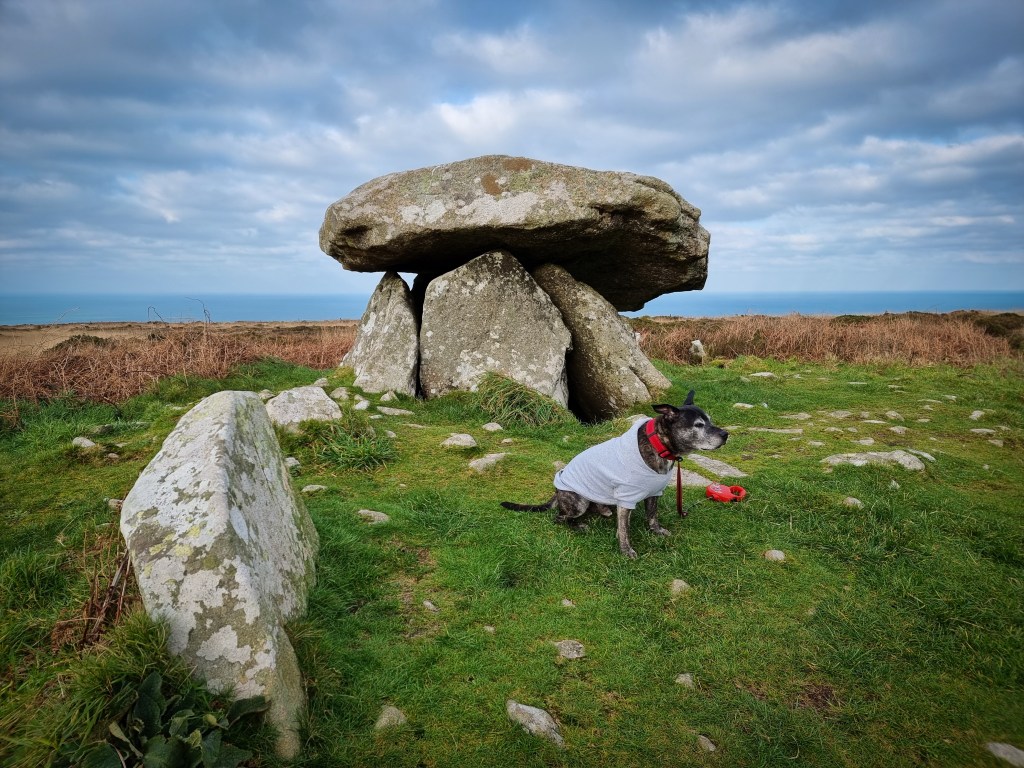

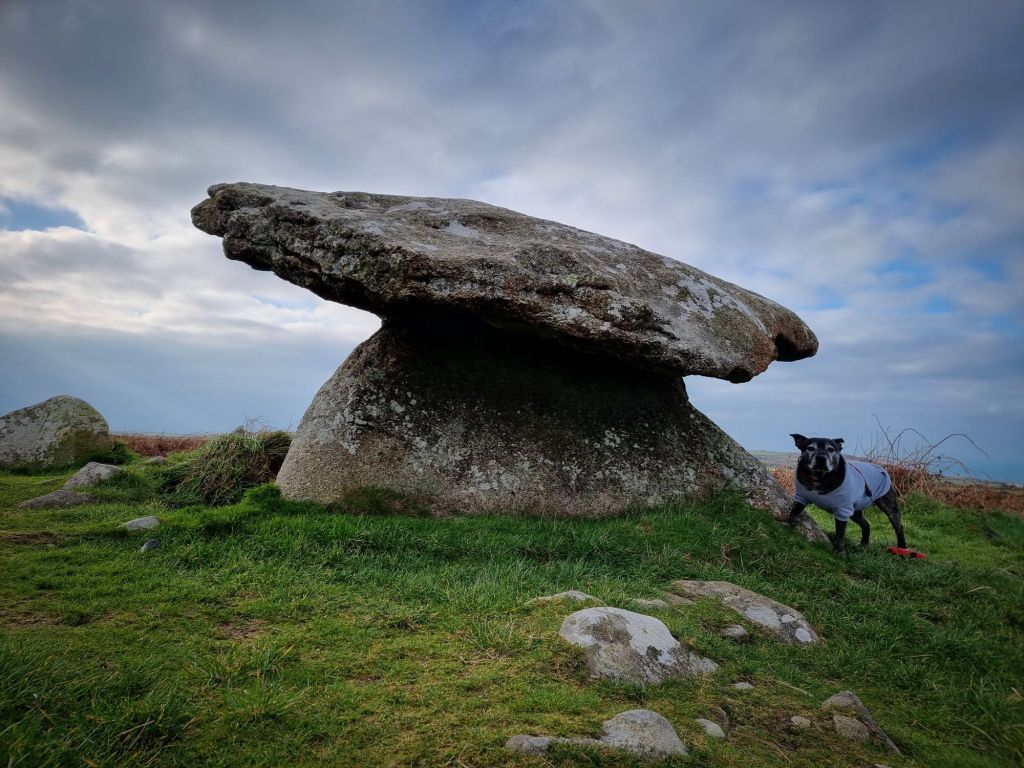
Neolithic monument in Cornwall. Just above Chun Quoit is Chun Castle, an Iron Age fortification. The name ‘Chun’, or more correctly in Cornish, ‘Chûn’ or ‘Chuûn’ and pronounced ‘Choone’ comes from ‘Chy-an-Woone’ or ‘Chywoone’ meaning ‘the House on the Downs’.
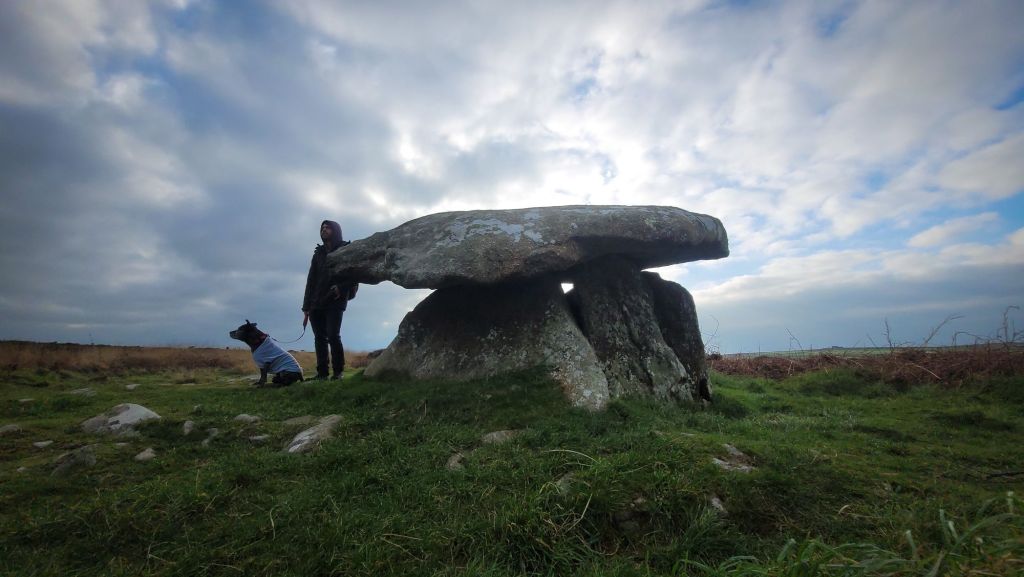
In 1872 William Copeland Borlase records Chun Quoit in his book, ‘Naenia Cornubiae’, but gets his orientations wrong:
“CHYWOONE CROMLECH.
The most perfect and compact Cromlech in Cornwall is now to be described. It is situated on the high ground that extends in a northerly and westerly direction from the remarkable megalithic fortification of Chywoone or Chuun, in the parish of Morvah. The “Quoit” itself, which, seen from a distance, looks much like a mushroom, is distant just 260 paces from the gateway of the castle ; and about the same distance on the other side of it, in the tenement of Keigwin, is a barrow containing a deep oblong Kist-Vaen, long since rifled, and now buried in furze. Thinking this monument the most worthy of a careful investigation of all the Cromlechs in the neighbourhood, the author proceeded to explore it in the summer of 1871, with a view to determine, if possible, the method and means of erection in the case of such structures in general.
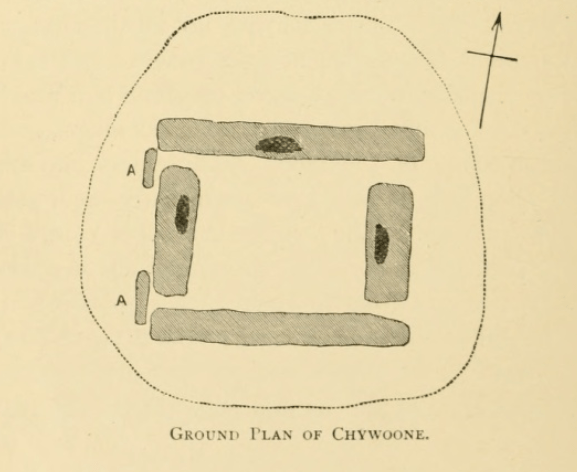
Sinking a pit by the side of the western stone, it was first of all discovered that the building rested on the solid ground, and not on the surrounding tumulus in which it had been subsequently buried. The Kist, as it seems, was formed in the following manner:- The two upright stones forming the east and west ends of the chamber were the first to be set up, at a distance of about six feet apart ; the breadth of the latter is four feet, and of the former 3 feet 10 inches, while the height of both is as nearly as possible the same, 6 feet 4 inches. Another flat block of granite, 8 feet 4 inches long, was then set up in a slanting position against their northern edges, precisely as one places the third card in building a card box, serving at the same time as a part of the fabric, and as a stay or hold-fast to the sides against which it rests. It was from this side, no doubt, and probably over this slanting stone, that, with the assistance of an embankment and rollers, the cap-stone was raised into its present situation, from which, unlike Humpty Dumpty, in the Nursery Rhyme, not all the adverse combinations of subsequent ages have as yet been able to replace it. This covering stone is a rough slab of hard-grained granite, of a convex shape, and, if the meaning of “vaulted” really enters into the word Cromlech, it would be particularly applicable in this instance. The length across the centre is twelve feet, and the breadth the same, while in thickness it averages from fourteen inches to two feet. The height of the interior of the Kist is seven feet and a small pit seems to have been sunk in the centre, below the level of the natural soil. It is here that the interment in all probibility originally rested, and the chamber was then completed by a fifth stone (7 feet 8 inches long) thrown against the south side, but not reaching sufficiently high to come in contact with the covering stone. The barrow or cairn, which in some places nearly reaches the top of the side stones on the exterior, is thirty-two feet in diameter, and was hedged round by a ring of upright stones. In digging down some of this pile from the sides of the monument, it was discovered that the interstices between the side stones had been carefully protected by smaller ones, placed in such a manner as to make it impossible for any of the rubbish of the mound to find its way into the kist. This arrangement will be better understood by referring to the letters A A in the accompanying plan, and is very suggestive of the whole being once totally buried in the tumulus…
…Among the heap of stones a small fractured piece of flint was discovered. Its shape, however, does not lead to the supposition that it was ever used as an instrument of any kind. A round cavity on the capstone seems to have been a work of modern times, and was probably the socket of a pole during the survey.
There are ruins of hut-circles within the enclosure at Chuun Castle, as also at Bossullo Crellas immediately below. –
– https://babel.hathitrust.org/cgi/pt?id=uc2.ark:/13960/t9r213s92&seq=78
1890 – The Giants of Towednack records a local oral tradition that the Castle on Morvah Downs was the abode of the giant named Old Denbras the Hurler who is killed in a wrestling match with a burly young man named Tom. He inherits Chûn Castle and the lands about on the condition that he buries the giant at his favourite seat on the hill facing out to sea;
“In the castle-court they found the club and sling with which Denbras slew the game he wanted: these Tom placed on the giant’s knees, and Joan laid green oak-branches and flowers around him; then they worked with a will, and before sunrise they collected so much stones as raised the barrow gradually sloping, even with the tops of the flat uprights which enclosed the giant. Then, by the help of poles, or such contrivances as were only known to the old folks, they placed the quoit or capstone over the head of Denbras, which hid him for ever from the light of day; and, before the sun sunk below the hill-tops, they had raised as noble a barrow over the giant as any to be found on Towednack hills; yet they were not without adding, time after time, to the carp of the giant’s resting-place – https://www.sacred-texts.com/neu/celt/swc1/swc103.htm
The following is quoted from ‘The Old Stones of Land’s End’, by John Michell published in 1974:
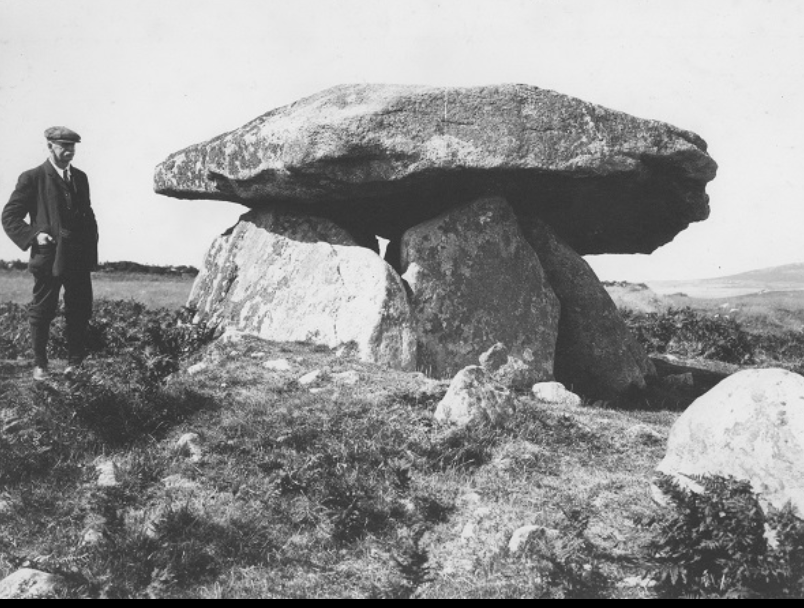
“Chun Quoit, the most complete dolmen in the district, stands high on a ridge below the remarkable prehistoric enclosure, Chun Castle. Within this enclosure and around it are the foundations of numerous ancient settlements, evidence of former high population in country now desolate. The great capstone of the Quoit is roughly circular with a diameter of 12 feet and its stands about 7 feet above the ground…
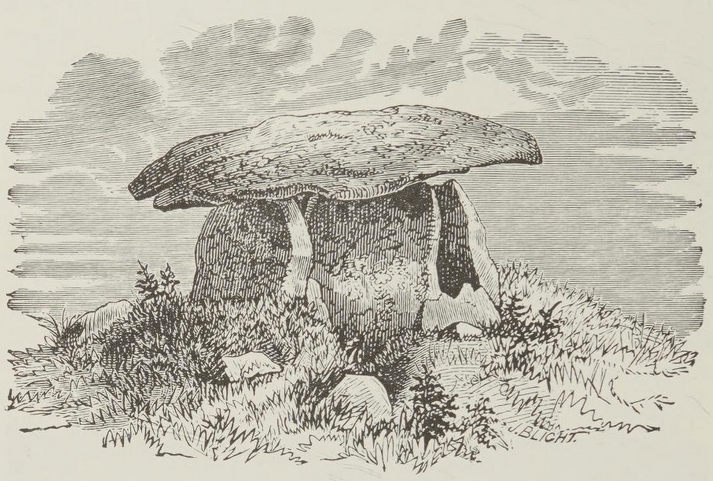
…Modern archaeologists consider that a ring of smaller stones encircling the Quoit was the retaining wall of a mound that once covered it. In fact there is no evidence for this belief which is simply an extension of the theory that all dolmens were originally burial chambers. J. T. Blight, who visited the monument with members of the Cambrian Archaeological Association in 1864, was disinclined to accept the former existence of a covering mound, giving his reasons in ‘Antiquities of West Cornwall’.-
‘The supposition that such a heap would have disappeared in the lapse of ages scarcely applies in this case, for, as already stated, the hillside is studded with small barrows, not a quarter of the height necessary to contain this cromlech, yet they remain apparently just as they were when first constructed. Surely if the material which formed a mound eight or ten feet high were dispersed through exposure or through some inexplicable process connected with time, how much more rapidly should the lesser mounds have disappeared.
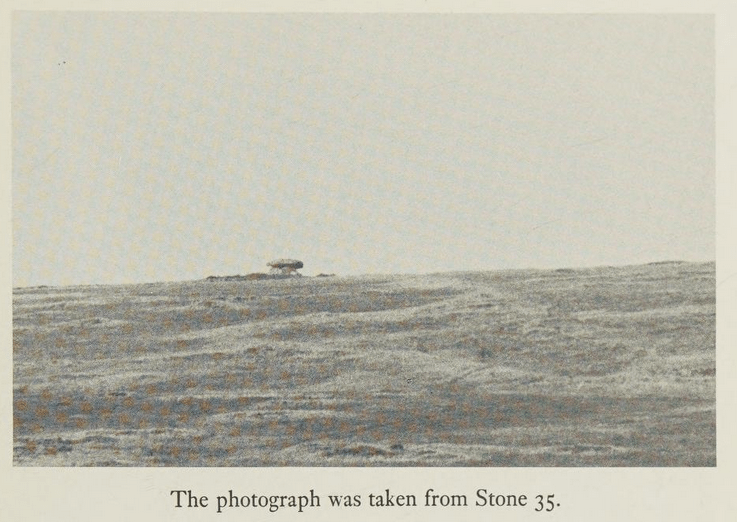
…If mounds over cromlechs were willfully removed for the sake of pillaging the kistvaens, how comes it that those kistvaens themselves are not demolished? It does not seem likely that the depredators who destroyed the mounds would have much respect for the stone chambers. Such as some of the difficult points for consideration in connexion with this question.’
W.C. Borlase dug beneath the stones of the Quoit but found no trace of an interment. No alignments found.” – https://archive.org/details/oldstonesoflands0000mich/page/81/mode/1up
 CoralJackz - That History Couple
Leave a comment