
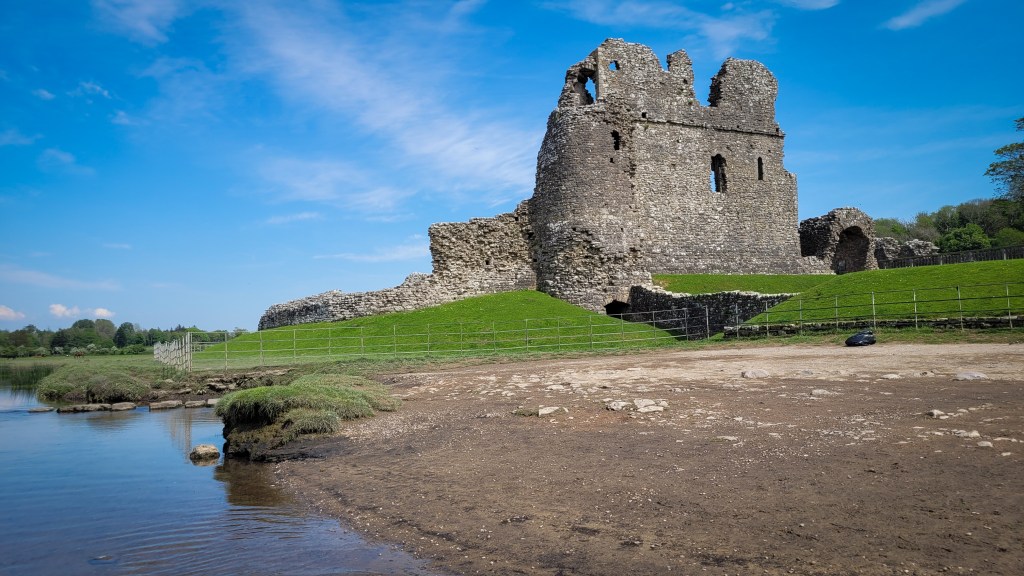

Ogmore Castle (Castell Ogwr) is located in the Vale of Glamorgan, Wales. The Castle was built by the Normans in the 12th century to guard Glamorgan against attacks from the Welsh in the west. This was part of a trio of castles including Newport and Coity. Construction began around the year 1106, first as an earth and timber structure.
It was the home of William de Londres, one of the legendary Twelve Knights of Glamorgan. He was one of many Norman Lords who came from France to conquer England and then began invading Wales.
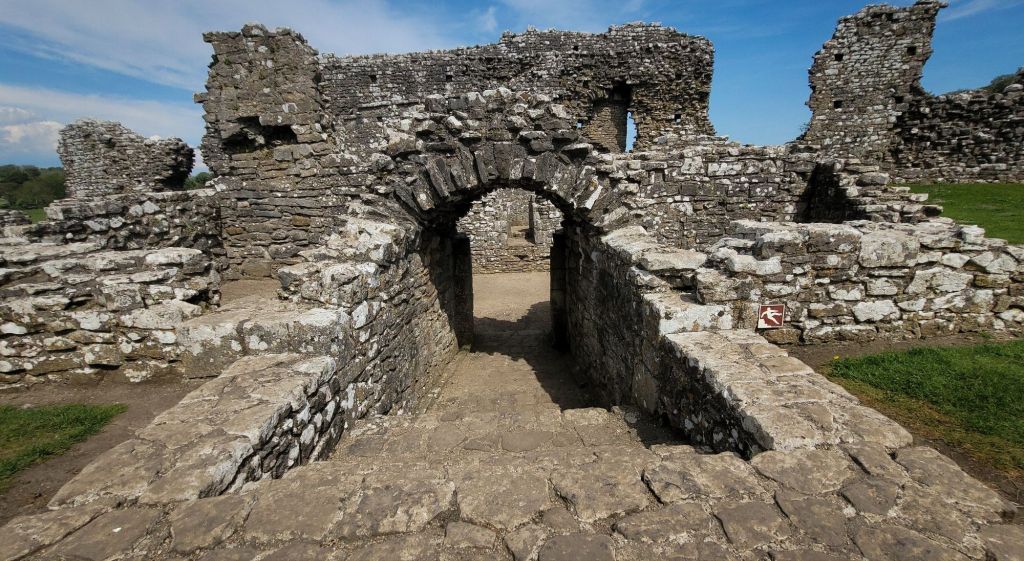
In 1116, a large Welsh army, led by Gruffydd ap Rhys, Welsh Prince of Deheubarth, attacked the castle. William de Londres’ butler, Arnold, is credited with protecting the castle from the Welsh attack in his absence. For this, he was knighted Sir Arnold Butler, also receiving the castle and manor of Dunraven as reward.
Soon after the attack of 1116, the keep was rebuilt in stone for greater protection, and it was one of the first castles in Wales to be built in stone. As the Norman’s continued to expand through the Vale of Glamorgan, the importance of the castle at Ogmore began to decline. By the time Edward I conquered Wales, in the late 13th Century, the castle’s military role had come to an end, although it continued to be used.
“The castle remained in the Londres family until 1298, when their descendant, Maud de Chaworth, married Henry of Lancaster. The Lordship of Ogmore was now in the hands of the Dukes of Lancaster, and when Henry of Bolingbroke became Henry IV, King of England, in 1399, it became a Royal residence. Unfortunately, this did not help it to survive, as the remote location slowly fell into decline, although it was still a residence until the 16th Century, and it continued further as the local Court House until 1803.” – https://www.medievaltravels.com/ogmore-castle-wales
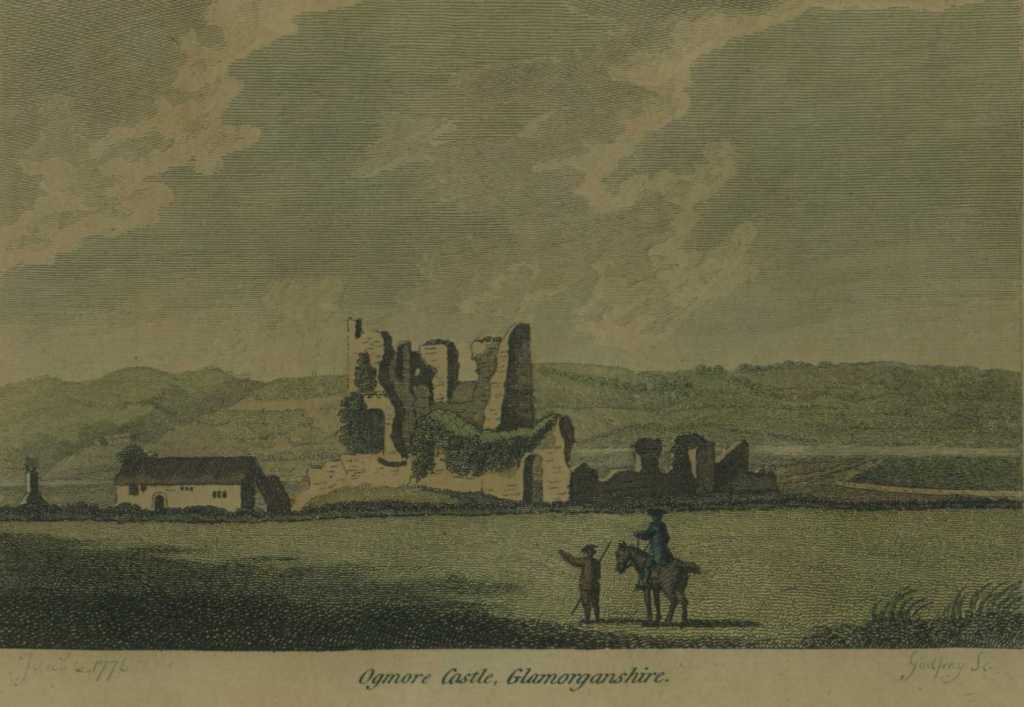
Legend of Y Ladi Wen (The White Lady):
The following is quoted from ‘Folk-lore and Folk-stories of Wales’, by Marie Trevelyan (1909):
“Ogmore Castle, near Bridgend, Glamorgan, had a white lady who was supposed to guard treasure which was kept under the flooring of the tower. A man accosted her once, and she took him to the spot, where she asked him to lift a large flooring-stone. This he did, and in a hole under the stone he found an old” crock full of golden guineas. “Take one half,” said the white lady, “and leave the remainder for me”. He did as he was bidden, and replaced the stone. One evening he thought he might as well have the other portion, and accordingly lifted the stone, and filled his pockets with the gold pieces. Just as he was leaving the castle the white lady appeared, and accused him of theft. He denied having taken the gold, but she made him take off his coat, and in doing so the money rattled out. The white lady then set upon him, and, to his dismay, he found she had claws instead of fingers, and with these she nearly tore him to pieces. He shouted, and tried in vain to get out of her grasp, but this he was not able to do until she had badly used him. He went home in a dilapidated condition, and was accused of having been mixed up in a drunken brawl, which he stoutly denied. Soon afterwards he was taken ill, and gradually became worse. Nobody knew what his illness was, and in the course of time he wasted away. Before he died he confessed to his adventure, and people called his complaint “the white lady’s revenge”. – https://archive.org/details/afl2317.0001.001.umich.edu/page/200/mode/2up?q=ogmore
Engraved Stone:
The Ogmore Cross Shaft is an early medieval, Latin-inscribed stone which was discovered at the Castle during a clearance in 1929. It is believed to date to the early 11th century. The text indicates that a man named Arthmail donated a field (or land) to the church. It would have originally been part of the base of a standing stone cross. The cross is thought to be one of those displayed at St Teilo’s Church in Merthyr Mawr. The original stone has been placed in the National Museum of Wales and a cast now stands near to the place where it was found.
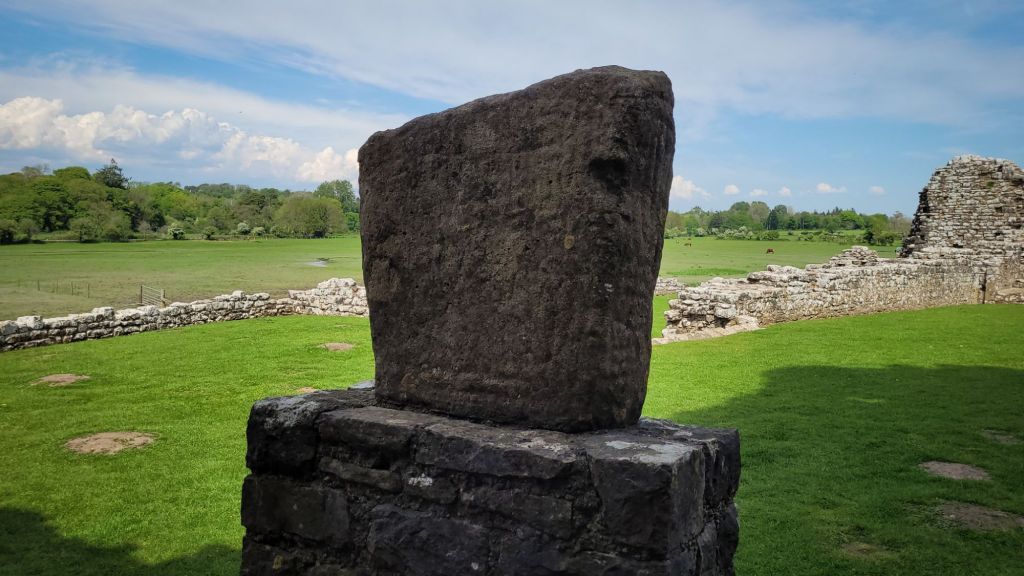
C. A. Ralegh Radford describes the stone in 1974:
“During the clearance of the castle in 1929 an early inscribed stone was found built into a limekiln of early nineteenth-century date, which had been inserted into the detached building on the east side of the inner ward. The original stone has been placed in the National Museum of Wales and a cast now stands near to the place where it was found.
The stone formed part of the shaft of a decorated cross of the eleventh century. There are Latin inscriptions on both faces of the shaft and narrow panels of interlaced ornament on the two edges. The original appearance must have been similar to that of the great cross at Merthyr Mawr, which stands across the river, barely half a mile away. The principle inscription on the Ogmore shaft has been read as follows:
(SCIENDUM) – Be it known to all
EST (OMNIBUS) – (men) that Arthmail
QUOD DED(IT) – has given this field
ARTHMAIL – to God and (Saint)
ARGUM D(E)O – Glywys and to Nertat
ET GLIGUIS – and to Ffili the Bishop
ET NERTAT
ET EP(iscop) I
The second inscription, on the back of the shaft, can be read only in part. It starts with the formula: In nomine d(e)i sum(m)i (in the name of the most high God). Following this we should expect the name of the donor and a record of the setting up of the cross. Only a few letters are legible and they do not conflict with this suggestion.
The cross was doubtless set up to mark the property to which the grant was referred. Sir Ifor Williams has compared the principle inscription with the text of the other early donations recorded in the Book of Llandaf. St Glywys is a local saint, who must have been the patron of an ecclesiastical establishment in the neighbourhood. Both St Glywys and Nertat are named on the great cross of Merthyr Mawr.” –https://www.peoplescollection.wales/sites/default/files/chs02965OgmoreCastlehistory1974_0.pdf
Graham Loveluck-Edwards covers the stone in more detail here – https://nation.cymru/feature/the-secrets-of-the-ogmore-stone/
Stepping Stones:
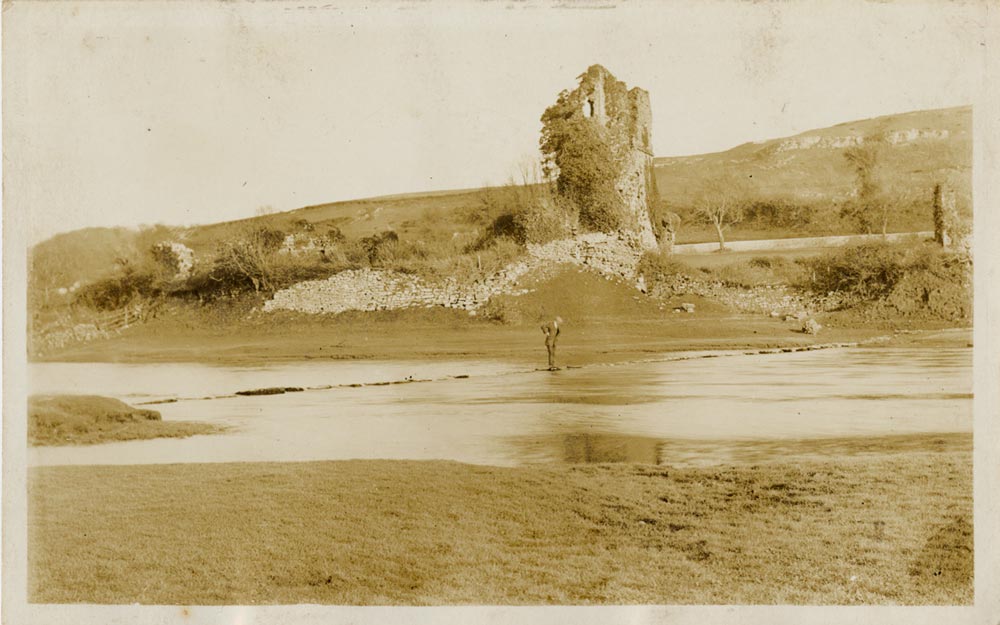
Near the castle are the iconic stepping stones which were likely put there shortly after construction of the castle.
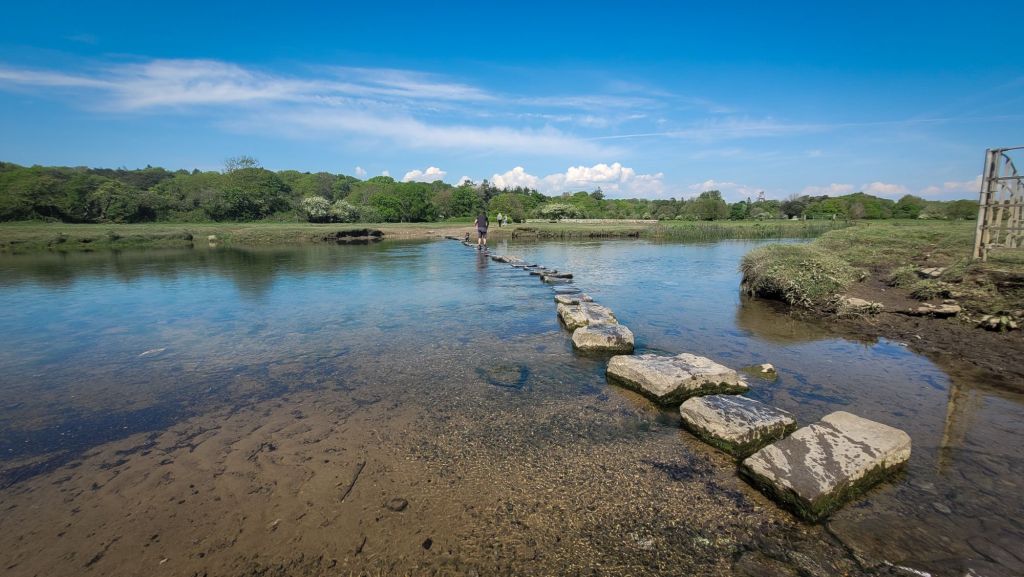
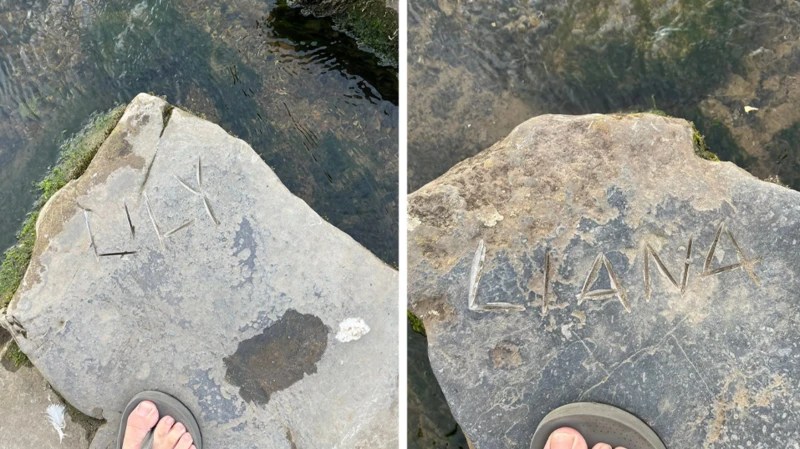
In 2025, the stones were sadly vandalized – the names Patrick, Lily and Liana being carved deeply into three of the stones.
 CoralJackz - That History Couple
Leave a comment