
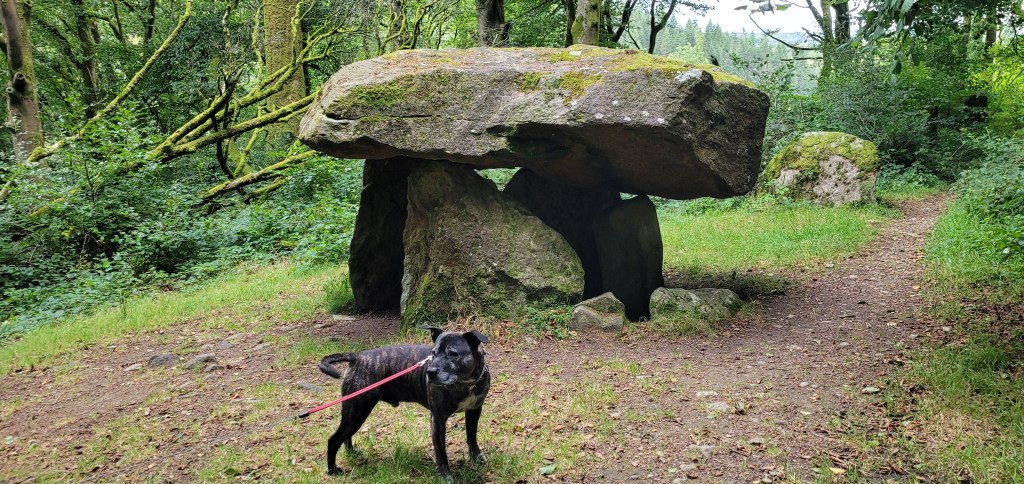

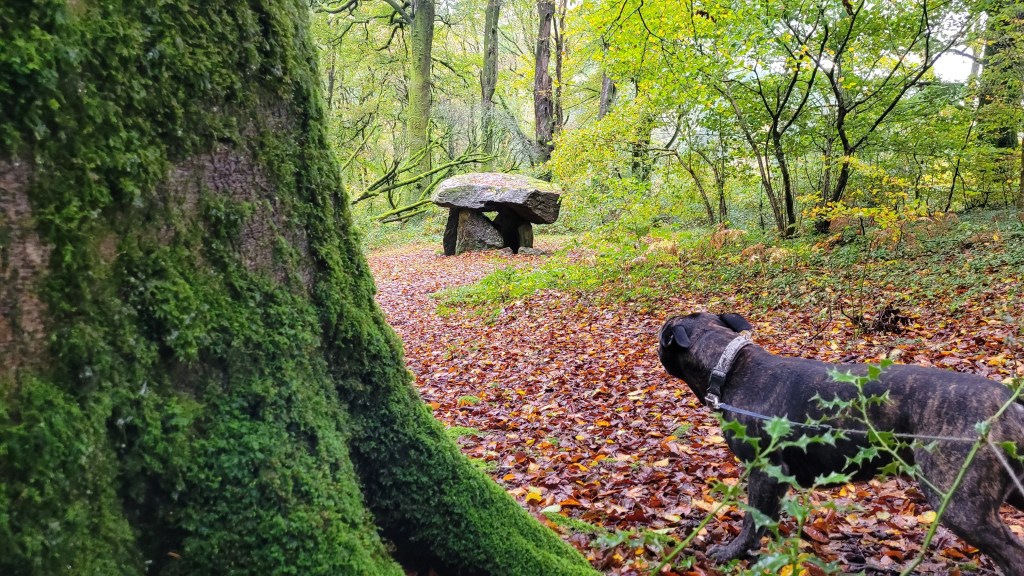
A stunning Neolithic cromlech/dolmen situated on a public footpath in a wooded valley. This is a wonderful site, and is steeped in legends..
Earliest records:
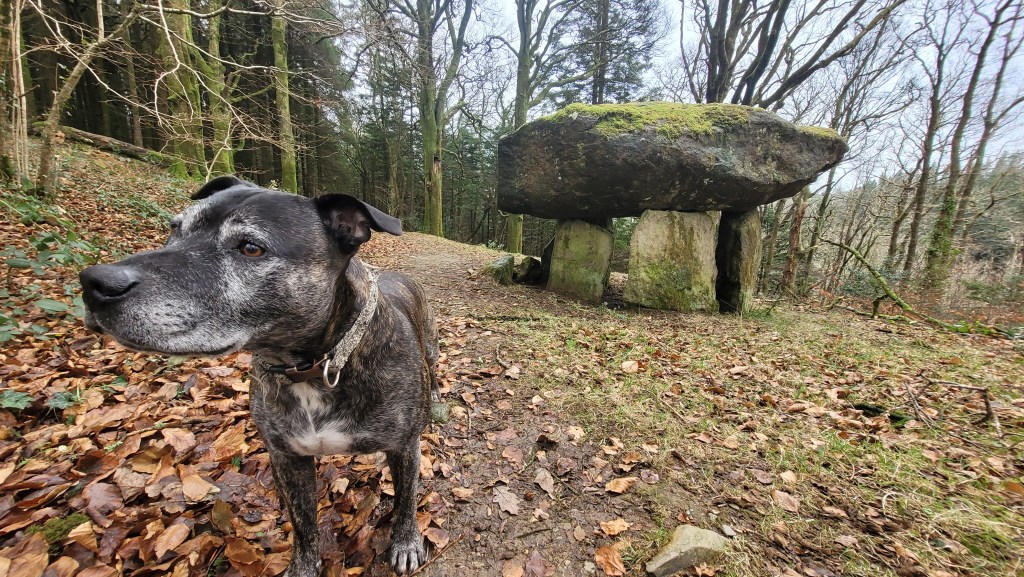
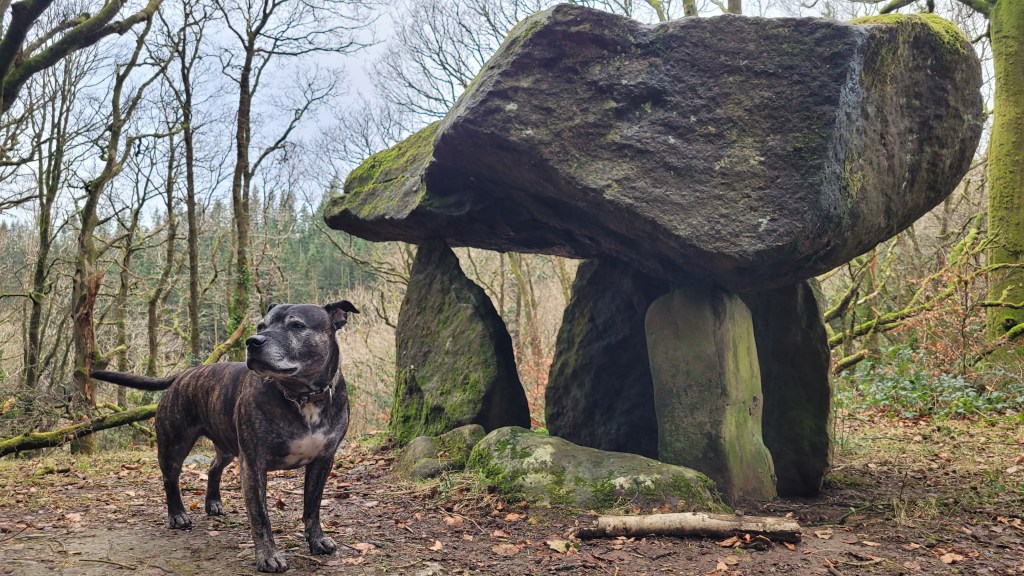
The earliest record we could find of Gwal y Filiast is from Edward LLuyd in 1695, who notes – ”Gwaly Viliast or Bwrdh Arthur in Llan Boudy parish, is…a rude stone about ten yards in circumference, and above three foot thick, supported by four pillars, which are about two foot and a half in length.”
Gardner Wilkinson in 1871 says:
“About two miles to the east of Meini Gwyr is Llanglydwen ; and a little to the south of it is the cromlech of Dolwilim, in a very picturesque spot, overlooking the wooded banks of the taff (or Avon Taff). The capstone is 11ft 6 long by 8ft 10, and 2ft 5 thick, sloping to the north-east ; and the four stones which supported it formed a chamber, 4 ft 6 broad, now open to the south-west, the highest of them being 4ft 4. The total height of the cromlech is about 6ft 9. In the river, immediately below, is a large slab, through which the water has bored a large hole ; but it possesses little interest, except from its position in the stream which rushes and breaks about it, overshadowed by alders and other trees.
In the Liber Landavensis a stone called Llech Meinich, ‘The Monk’s Stone’ is mentioned, where seven young men, brought p by Saint Teilo to lead a religious life, were supported daily by seven fishes deposited miraculously for them on that stone ; but it cannot be the one below the Dolwilim cromlech, as the place is said to have been called Llan Dyfrgwyr (holy enclosure, or ‘church, of the Men of the Water’) which is thought to be the modern Llandowror, to the south-west of Caermarthen. It is true that neither Llandowror, nor Craig Deilo, is on the Taf, but on a small tributary of it, called Llandwr ; though one of these has a better claim to the honour of being connected with the story than the slab below Dolwilim.” – From ‘Cromlechs and Other Remains in Pembrokeshire’
–https://babel.hathitrust.org/cgi/pt?id=coo.31924087796771&seq=289&q1=dolwilwm
The following is quoted from Barnwell in 1872:
“One of the most perfect and interesting dolmens in Wales stands in the grounds of Dolwilym, in the northern extremity of the parish of Llanboidy, in Carmarthenshire. The spot in which it is placed commands a singularly picturesque view of the vale and river of Taf, and is about midway down the steep slope on the right side of the river. Originally the chamber consisted of five or rather six stones, although only four now remain. The fifth, now missing, filled up the empty space at the south-west angle ; and in all probability there was a second small stone at the eastern end, as the one now there could not, from its shortness, have closed that entrance.
The western side is formed of one large stone on which the capstone rests ; whence it is certain that the entrance was not here, but at the opposite end, towards which also the capstone gradually inclines. The upright stone at the eastern extremity being 4ft 4 ins, – a difference that would not be expected from the almost horizontal position of the capstone. Sir Gardner Wilkinson gives the length and breadth, 11ft 6ins, and 8ft 5ins. Another measurement, taken diagonally, gave the two diagonals, 11 and 10ft.
There are several scattered stones lying about, all probably connected with the chamber and mound; of which last, however, hardly any traces remain.
There are in all thirty-two stones within the circle ; but the exact position, on account of the long and wet grass, was not ascertained with any accuracy of detail on the occasion of its being examined ; but at any rate there are the remains of the circle of isolated stones which constantly surrounded the base of the tumulus, at some little distance from it.
It has two names according to E. Davies, the author of the well known volumes on Celtic antiquities and Druids, one of which is Bwrdd Arthur (Arthur’s Table), and the other, Gwal y Vilast (the couch of the greyhound bitch). Of this animal there are many records scattered over Wales. Thus Ffynnon Milgi, in Llanelidan parish, in Denbighshire, is one instance. The inner sides of the upright stones are smooth and regular, while the lower face of the capstone, contrary to the more usual practice, is extremely rough and rugged. Near it is what is known as Crochan Arthur.”
–https://journals.library.wales/view/2919943/2999961/56#?xywh=-716%2C554%2C3624%2C1887
Legends:
The name Gwal y Filiast is thought to translate to something along the lines of “The lair of the female grey hound”. Several other prehistoric sites share this name.. We will cover the topic a lot more on this website, as the rabbit hole runs deep. For now, here are a few old references to the name, as well as a brief description of the story attached to it..
Rev T Rees in A Topographical and Historical Description of South Wales (1815) who called it Lech-y-Filiast and states “that it has been conjected that it derived from the circumstances of the early Christians envincing their contempt for these vestiges of pagan worship by converting them into kennels for their dogs…”
There is also another legend associated with this site.. Here is a quote from the book British Goblins by Wirt Sikes, 1880: “Under a cromlech at Dolwillim, on the banks of the Tawe, and in the stream itself when the water is high ; there is a circular hole of considerable depth, accurately bored in the stone by the action of the water. This hole is called Arthur’s Pot, and according to local belief was made by Merlin for the hero king Arthur to cook his dinner in.”
In ‘Folklore and Folkstories of Wales’ (1909) Marie Trevelyan argued that that these megalithic monuments were named in Ceridwen’s honour as a canine symbol. Others have speculated that Gwal-Y-Filiast itself is the site where Ceridwen transforms into the greyhound in her pursuit of Gwion.
The name is often linked to the old Welsh Goddess of transformation, rebirth and inspiration. An old Welsh tale found in the Mabinogion, set in the days of King Arthur tells of Ceridwen and Taleisin.. The following is quoted from the Lady Charlotte Guest translation of The Mabinogion, published in the 1840s:
“In times past there lived in Penllyn a man of gentle lineage, named Tegid Voel, and his dwelling was in the midst of the lake Tegid, and his wife was called Caridwen. And there was born to him of his wife a son named Morvran ab Tegid, and also a daughter named Creirwy, the fairest maiden in the world was she; and they had a brother, the most ill-favoured man in the world, Avagddu. Now Caridwen his mother thought that he was not likely to be admitted among men of noble birth, by reason of his ugliness, unless he had some exalted merits or knowledge. For it was in the beginning of Arthur’s time and of the Round Table.
So she resolved, according to the arts of the books of the Fferyllt, to boil a cauldron of Inspiration and Science for her son, that his reception might be honourable because of his knowledge of the mysteries of the future state of the world.
Then she began to boil the cauldron, which from the beginning of its boiling might not cease to boil for a year and a day, until three blessed drops were obtained of the grace of Inspiration.
And she put Gwion Bach the son of Gwreang of Llanfair in Caereinion, in Powys, to stir the cauldron, and a blind man named Morda to kindle the fire beneath it, and she charged them that they should not suffer it to cease boiling for the space of a year and a day. And she herself, according to the books of the astronomers, and in planetary hours, gathered every day of all charm-bearing herbs. And one day, towards the end of the year, as Caridwen was culling plants and making incantations, it chanced that three drops of the charmed liquor flew out of the cauldron and fell upon the finger of Gwion Bach. And by reason of their great heat he put his finger to his mouth, and the instant he put those marvel-working drops into his mouth, he foresaw everything that was to come, and perceived that his chief care must be to guard against the wiles of Caridwen, for vast was her skill. And in very great fear he fled towards his own land. And the cauldron burst in two, because all the liquor within it except the three charm-bearing drops was poisonous, so that the horses of Gwyddno Garanhir were poisoned by the water of the stream into which the liquor of the cauldron ran, and the confluence of that stream was called the Poison of the Horses of Gwyddno from that time forth.
Thereupon came in Caridwen and saw all the toil of the whole year lost. And she seized a billet of wood and struck the blind Morda on the head until one of his eyes fell out upon his cheek. And he said, “Wrongfully hast thou disfigured me, for I am innocent. Thy loss was not because of me.” “Thou speakest truth,” said Caridwen, “it was Gwion Bach who robbed me.”
And she went forth after him, running. And he saw her, and changed himself into a hare and fled. But she changed herself into a greyhound and turned him. And he ran towards a river, and became a fish. And she in the form of an otter-bitch chased him under the water, until he was fain to turn himself into a bird of the air. She, as a hawk, followed him and gave him no rest in the sky. And just as she was about to stoop upon him, and he was in fear of death, he espied a heap of winnowed wheat on the floor of a barn, and he dropped among the wheat, and turned himself into one of the grains. Then she transformed herself into a high-crested black hen, and went to the wheat and scratched it with her feet, and found him out and swallowed him. And, as the story says, she bore him nine months, and when she was delivered of him, she could not find it in her heart to kill him, by reason of his beauty. So she wrapped him in a leathern bag, and cast him into the sea to the mercy of God, on the twenty-ninth day of April..” https://www.gutenberg.org/files/5160/5160-h/5160-h.htm
Some say that these structures are ‘portals’ to the otherworld.. What do you think?…
Old Photographs & Illustrations:
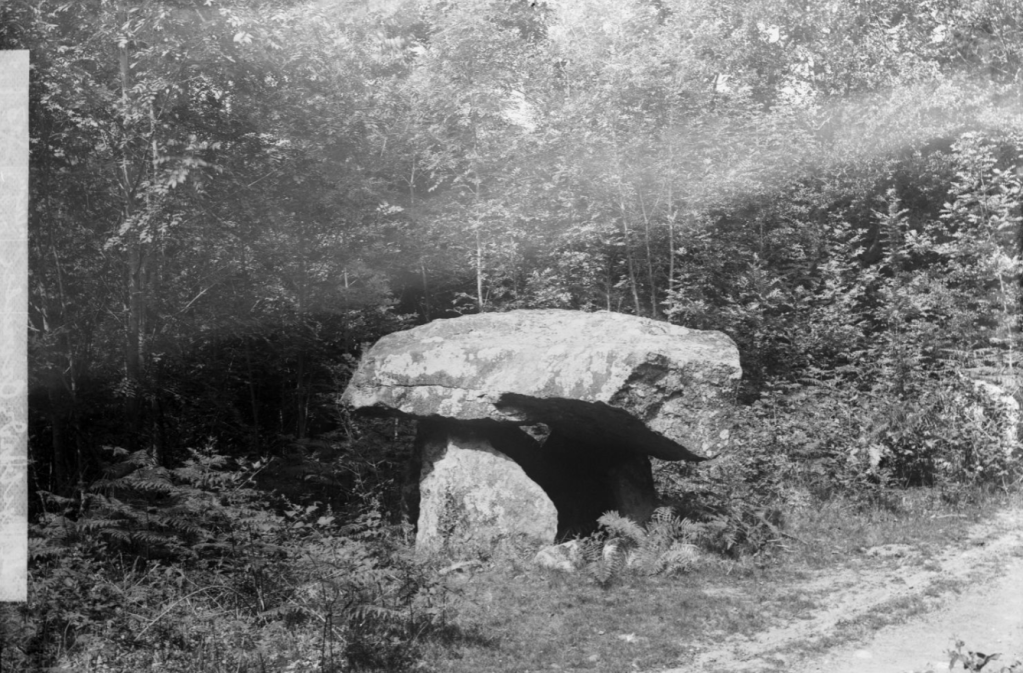
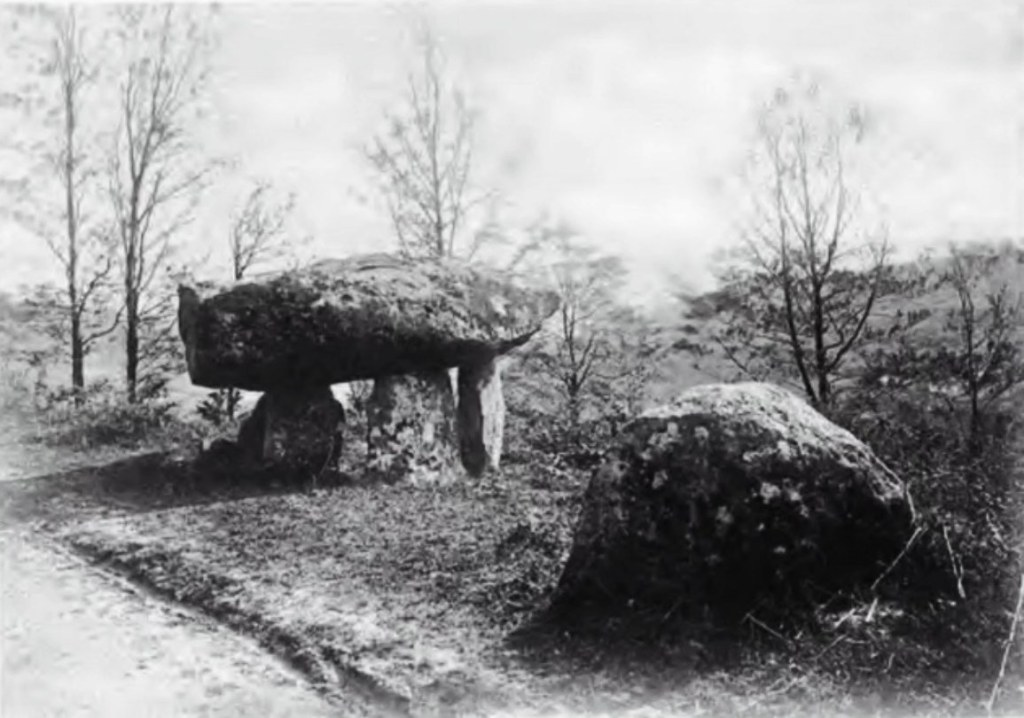
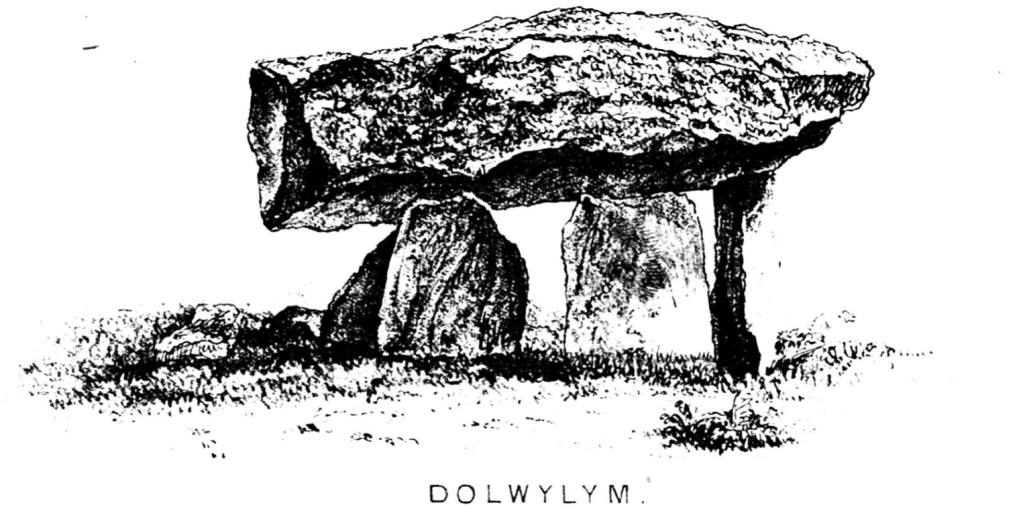
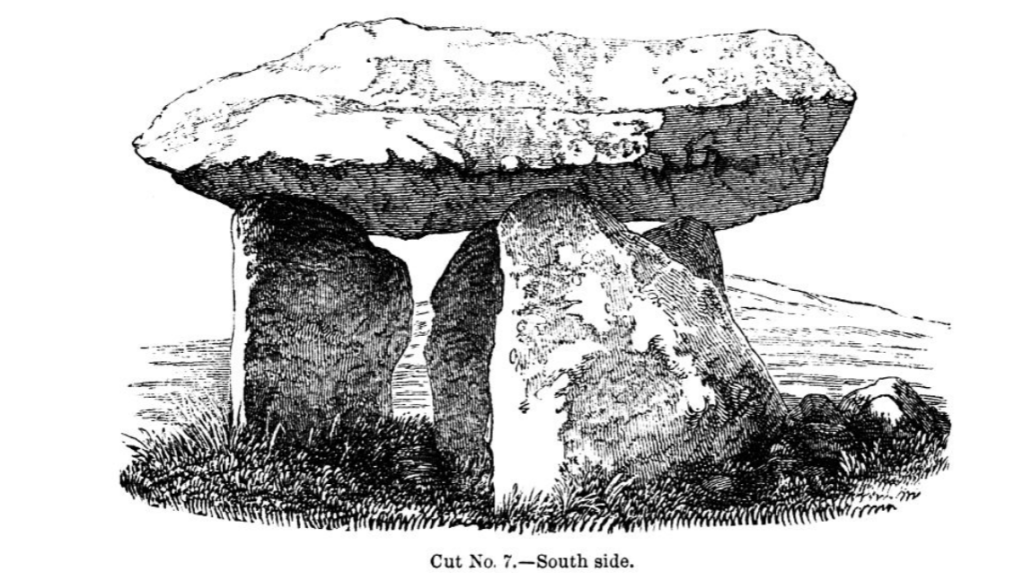
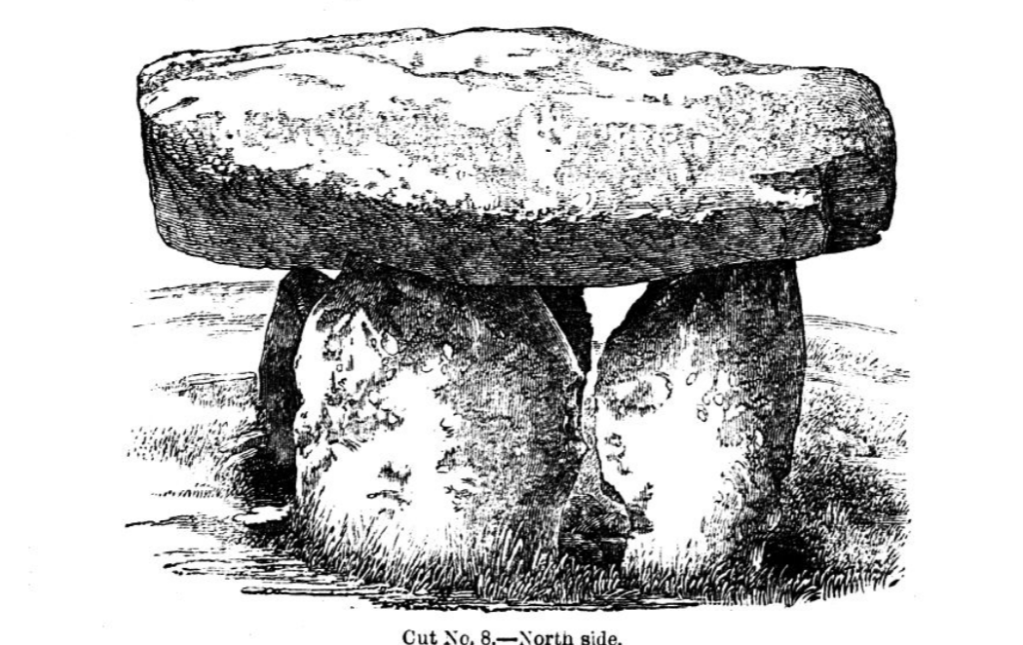
Image 1: Taken by John Thomas in 1885
Image 2: Taken by Mr. H Mortimer Allen of Tenby in 1906
Image 3: Illustration from Barnwell 1872 Arch. Camb.
Images 4 & 5: Barnwell 1872 ‘Notes on some south Wales cromlechs’ with the description:
“Cut no 7 represents the south or nearly south side of the Dolwilym chamber. The gap at the south-west corner was originally filled up by a slab, as already observed. Cut no 8 gives the north side, which consisted of a single slab joining the western one at right angles. The stone at the east end does not appear in the cut to be so much lower than the large western slab. A third and different view will also be found in one of the plates.”
Accessing the site:
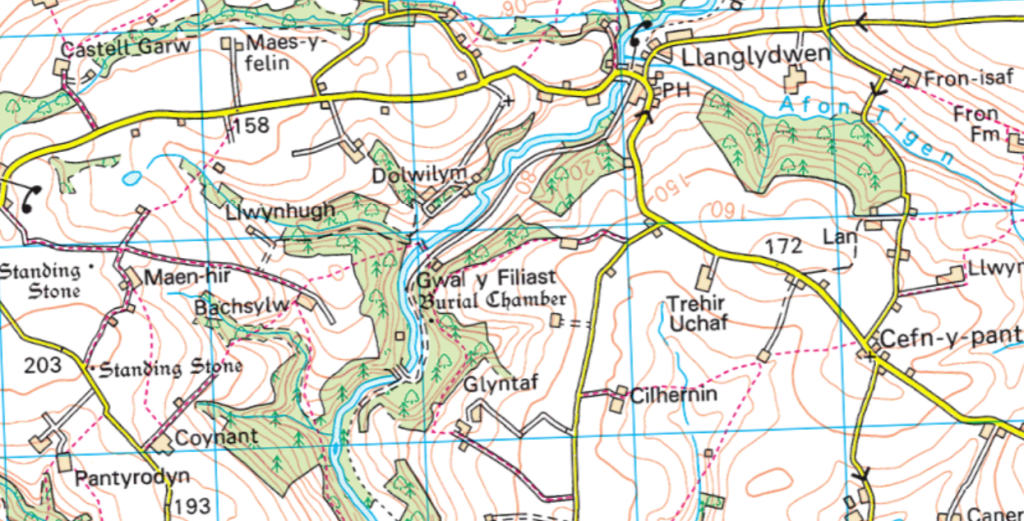
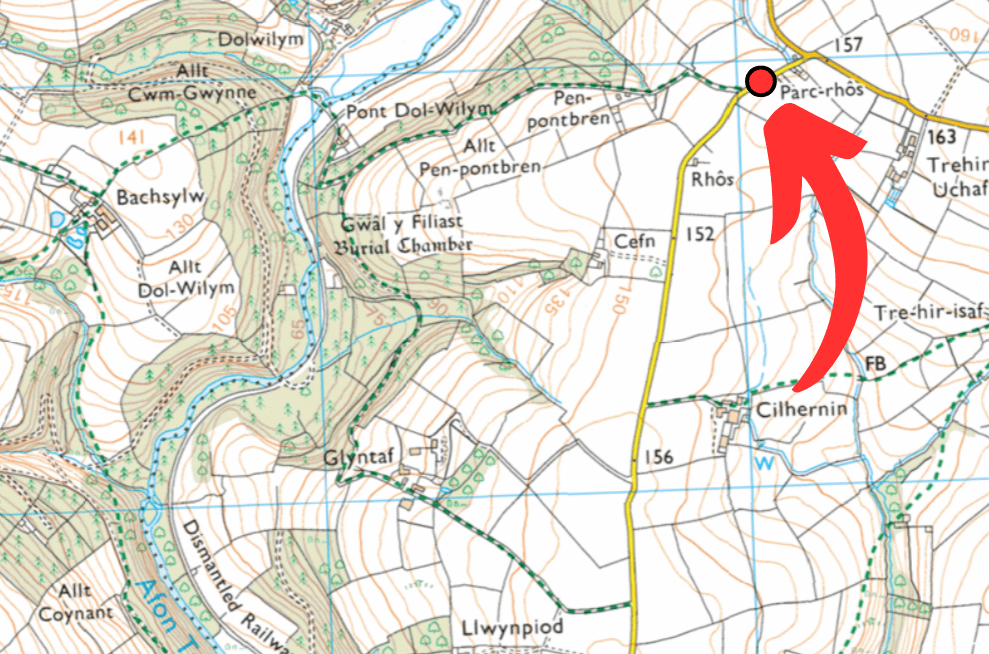
The commonly used route to Gwal y Filiast is accessed by parking in the layby we’ve pointed out on the map. Then simply follow the footpath through the woodlands to the cromlech. As you almost reach the cromlech, the path splits.. Stick to the left path to reach Gwal y Filiast..
This site is gaining a lot more popularity in recent years, so please remember to leave no trace. We visit here often and have seen evidence of fires nearby, drawings carved into the stones and people scraping moss from the top..
Maps from https://www.bing.com/maps/?cp=51.901247%7E-4.660002&lvl=14.7&style=s
 CoralJackz - That History Couple
Leave a comment