


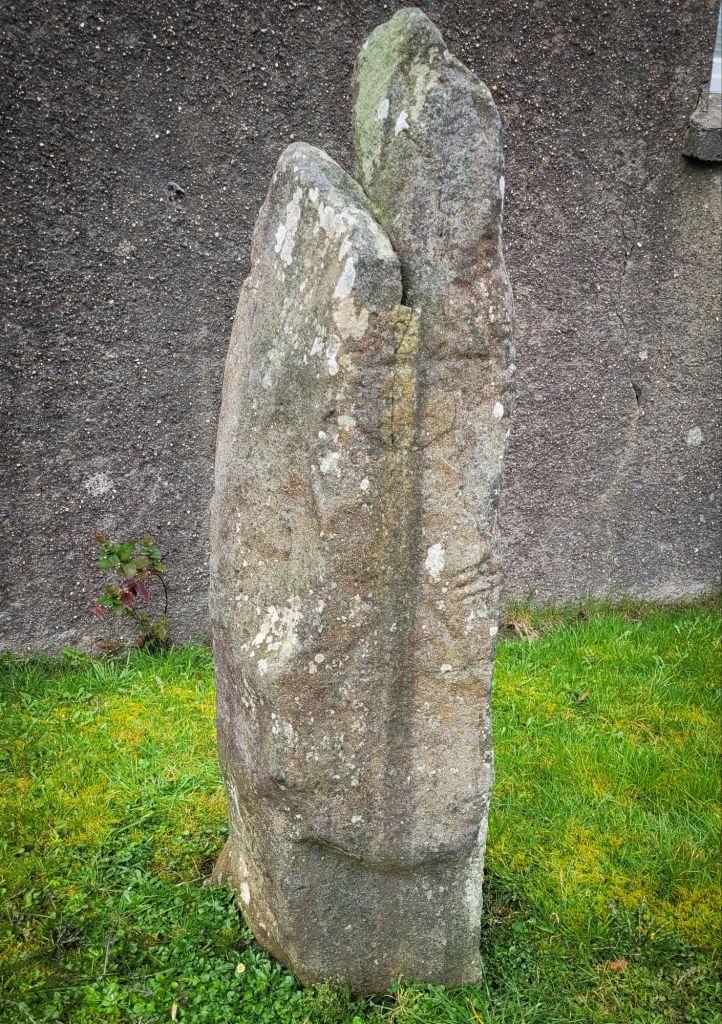
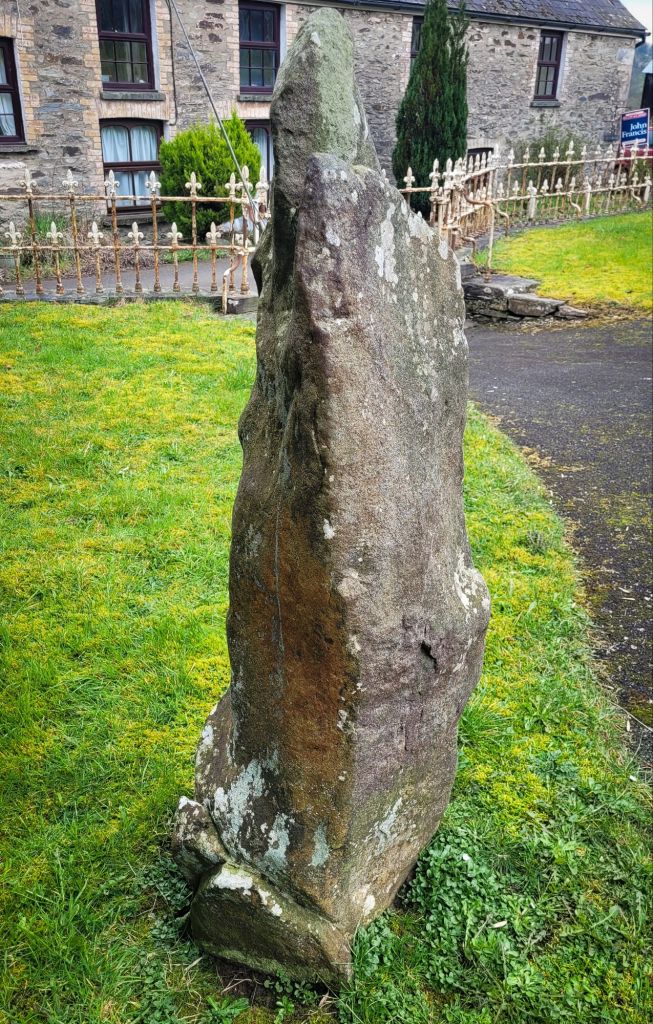
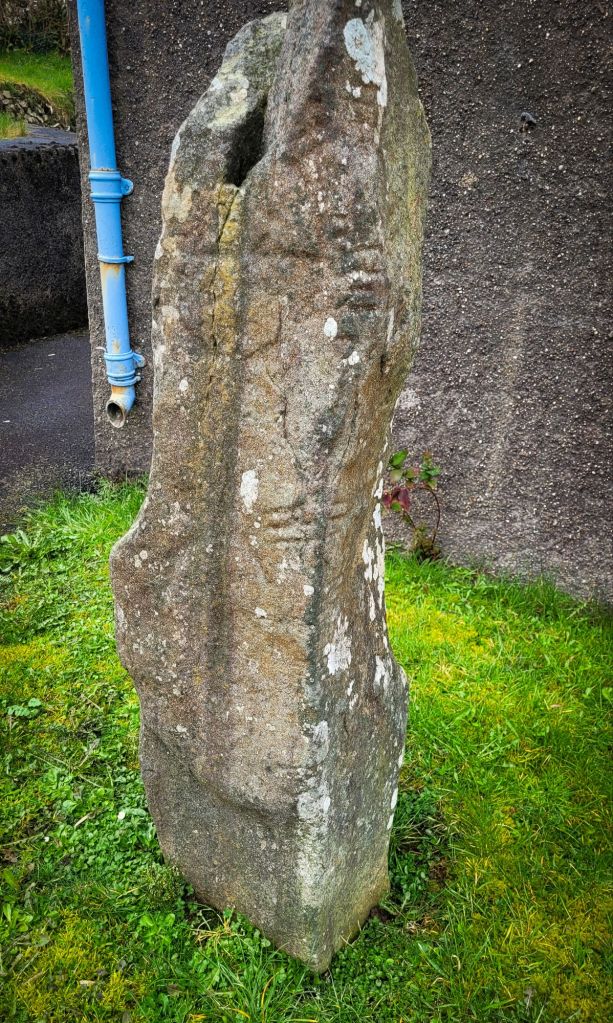
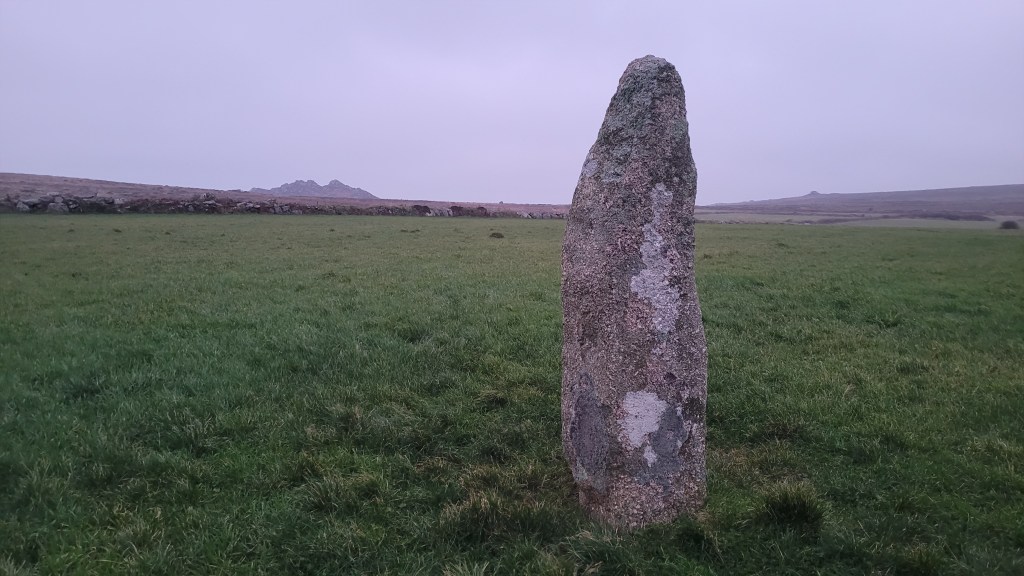
Efessangus stone Ogham inscribed stone.
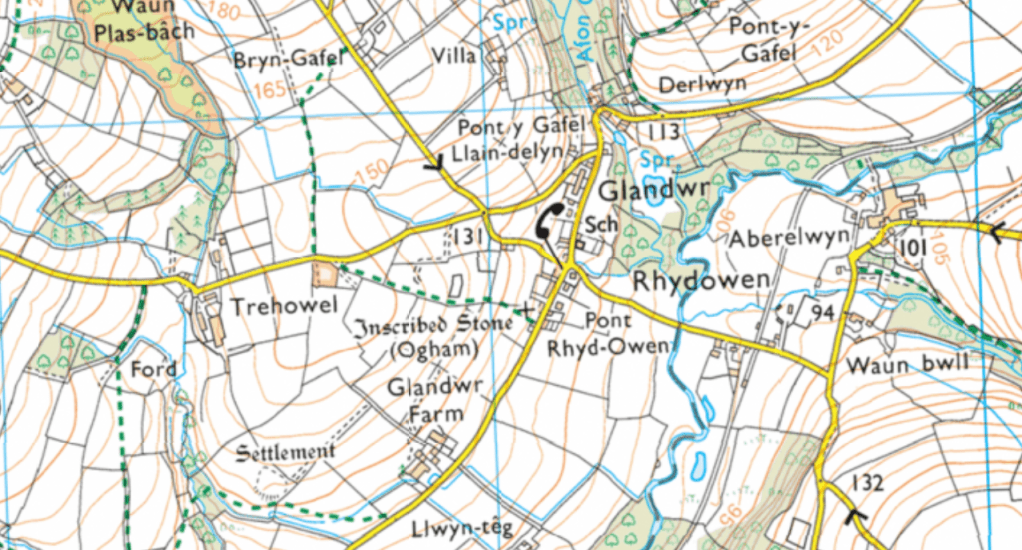
Glandwr – Pembrokeshire, Wales
The stone was visited by John Rhys, who reports in 1913 in the Archaeologia Cambrensis: `On the next day Dr. Owen motored me to Trehowel Farm, near Rhydowen Station, on the Whitland and Cardigan line of railway, to see an Ogam inscribed stone. We had with us Mr. James, the Pembrokeshire Director of Education : he acted as our guide, for his home is near Rhydowen ; and it was he who gave us the news of the discovery of the stone : that was so long ago as October, 1908. The discovery was due to Mr. Arthur O. Griffiths, of Glandwr, and Mr. Llewelyn James, brother to our Director of Education for the day. The discovery consisted in their noticing that a gate-post, near the farmhouse of Trehowel, bore traces of ancient markings and of the outlines of a cross. The stone had been there some thirty or thirty-five years unnoticed, but not undamaged by the wheels of the carts that from time to time passed in and passed out of the field. The history of the stone, so far as Mr. James could get it, was that it had been brought down there from a neighbouring farm called Yet Wen, from a spot on an exposed hill known as Mynydd Stambar. Near the stone were found, he was told, pieces of crochanau, which would seem to point to fragments of sepulchral urns, also traces of fire. He writes of the spot as a lloc defaid: after visiting it, I should describe it as a meeting of two fences at right angles where sheep can be cornered and caught. Mr. James was good enough to send me photographs which he had taken of the stone. At my request Mr. Eyre Evans visited Trehowel at the end of March, 1910, and took a rubbing and a copy of the inscription and cross. He also asked the tenant, Thomas Lewis, questions as to the removal of the stone to its present position. The reply was that he remembered the stone thirty-nine years before, and knew exactly the site on Mynydd Stambar. He added that he brought down two stones : one of them was standing and the other lying down close to it. This is likely to be correct, but when I cross-examined him on my visit there in October, 1910, he admitted that it was not he that brought the gatepost down. This was in answer to my question whether it was brought down in a cart or on a sledge, or else dragged by horses along. the ground, for I thought this latter method of removing the stone might account for some of the injuries to it. As to a second stone, he could tell me nothing ; he seemed to have forgotten all about it, and I am inclined to think that was not brought away at all, at any rate, not about the same time. At present there is no such stone visible on the site on Mynydd Stambar ; at all events, no stone of anything like the same dimensions as the inscribed gatepost… Mr. Eyre Evans had the hedge cleared away round the stone in quest of more writing, but he found none, either Goidelic or Latin.’
Rhys visited the site twice, here is his other report:
`On the day when I visited the stone with Dr. Owen it was raining so hard that it was very difficult to do it justice, but on my second visit I had a very fair day. Under even the most favourable circumstances the reading is extremely puzzling…This is what I have made of it:
Efess[a^o][Gw]iAsegni
The first lacuna would take four or five notches ; I give the preference to the former, that is the vowel e. As to the next, I am puzzled whether to assign it one or two ; that is a or o. After the wider gap the scoring seems to yield aseg, followed by three scores on the B side which are complete, and followed by two more imperfect ones : I guess the group to have consisted of five scores, making the consonant n. Now gn suggests at once the very common ending -agn-, in the genitive -agni, in Ogam epitaphs ; but besides -agni there also occur -egni and -igni. Looking at the stone itself I could hardly decide between four notches or five, but I find that one of Mr. James’s photographs enables me to decide for four, the vowel e. There are two more vowel groups of notches to be guessed, and supposing the whole to end with a word in -egn-, I have suggested an i to make a genitive -egni, at the end. The width of the gap before asegn seems also to demand at least five notches, which would indicate that the first part of the inscription ended also with a genitive in i. Whether this would quite fill that gap I am by no means sure ; but I should hardly go beyond two more scores, whether short or long. This would leave us to choose between Asegni, Osegni, Basegni, Masegni, Dasegni, Lasegni, Gasegni : it is useless to guess any further.
`Besides the doubts which enter at the vowel gaps the first vowel and the first consonant make room for another to come in making | ||||////, ef, into |||||///, ing, or let us write i[Gw] with the character used by German glottologists for ng : in Ogam the [Gw] has the symbol of three slanting scores ///. It happens that the first score of the ///// is not very clearly produced towards the left or the H side ; but it is on the B side. One might perhaps regard that as no part of the writing : then there would be nothing left but a notch as part of the initial vowel. However, the notch, if such, will be found also in the case of the second score of the four, ////. In this case the first name would be I[Gw]issa[Gw]i. As regards the first consonant, Mr. James wrote to me before I had seen the stone , as follows :-“The photograph marked 1 shows clearly that there are not more than four long strokes above the lowest group of notches. No. 2 seems to suggest only three, but I noticed that there is a faint long stroke below the three next to the notches on the right side of the edge only. It does not show clearly on the left side of the edge.” That is so, and Mr. Eyre Evans, without knowing anything about the photographs, on March 31, 1910, read the slanting scores as four, and not three, without any hesitation. Dr. Owen and I tried to decide the point, but it was raining so hard that we made no satisfactory progress towards that result, and I felt that it would be necessary to examine the Ogam again, if possible not in thunder, in lightning, or in rain. In October 1910 I got a fairly fine day with no rain, and I examined the four slanting scores as carefully as I could : I came to the conclusion that the first was produced beyond the edge on the left or H side, but it was faint as if the surface of the stone had by some accident been abraded there. So I give up considering the first part of the inscription as i[Gw] : this I do as a matter of reading. If, however, anybody wished to treat the name as I[Gw]essa[Gw]i, I may point out one grave difficulty attaching to it–namely, that all our Ogam inscriptions show only five or six instances of the guttural nasal [Gw] in all, while this reading would supply two more in one and the same word. So any calculation of the chances would, I should think, prove heavily against I[Gw]essa[Gw]i being the right reading.’
Macalister, in 1945 reports: `It has now been removed once more, to the enclosure surrounding the Baptist Chapel of the hamlet of Glandwr, where it stands close to the gateway’. – https://www.ucl.ac.uk/archaeology/cisp/database/stone/lfrn2_1.html
Access to the stone:
Very easy to access, in the churchyard in Glandwr
 CoralJackz - That History Couple
Leave a comment