
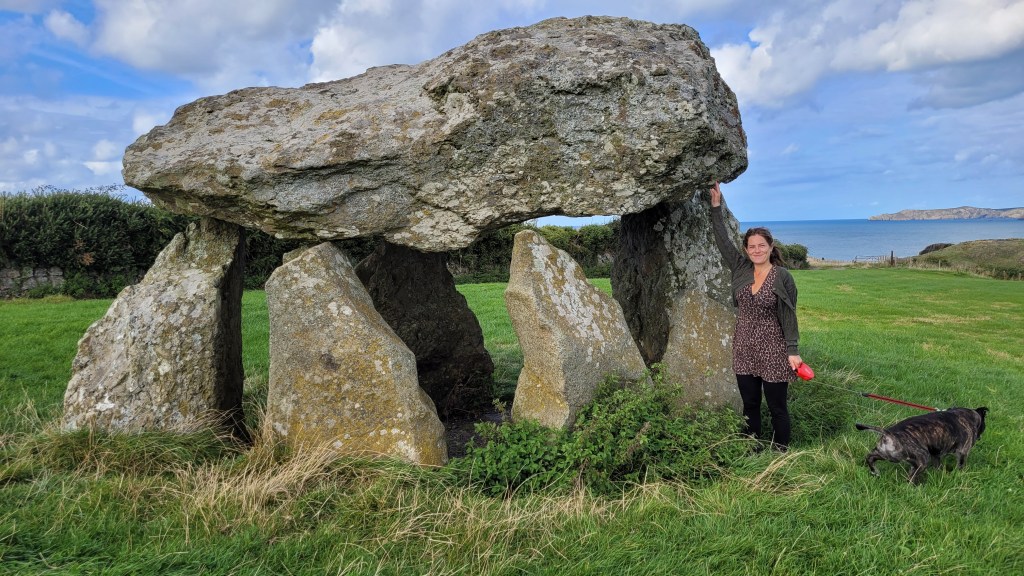

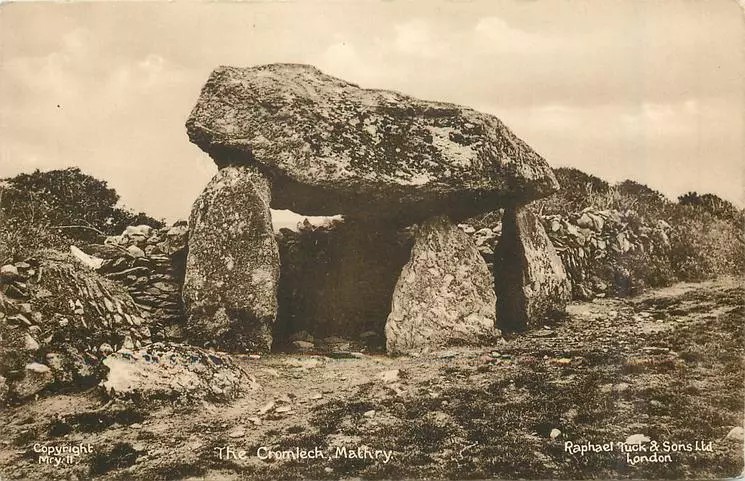
This beautiful Cromlech sits in a field overlooking Abercastle Harbour and the Irish Sea. It’s fat, rounded capstone is perched on only three out of the six large upright stones. The structure is estimated to be around 5000 years old, dating back to the Neolithic Period.
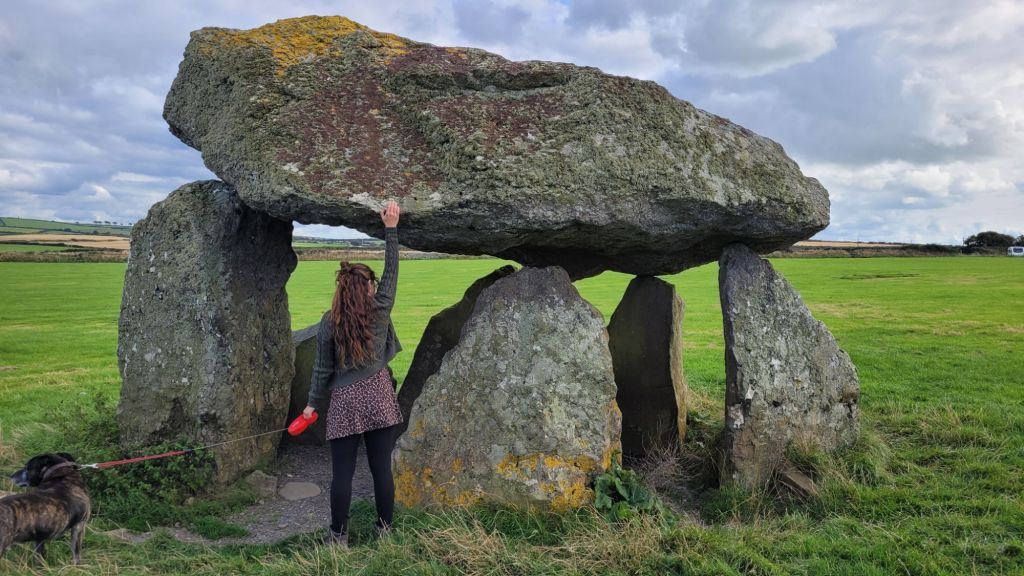
Early records of Carreg Samson & old images:
The following is quoted from A Historical Tour Through Pembrokeshire, written by Richard Fenton in 1810:
“From Abercastle ascend to Long House, and in my approach to it on the left hand observe a most perfect Cromlech. The incumbent stone is from sixteen to eighteen feet long, very thick to the north, but rather thinner as it inclines towards the south and the west. It is of a curious texture, having flint and spar bedded all through it, as have the columnar stones it is supported by, which are six in number, four only in contact with the altar stone, and those the four end ones ; the tallest, upright, and much the thickest, is five feet six inches high.” – https://archive.org/details/b22013179/mode/2up?ref=ol&view=theater
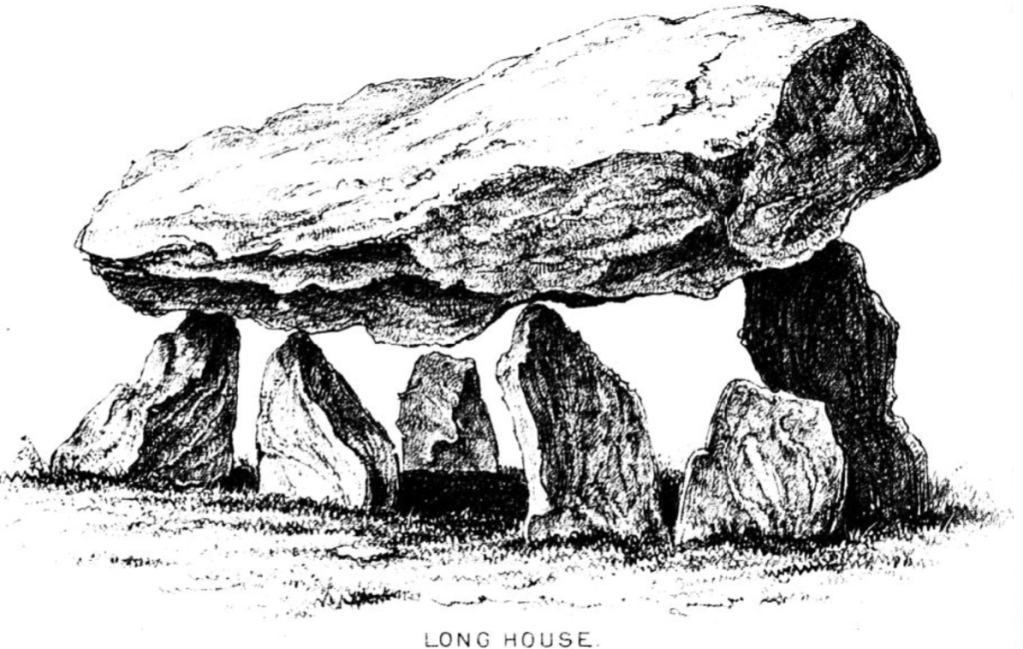
Edward Lowry Barnwell records the site in Archaeologia Cambrensis in 1872 and provides us with an illustration:
“The Longhouse cromlech is the finest of those in this part of the country, and, perhaps, one of the finest in all Wales. It is somewhat masked by the hedge and bank against which it stands, and which have not been introduced in the drawing. In Fenton’s time the capstone rested on four of the uprights ; at present it rests on three. The six uprights, however, mentioned by him still remain. He also states the length of the capstone to be from 16 to 18ft ; but its maximum length, according to Sir Gardner Wilkinson, is 15ft. It stands in an elevated position, within sight of the sea. All traces of its former covering have dissapeared as the land on which it stands has been for a long time cultivated.” – https://journals.library.wales/view/2919943/2999961/63#?xywh=-70%2C247%2C2481%2C2618&cv=63
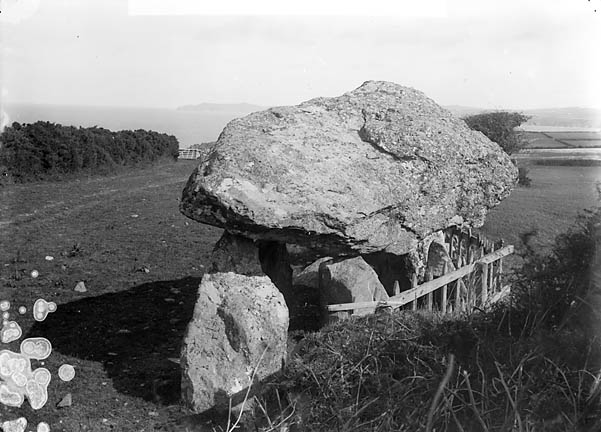
Using the Welsh newspapers archive, we found an interesting letter in The Cambrian newspaper, 19th September 1890, written by Mr E. Owen Phillips of St David’s:
“….I have just returned from visiting the celebrated Longhouse cromlech, which, I am glad to say, remains in its integrity, untouched by the rude hand of the destroyer, and I am thankful to believe likely to remain so.
Mr. Griffiths, the owner of the farm on which the Cromlech stands, accompanied me to the spot, and I have his authority for stating that he takes the greatest interest in this magnificent monument of prehistoric archaeology and in its preservation. His father-in-law, a former tenant of the farm, spent much time and labour, in clearing away obstructing rubbish, in order to bring the cromlech into bolder relief and afford a better view of it all round – a great improvement, as it certainly presents a more grand and striking appearance at present than it did when I saw it some years since.
On my asking Mr. Griffiths for an explanation of the statement which appeared in a letter to The Times of September 6, that a labourer who was engaged in grubbing up stones near the monument to fill in a gap in a fence, said that he, the owner, “threatened to overthrow and demolish the monument altogether in order to construct a new bank across an adjacent field!” Mr Griffiths replied that “there was not a word of truth in it, nor any foundation for the statement, and that very probably the man was hoaxing the stranger.”
Mr. Griffiths complains and feels aggrieved that, assuming the statement to have been made, Mr. Greville Chester did not call on him to ascertain the truth or otherwise of it; the more so as Mr. Chester must have passed within a few yards of his house on returning from the cromlech. The disturbance caused by the stones, which are now to be seen filling up a gap in a fence, does not in the slightest degree interfere with the stability of the cromlech, which the public will be interested to know the present landlord is as anxious to preserve as carefully as it has been in the past.
At the same time, I agree with Mr. Greville Chester that it was an oversight, at least, on the part of the Ecclesiastical Commissioners “not to insert a proviso in the deed of sale for the preservation of so important a monument of prehistoric archaeology;” since the farm might have found a purchaser in one whose conservative interest in this grand old monument was less than that of the present owner.”

Excavations:
This monument was excavated in August 1968 by Frances Lynch. To read the full excavation report here is the link (page 15) – https://journals.library.wales/view/4718179/4746946/20#?xywh=-171%2C1245%2C3119%2C1624
We also explore the finds from the excavation in our YouTube video covering Carreg Samson –
The following is from Christopher Thomas Barker 1989 ‘A Reassessment of the neolithic chambered tombs of south-west Wales’:
“The tomb was erected in an irregularly-cut and partially back-filled pit. The oval chamber (3.4m by 1.7m) was originally walled by seven orthostats – six survive. The entrance, at the NW, may have been approached by a passage; three possible stone-holes were found, suggesting a passage of about 2m in length. The extent and nature of any covering cairn remains uncertain.
The chamber floor (laid yellow clay) had been disturbed by the digging of three deep holes. However, fragments of burnt bone were recovered from the undisturbed floor at the E end of the chamber, while the NW quadrant yielded a quantity of sherds from a single pot. This hemispherical bowl, with a simple slightly-everted rim, “may be regarded as Early Neolithic, but it is not directly comparable with the material from Clegyr Boia or Dyffryn Ardudwy” (Lynch 1976,75). – https://theses.gla.ac.uk/78041/1/11007320.pdf
Coflein description of the excavation: “This revealed four additional stone-holes, one having supported a further chamber stone, the others indicating a possible passage leading off to the northwest. Slight traces of a covering cairn were found to the south and it was shown that the monument had been raised over a pit 0.8 meters deep, filled with clay and stones. Find included a small quantity of burnt bone, pottery and flints.”
Legends:
We haven’t found out exactly when this monument went from being called ‘Longhouse Cromlech’ to it’s more well known name today “Carreg Samson”.. It translates in Welsh to Samsons Stone. Supposedly from an old legend that the Celtic Christian saint placed the capstone upon its standing stones using just his little finger. In the process his finger was severed and buried nearby. But of course this saint was said to have lived in the 5th century.. thousands of years after the construction of this monument.
Accessing the site:
We like to park at the carpark in Abercastle and follow the Pembrokeshire Coastal Path for about a mile up to Carreg Samson. At busy times of year this carpark gets very busy and spaces are limited, but the walk from here is stunning. Alternatively, visitors to Carreg Samson tend to park on the grass verge along the main road near the entrance to Longhouse farm. Remember to never restrict access to fields or driveways. This is also currently a working farm so there may well be tractors about when you visit.
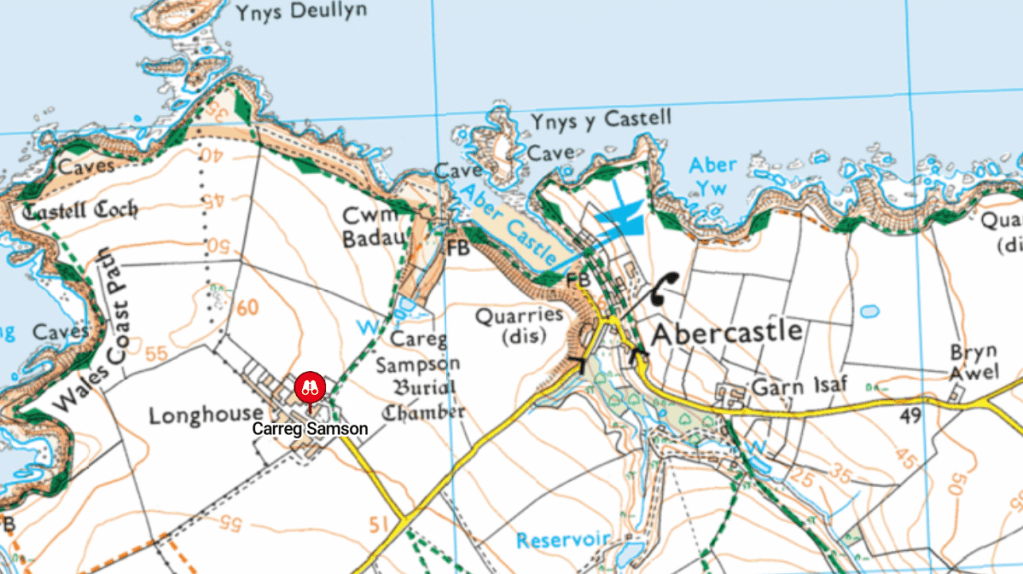
https://www.bing.com/maps/?cp=51.958082%7E-5.126124&lvl=15.9&style=s
 CoralJackz - That History Couple
Leave a comment