
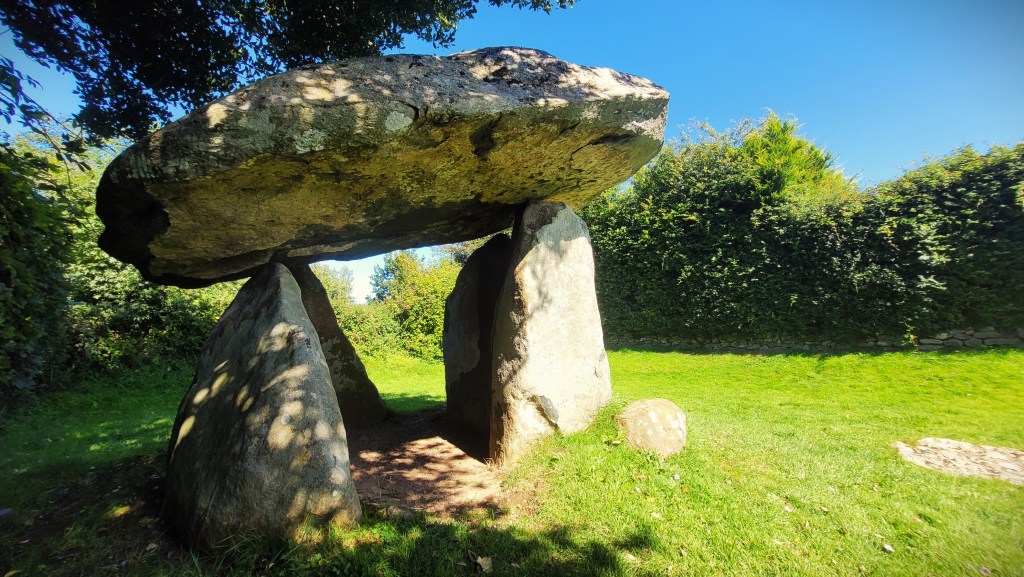

This neolithic structure is situated next to some bungalows on the outskirts of Newport town. It’s composed of four upright stones topped by a very large capstone. Despite it’s appearance, a close up look shows that only two of the upright stones actually support the capstone.
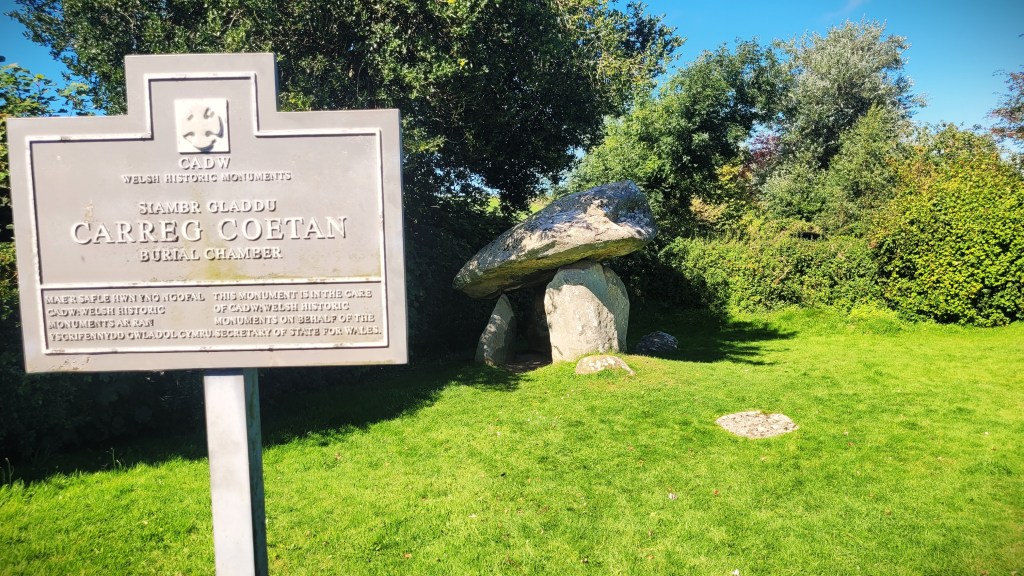
The ‘coetan’ part of its name is supposedly a reference to the game of quoits, often associated with monuments of this type. According to legend, King Arthur himself played the game with the stones of this monument..
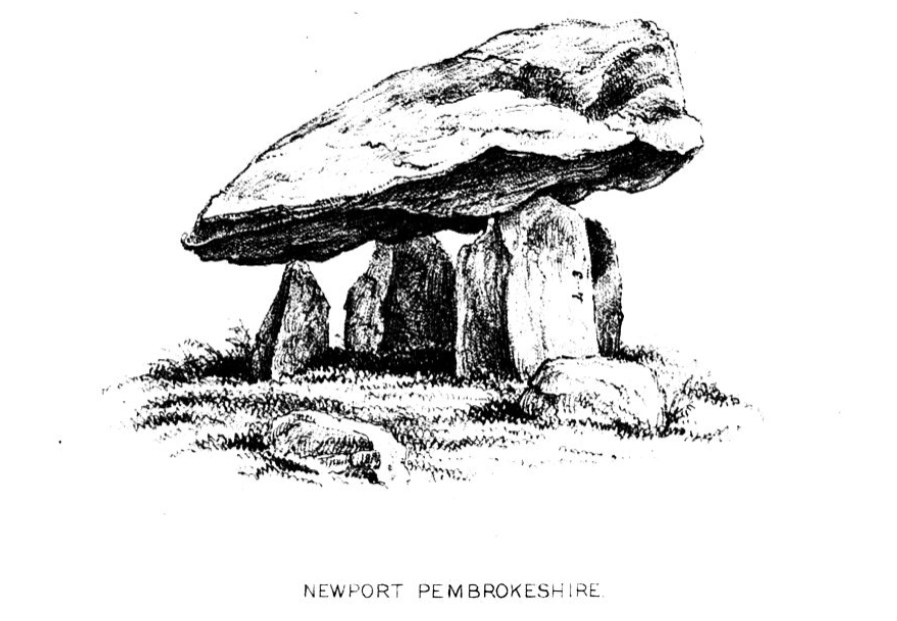
“In a small field, between Newport and its harbour, is another monument, still larger,and quite perfect, of the same kind [as Cerrig y Gof] ; the upper stone is shaped like a mushroom, and is upwards of nine feet in diameter..
..The landlord of the hovel were we baited, at Newport, on conducting us to these stones, asked our opinion concerning them: and, on our telling him, we conjectured them to be the sepulchral monument of some great man among the ancient Britons, he answered, with much satisfaction, that he entirely agreed with us, and doubted not, but upon digging, the skeleton of a huge giant would be discovered.” (Wyndham 1775,93)
The following information is provided from ‘A reassessment of the Neolithic Chambered Tombs of South-West Wales (Carmarthenshire and Pembrokeshire)’ by Christopher Thompson Barker:
“The surviving stones are part of a small,single-chambered Portal Dolmen with all the typical features. The H-shaped front, two tall portal stones with a high closing slab between them, clearly existed at this site, though unfortunately the eastern portal stone has been removed. The extra height of the portal area, slight but noticeable, is enhanced by the shape of the capstone. ..The chamber behind the portal is small and rectangular. The western side stone is missing…There is a very slight rise in the ground some 2m in front of the portal which may cover blocking material, and there are some large boulders in the general vicinity” (Lynch 1972,69-70). This classification of the burial chamber as a Portal Tomb is not accepted by Grimes, who sees it as a simple polygonal chamber (1936b,132;1960,11).” –https://theses.gla.ac.uk/78041/1/11007320.pdf

The following is from ‘A guide to ancient and historic Wales’ by Sian E Rees, who led excavations here, published in 1992:
“Cadw Guidebook. This small but well-preserved chambered tomb lies on the estuary of the River Nyfer on low-lying flat land near the sheltered Newport Bay. It is one of a number of tombs which lie clustered along the fertile slopes of the Nevern Valley. In common with most of these, it defies attempts to categorise it firmly within the classes of chambered tombs in Wales, though the appearance of a blocked entrance on the higher, south-eastern side of the chamber suggests at least an influence by the portal dolmen tradition. The large megaliths of which the tomb is composed are almost certainly local erratics, carefully selected for shape and size, but not apparently fashioned or tooled. The massive wedge-shaped capstone is supported by only two of the four sidestones which stand about 1.5m high at the front.
Excavations in 1979 and 1980 revealed that the chamber had been surrounded, and presumably partially covered, by a circular cairn composed of redeposited sandy glacial drift subsoil and revetted by a ring or kerb of boulders about 11m in diameter. Only one small segment of the cairn survived, and on the old ground surface below it lay round-bottomed Neolithic pots with out-turned, heavily incised rims, made of a coarse fabric tempered with large pieces of quartz. The pots probably served as cremation urns, as, within and around the broken sherds, were quantities of charcoal and pieces of the cremated bone of adult humans. They lay on a surface which had been carefully laid with small slabs of stone. Also outside the chamber, but unassociated with the cremated bone, was found a considerable amount of Neolithic pottery of a burnished brown corky fabric. A fragment of polished axe, flint knives and scrapers were also found.
The tomb was dated by a series of four radiocarbon dates to about 3500BC (corrected date). The tomb was probably open for a number of years to serve the Neolithic farming community who settled in the area in the 4th millennium. Access to the tomb was presumably through the apparently original spaces between the sidestones, though these may have been blocked by drystone walling between successive interments of the cremated remains of the dead.
The coetan part of the name of the tomb refers to the old game of quoits, and is often associated with burial chambers in England and Wales. In this particular case, King Arthur, who also frequently appears in the place-names of historic sites, is supposed to have played the game using the ‘carreg’ (stone) of the tomb.” – https://archive.org/details/guidetoancienthi0000rees/page/16/mode/1up?q=coetan

To read the full excavation report, here is the link to the download: https://archaeologydataservice.ac.uk/library/browse/details.xhtml?recordId=3214007
https://archaeologydataservice.ac.uk/archiveDS/archiveDownload?t=arch-3493-1/dissemination/161-2012/03_Arch_Camb_161_051-164_Sian_Rees.pdf
 CoralJackz - That History Couple
Leave a comment