
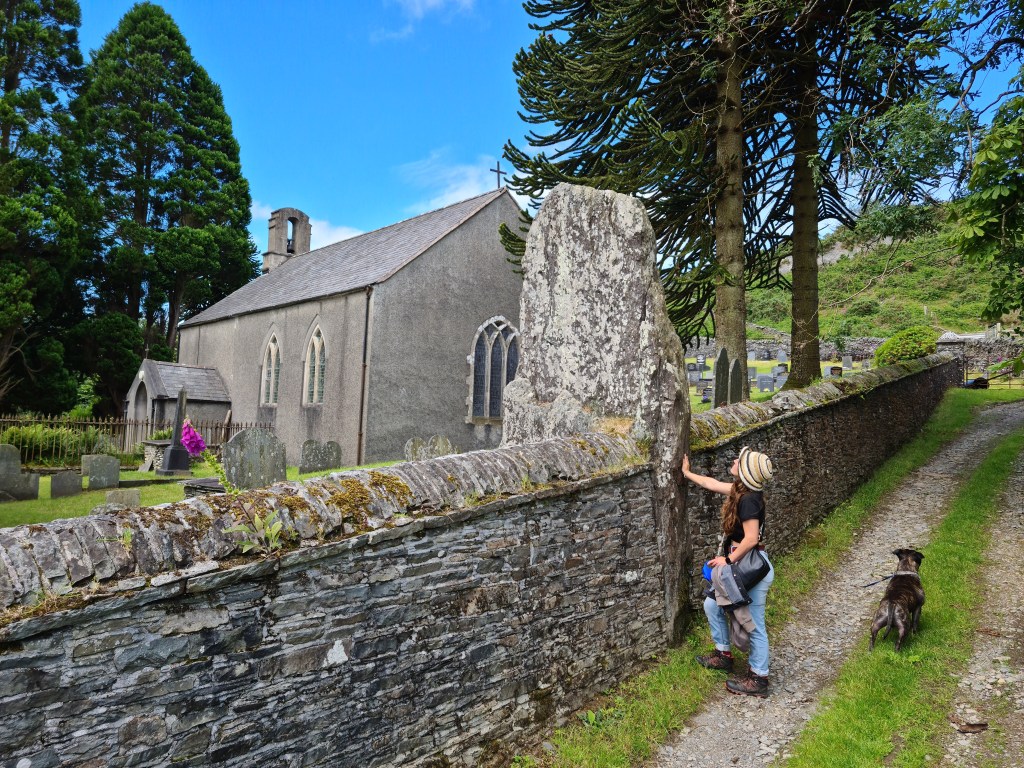

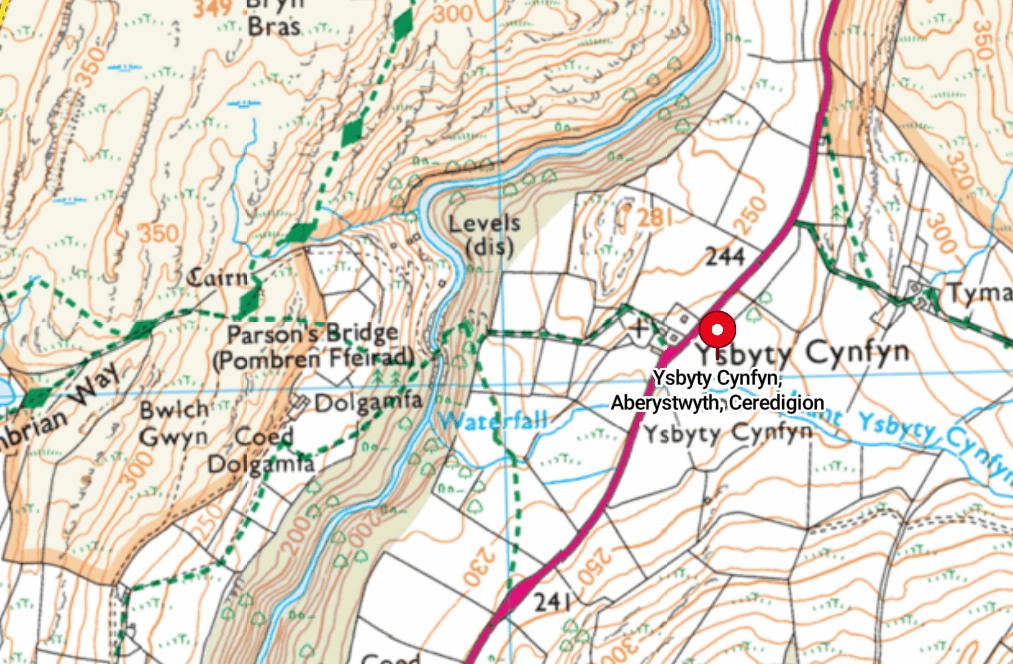
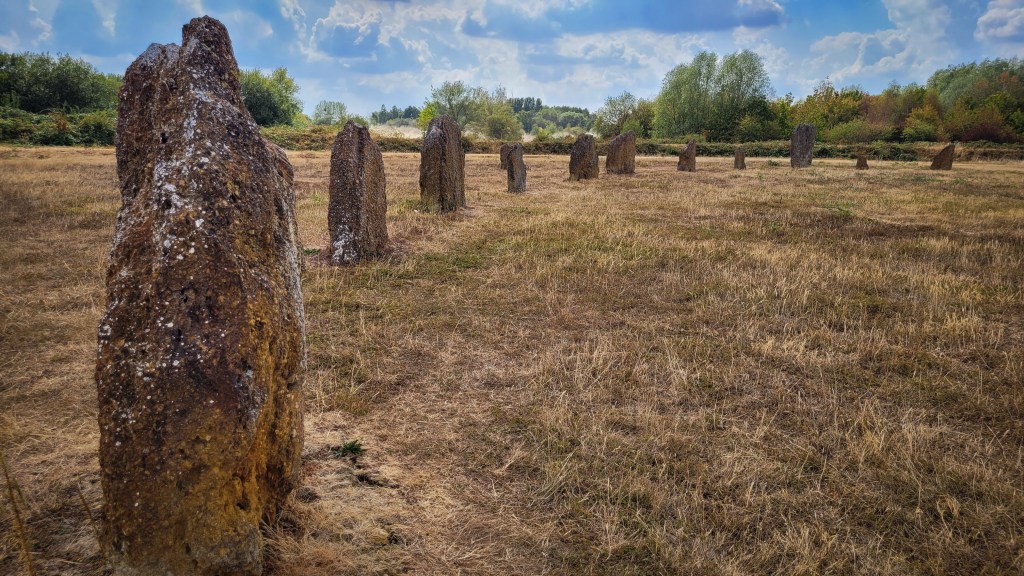
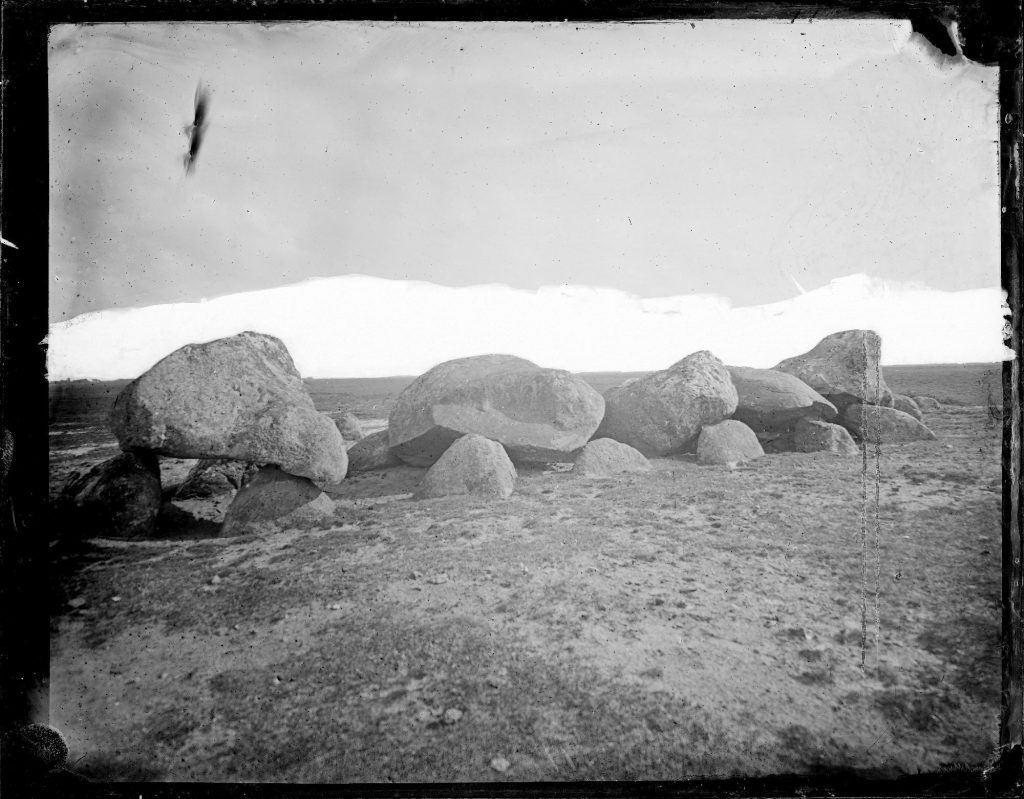
St Johns church in the tiny village of Ysbyty Cynfyn is curiously built upon an ancient site – perhaps an embanked stone circle, of which some huge stones remain.
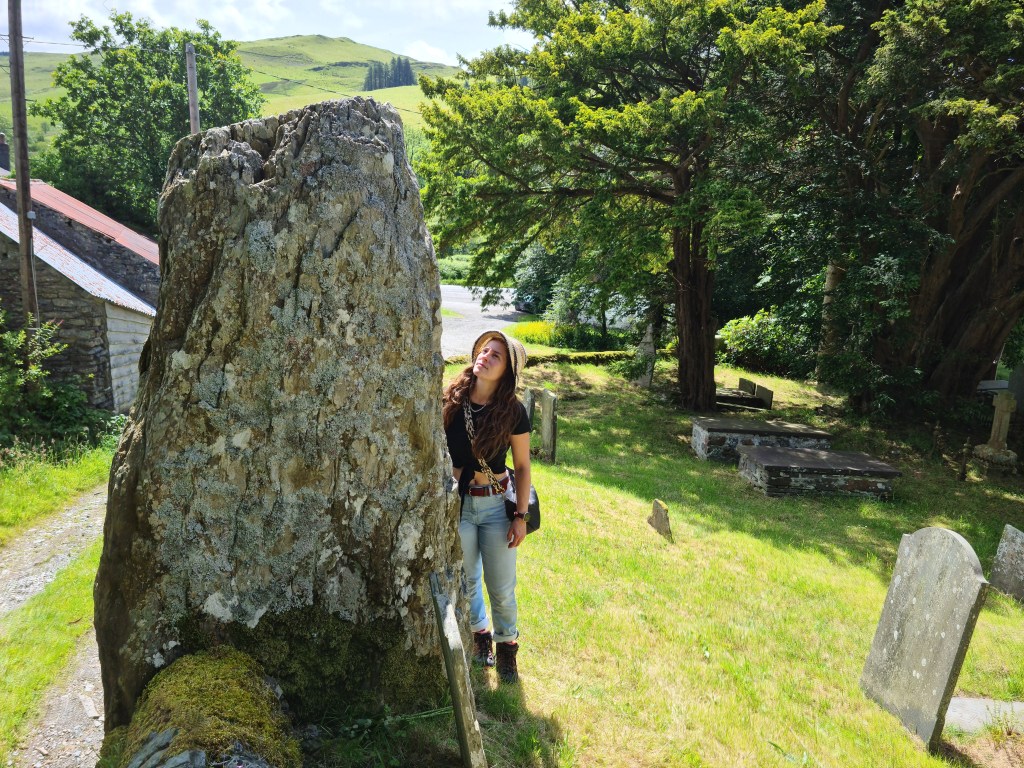
Today, this villages comprises of a church and farm. The form of the medieval church which is said to have been here prior is not known. It was rebuilt in 1827 on the same site, possibly to a larger plan than its predecessor. The early history of this area is also unclear.
This area lies on a major north-south route-way, now the B4343. Thought to be an ancient road, it was converted to a turnpike in 1770. There are lots of references to Ysbyty Cynfyn being a residence of some Knights- Hospitallers. But also that it was the ancient hospitia of the monks of Ystrad Fflur Abbey (Strata Florida). Two are religious orders that were active in medieval Wales and owned significant amounts of land and is still disputed if either owned this.
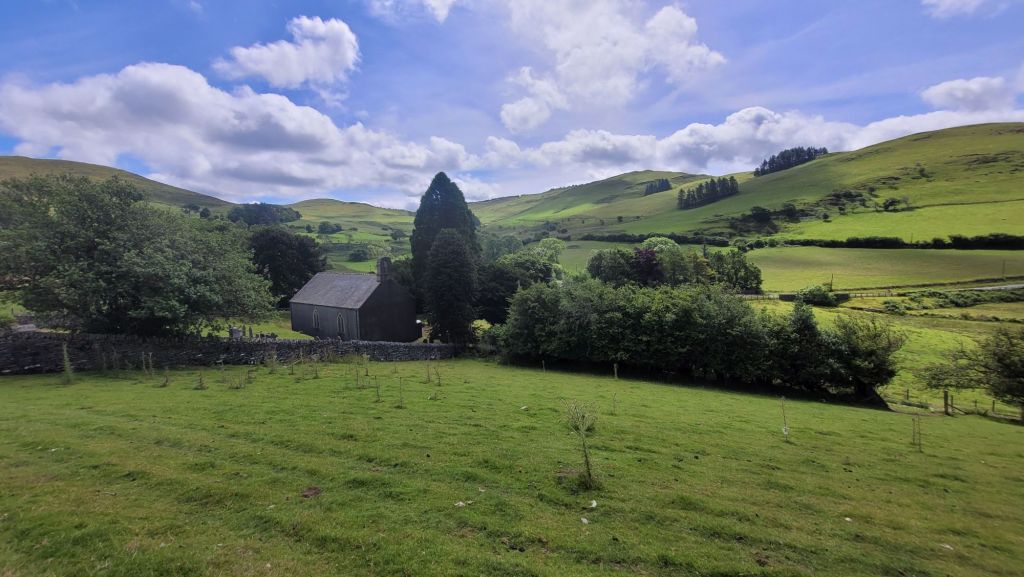
Ysbyty Cynfyn is just a few miles from the iconic Devil’s Bridge and The Hafod Estate, which was massively popular with early tourists in Wales during the 18th and 19th century. People would sometimes venture to see this church which was built within the so-called “druidical circle”.. and then continue down the valley to see the majestic Parsons Bridge..
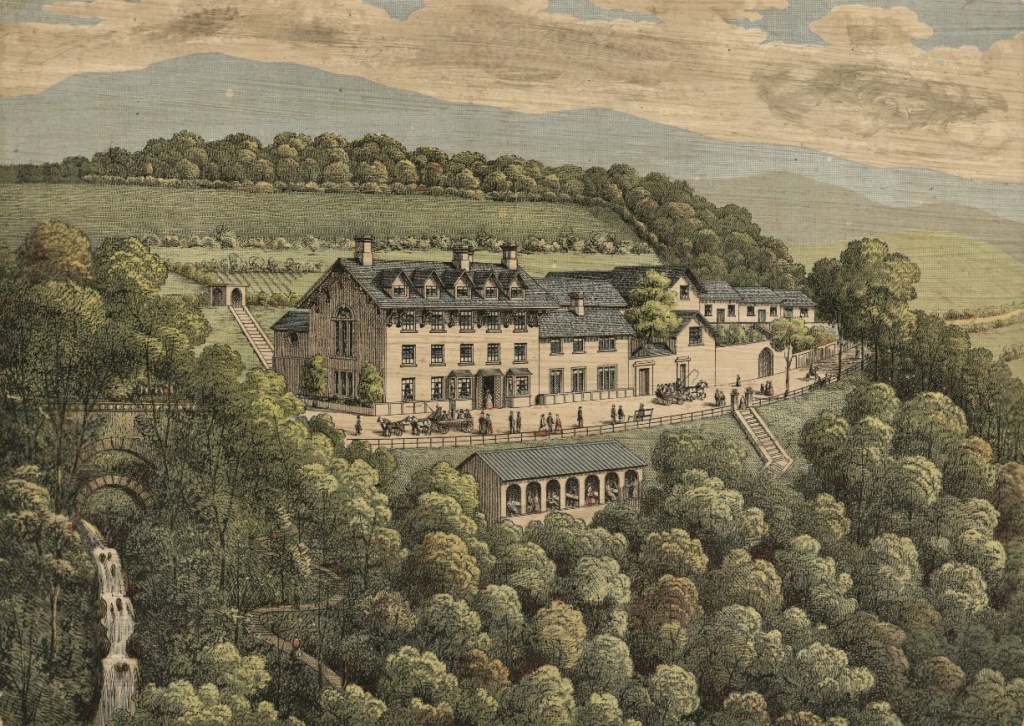
There used to be an inn or public house somewhere here but the exact location appears to be unknown. While researching we found lots of old writing dating back to the 1700s, from old tourists who mention their stay here, often referring to it as Hetty’s Cavern. It opened before 1769 and closed around 1830.
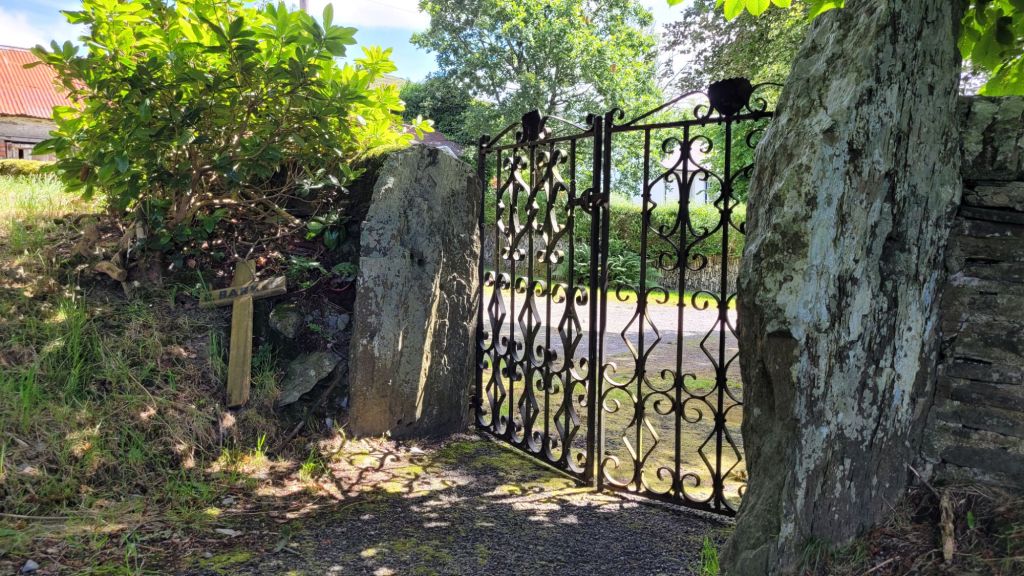
An early mention we found talking of the stones in the churchyard walls was from 1770. From Diaries of Tours made in England and Wales by the Rev. A Catcott. An English geologist and theologian who’s journals contain descriptions of the surface geology which he was gathering to prove his belief in the biblical flood. He wrote “In the churchyard at Ysbyty Cynfyn a druidical stone: not placed as a fence since it stands edgeways to the bounds.”
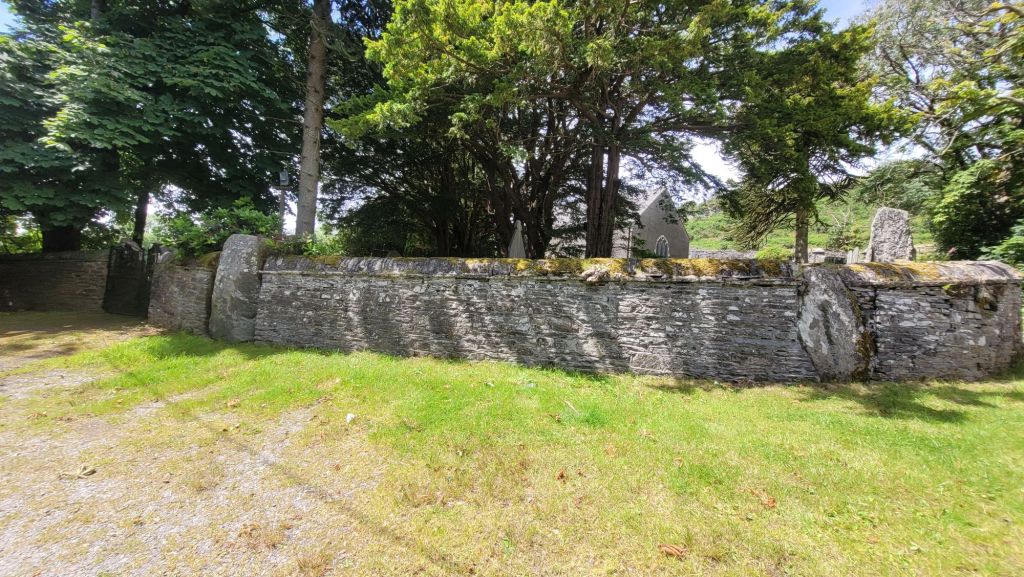
Some archaeologists have thought that the churchyard is bounded by a prehistoric embankment with standing stones in it. This might have been what is classified as an Embanked Stone Circle. Others think the churchyard boundary (which evidence suggests was never actually circular), is a relatively modern construction, or even a folly, created to attract tourists.
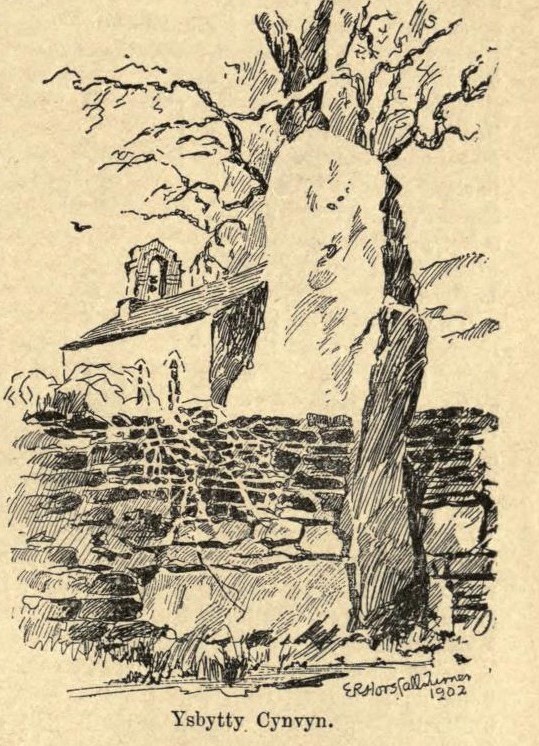
We personally first came across this church while reading E.R. Horsfall-Turner Walks and Wanderings in County Cardigan written in 1902, who also provides a sketch of one of the stones:
“We are in the hwyl for ancient history at Ysbutty Cynvyn… A glimpse of a complete circle of twelve erect stones is seen on the opposite bank of the Rheidol, from the top of the rocky path to the Parson’s Bridge. [Dolgamfa, see above] The imaginative mind has in these solitudes ample opportunity to people the hills with wild-eyed, bearded race of yore, clothed in undressed skins and armed with flint-tipped javelin and arrows, stealthily dogging the steps of the black muzzled wild ox or the wolf, the deer or mountain goat ; for long past centuries seem to return again as these ancient heights impress us with their ages of loneliness, and we feel ourselves and our age quite shrunk near their majestic existence.”
There are two plans drawn by Iolo Morganwg of what appears to be Ysbyty Cynfyn church yard, the first showing six dots, presumably representing stones; the other five. Some of the wording on the same page as the two plans is very similar, suggesting that one is an (inaccurate) copy of the other.
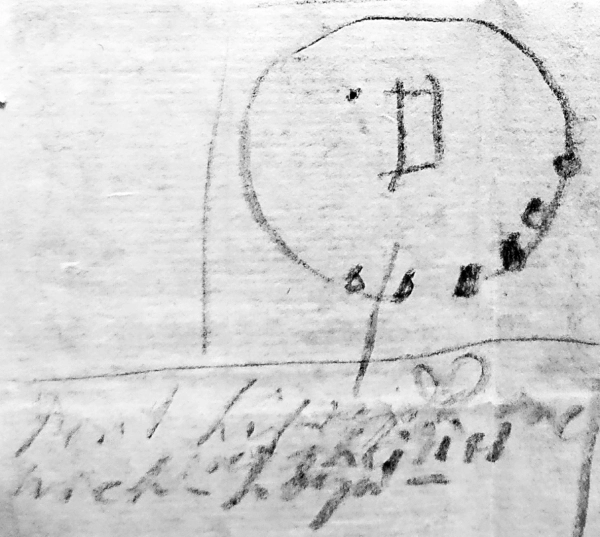
Above: A plan of a circle with six stones appears on the back of an undated letter drafted by Iolo. The first few words appear to be Pont Herwydd one arch, Ponterwyd a settlement just over a mile north. Although the note book does not mention Ysbyty Cynfyn, it lists Devil’s Bridge and Hafod as two of the places Iolo Morganwg passed through between Aberystwyth and Rhayader. The draft letter relates to visiting the homes of those who had old documents worth copying – the task Iolo was commissioned to do for Owen Jones (Owen Myfyr) in 1799 and 1800. It seems likely that this note and plan dates to 1799.
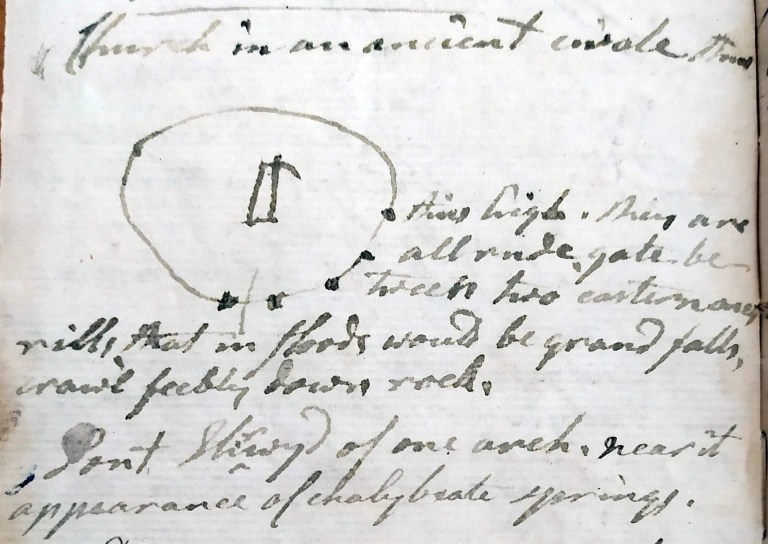
Above: A very similar plan of [Ysbyty Cynfyn] showing a circular churchyard with the church in the centre and five dots, probably representing standing stones on the periphery. The two squarish dots at the bottom of the sketch might be the cemetery gate posts. [The largest stone (next to the words ‘this high’ is now to the north-east of the east end of the church but this appears to show the church wrongly aligned, especially if the entrance to the grave yard is between the two stones to the left (where the circle is cut by a vertical line).
“Walk over Hafod grounds with E & B, visit Parsons Bridge, Church in an ancient circle stone ?this high [i.e. ?the stone nearest ‘this’ is the highest], they are all rude, gate between two eastern ones rills that in floods would be grand falls crawl feebly down rocks. Pont ?Stirwyd [Erwyd] of one arch, near it appearance of chalybeate springs.” From Iolo’s notes Williams, Edward, (Iolo Morganwg), Journey 3 Llandeilo to Cardiganshire and the north, c. 1800
Note that, despite his obsession with druids and circles, Iolo did not actually ascribe this as a druidical monument. Other writers after this did however.
In around the year 1807, Malkin writes:
“There are in the churchyard a large, upright stone monument, with the characters entirely defaced. I could not learn that any tradition was attached to them in the neighbourhood; and there was nothing in their shape or appearance, particularly to distinguish them from similar erections, to be met with in every part of this country. I have from numerous appearances in Wales, as well as from a great many passages furnished to me by my literary friends in old Welsh writers, whether historians or poets.. been fully persuaded that the first British Christians used the Druidical places of worship in the open air, within large circles of stones, like those of Stone Henge, and Rollrich, or as some call it Rollright, in Oxfordshire. The church and church-yard of Yspytty Kenwyn may be adduced as an instance of this. The church has been built within a large druidical circle or temple. Many of the large stones forming this circle still remain; and the fence around the church-yard is filled up by stone walling in the intermediate spaces.”
Malkin, B.H., M.A., F.S.A., (1769-1842)
We found a great website https://sublimewales.wordpress.com which has countless old letters from antiquarians and tourists visiting Ysbyty Cynfyn to see the “druidical circle”. We highly recommend checking this out for some interesting reading.
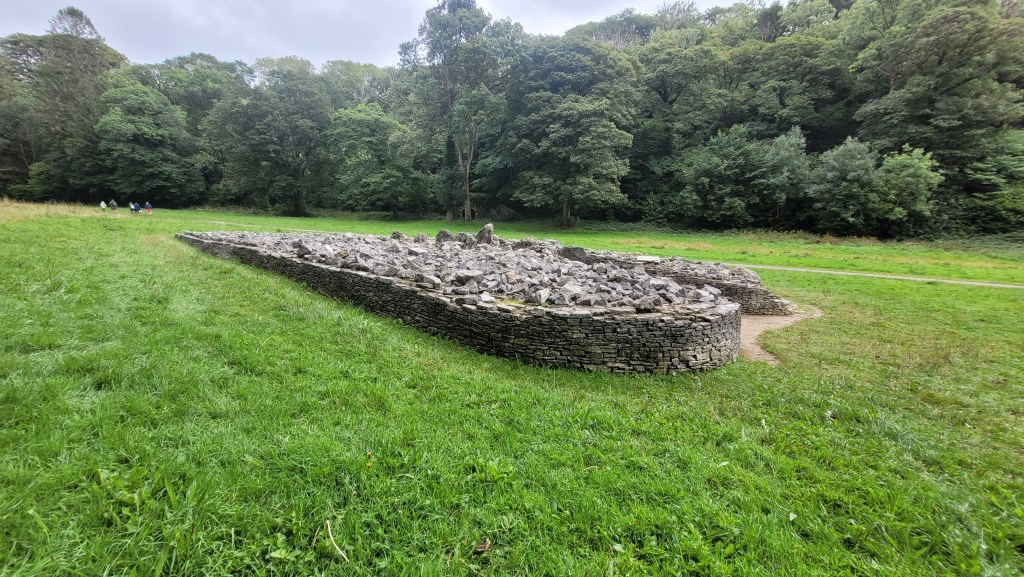
If you follow the public footpath around the back of the church, you will find Parson’s Bridge, overlooking a stunning gorge. You can then follow the path up the valley to Dol y Gamfa, a Bronze Age cairn-circle.
Here is the video we made covering Ysbyty Cynfyn church, Parsons Bridge and Dol y Gamfa:
We’ll finish with a letter written in 1784, about a stay at the Inn which was in Ysbyty Cynfyn:
1784
“..We got some account of the fine country about the Devil’s Bridge, Hafod etc., to which places as soon as we could mount we set off with a curiosity highly excited by the stories we had heard of these mountains, from the bathers at Aberystwyth. It was Saturday evening when we arrived at these wonderful scenes, expecting to find some sort of accommodation at the miserable inn at Spytty, called Hetty’s Cavern, but the landlady soon undeceived us by showing that she had no other lodging for herself, her husband and daughter, than a loft open to the kitchen, which indeed consisted of the whole house; she however, took in our horses and recommended us to go to farmer Hughes, a neighbour, who received us with much cordiality, giving us cheerfully, though late, the best beds he had, but unfortunately for us, though well warmed, they were quite damp, so that prudence dictated us to keep on our clothes.
Next day to Hetty’s Cavern to find no corn for the horses. Breakfast was milk, bad small beer, sorry potatoes and bread baked in a pot’.
{The following day Cumberland and his companion visited Devil’s Bridge and waterfalls separately; Cumberland became lost and prepared for a night in the valley, but met a boy who, after some attempt at communication, brought some food which Cumberland devoured and continued his exploration of the valley (since he had no thoughts of returning to his comfortless inn) and became completely lost and prepared to spend the night out-of-doors when his companion’s search party found him, having jumped over Parson’s Bridge (a board put over it on a Sunday).
As dark fell, his companion sent out a search party and discovered him. They returned to Hetty’s Inn.}
‘Finding our cavern truly miserable, for the Hetty’s spouse was brewing, she beating him and the house full of smoke we agreed to try Farmer Hughes again and arrived there about 11 o’clock when we found all his dogs about and dared not, as it was dark to approach too near the porch so that finding hollowing produced no answer we returned to the highway where two gates faced each other, I took my seat on one and Mr Long on the other and we held council where we were to pass the night; the moon now broke out and my companion, tired of strolling about had just declared he would sit there till morning, when suddenly, the gate giving way behind him he was decently deposited among some stubbles. To fill up time, we returned to Hetty’s as it grew cold and sat on each side of the fire place smothered with smoke and no refreshment but the small beer, we found ourselves inclined to sleep, but fearing a cold night we remembered the straw in the hay loft so we took blankets and lanterns and lay down in our great coats after climbing up the ladder with the daughter proceeding us. On thrusting my arms into the straw I found it was quite wet and turning to inform my companion I found to my surprise and laughter that he was gradually disappearing through the rafters of the hay loft and the stout Welsh lass struggling in vain to prevent it as one hand was holding the lantern.’
{They returned to the inn again but sleep was impossible because of the smoke and fleas, and continued their tour the next day to Tregaron.}”
Cumberland, George, (of Bristol, 1754-1848), A Tour in North and South Wales in the Year 1784, NLW Lloyd-Johnes MSS, (microfilm 215), f. 61
Lloyd-Johnes, H.J., ‘A Tour in North and South Wales in the year 1784’, National Library of Wales Journal, XIX, (1976), pp. 336-338



Leave a comment