
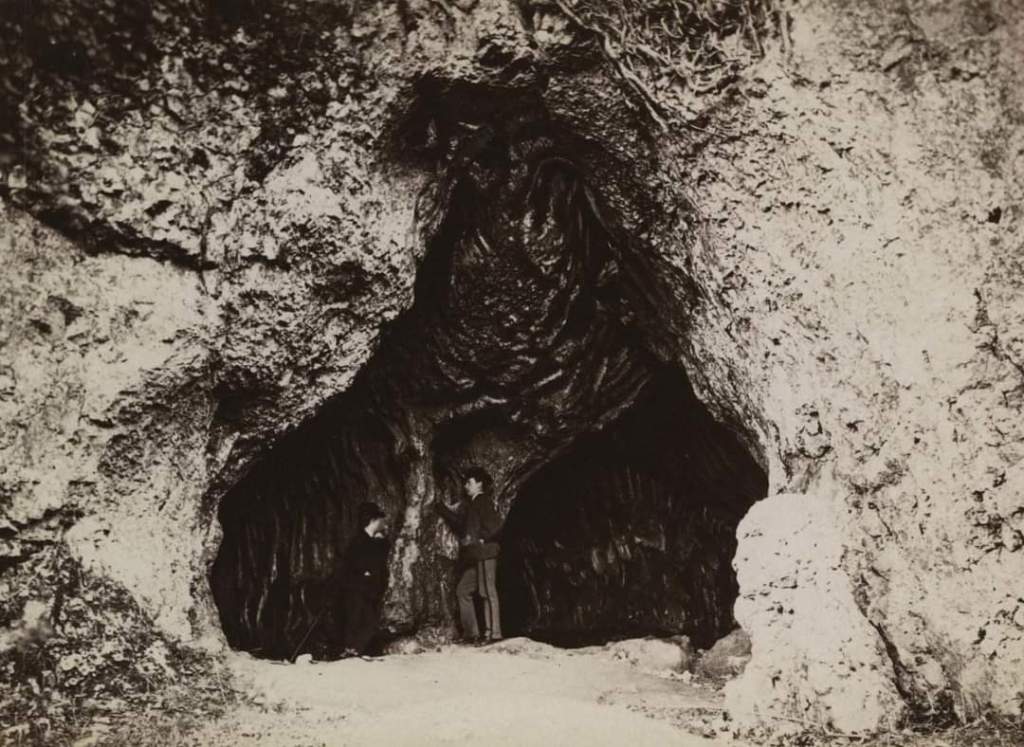

Hoyle’s Mouth Cave in Tenby – Pembrokeshire, Wales.
Situated in sloping woodland overlooking the valley.. The mouth of the cave is about 3m wide, 4m tall and leads into the main cavern where a narrow tunnel leads you further into the limestone. The passage we explored runs about 40m into the hill..

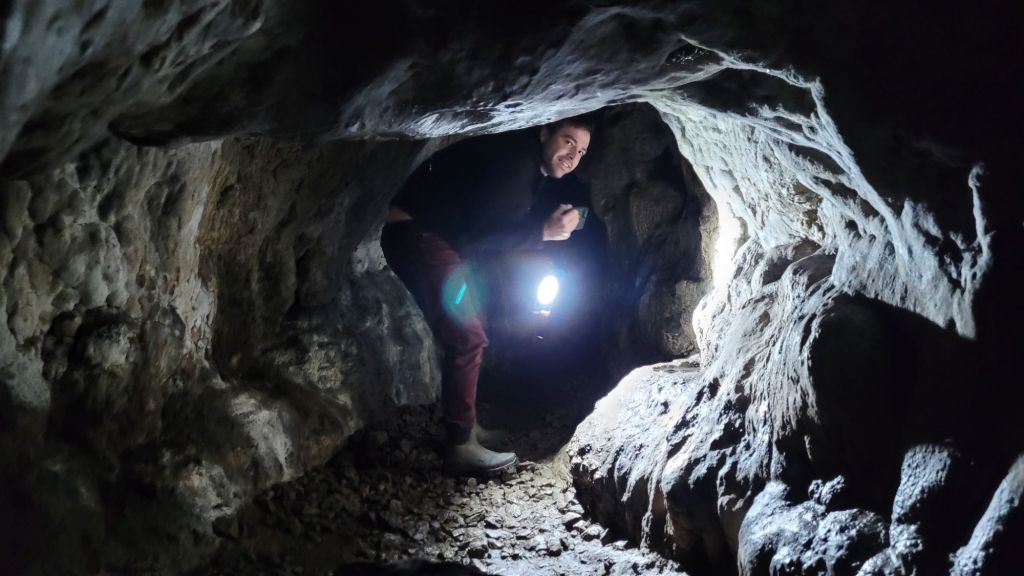
This cave is thought to have been occupied by humans (the homo sapien species) on two separate occasions during the Palaeolithic period, at about 30,000 and 10,000 B.C. Some two hundred stone tools and waste flakes have been found in this cave and bones reported from excavations included reindeer, mammoth, woolly rhinoceros, hyena, arctic hare, fox, bear and lemming.
The earliest recorded work on the cave was by Col. Jervis in 1840. He was followed by the Rev. G.N. Smith (1863), the Rev. H.H. Winwood (1865) W.Boyd Dawkins (1874) and E.L. Jones in 1882. The disturbance caused by these explorations and the need to confirm the contexts of the artefacts disclosed by them prompted the rescue excavations by Savory in 1973. He explored the areas outside and within the cave entrance trenches 1, 2 and 3 and apparently recovered very few bones of birds. The paucity of avian bone in this sector was confirmed during the years 1986 -1990 by the work of Aldhouse Green.
Another recent excavation at Hoyle’s Mouth was carried out in 1968, which resulted in further finds of flints and human bones. Between 1984 and 1990 the National Museum Wales undertook excavations of both Hoyle’s Mouth and Little Hoyle Caves. Artefacts of both Early Upper Palaeolithic and Late Upper Palaeolithic age were uncovered, as well as a later Mesolithic site and some early Christian finds.
The artefacts from Hoyle’s Mouth Cave are now widely scattered, housed in museums across Britain. A few are in Tenby Museum which was sadly closed the day we tried to visit. Many artefacts were poorly noted, some now lost. There were also reports of metal objects having been found which are now lost..
To read more about the excavations that took place at Hoyle’s Mouth Cave – https://www.pembrokeshirehistoricalsociety.co.uk/goosey-goosey-gander-jemima-shelduck-attendance-two-stone-age-occupation-caves-south-pembrokeshire/

Legends:
In the book, Tenby: A Sea-Side Holiday, written by Philip Henry Gosse in 1856.. He tells us of a legend associated with the cave:
“The people talk a good deal of a curious cavern called Hoyle’s Mouth, about which they have some strange notions. It opens at the end of a long limestone hill or range of hills, about a mile inland..
The popular legend is, that it is the termination of a natural subterranean which communicates with the great cave called the Hogan, under Pembroke Castle, some eight miles distant. It was once traversed, they say, by a dog, which, entering at one end, emerged from the other, with all his hair rubbed off!
A gentleman is said to have penetrated to a considerable distance, and found “fine rooms.” But the vulgar are very averse to exploring even its mouth, on the ostensible ground that a Boar, “a wild pig,” dwells there; I fear, however, that there are more unsubstantial terrors in the case.
I walked out to look at it, and if I found no dragons, nor giants, nor “pigs”, I enjoyed a most delightful rural walk.”
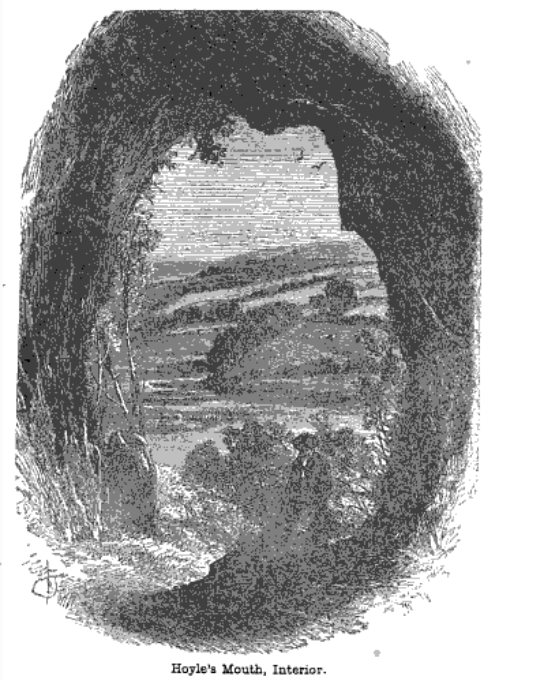
There was also a story reprinted in the Parish Magazine from 1941 entitled A Hoyle’s Mouth Tale:
“Somewhere about 1850 an elephant died at Tenby – one of the pets of travelling menagerie or circus. It was duly buried,, and its burying place was known to one of Tenby’s fishermen – a youngster at the time. Some years later, when the said fisherman – whom I will call ‘John’ for short – was temporarily feeling the hardness of the world, and the difficulty of making ends meet, the vision of the elephant’s grave occurred to him in his meditations, and it did so because there was some local excitement at the time about the exploration of Hole’s Mouth. Eventually, ‘John’ decided to visit the elephant’s grave, dig up a few of the bones, carry them to Hoyle’s Mouth, and bury them there. This he did, and keeping one of the bones, he then paid a visit to Mr Smith, of Gumfreston. The old rector was filled with astonishment at ‘John’s’ story of a new discovery in the cave, and not a little upset that he should have missed finding the mammoth remains himself in the course of his previous excavations. He immediately decided to start digging again, and (here, of course, was the point of John’s scheming), he showed his gratitude to the fisherman friend by giving him a job as a digger. They gradually found the bones, carefully distributed over the cave by ‘John’ so that the job might not end too soon, and Mr Smith was delighted beyond measure.”
To access the cave, we parked on Trefloyne lane in a layby near the Golf Club. The path to the cave can be a little tricky to find if you don’t know what you’re looking for.
Here is the video we made covering Hoyle’s Mouth Cave, as well as the nearby Longberry Bank cave and The King’s Quoit neolithic cromlech:
 CoralJackz - That History Couple
Leave a comment