

We began our walk from Port Eynon beach car park. As you walk around the coastal path you will come first to the remains of The Salt House.
According to local folklore, this building was fortified by legendary Gower pirate John Lucas in the 1700s, in order to further his unlawful activities, and that he had a secret tunnel that was used to move illegal contraband connecting it to nearby Culver Hole.. A tunnel big enough for a horse to travel through!
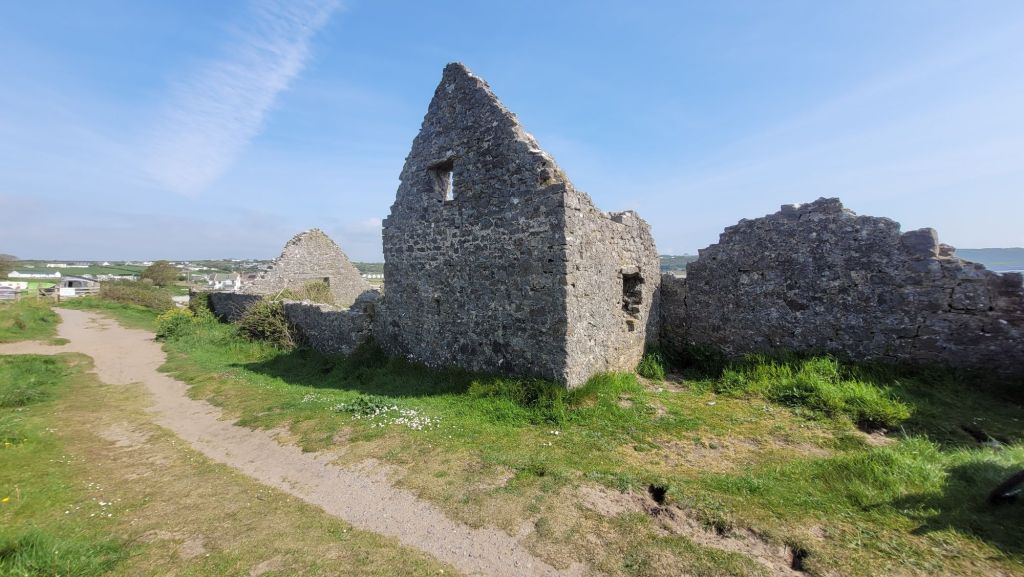
The supposed history also claims that 7 generations later, another John Lucas found a rich vein of paint mineral and exported it from his base at the Salt House but shortly after his death the building was ruined in a storm.
However, according to The National Trust, this interesting history was later shown to be a fabricated family history written by the Rev. Dr. J. H. Spry during the 1830’s in connection with a family lawsuit over the ownership of the property.
The site has been eroding steadily, which led to excavations undertaken in the 1980s and 90s. It appears to have been originally built in the mid 16th century as a site of salt production.
“The main building we see today was used for occupation and storage whilst three large chambers on the beach were used for salt production. The sea water would enter the beach chambers at high-tide where it would be stored in a reservoir. The water would be pumped into large iron pans and slowly heated and evaporated. As the salt formed it would be scooped off and stored in the northern part of the main building to dry. The first knowledge of a salt house at Port Eynon is also mentioned in a document of 1598. It would seem Welsh salt houses of the later 16thcentury were amongst the most advanced of their day. The value of the salt is perhaps shown by the fact that the site was enlarged and fortified during the 17thcentury, with the inclusion of musket loops within the thick walls. It appears salt production ceased around the mid 17thcentury. Some of the structures were subsequently demolished but occupation continued in the main house. The most recent being the use of the northern end as oyster-men’s cottages, which were finally abandoned around 1880.” – https://heritagerecords.nationaltrust.org.uk/HBSMR/MonRecord.aspx?uid=MNA135108
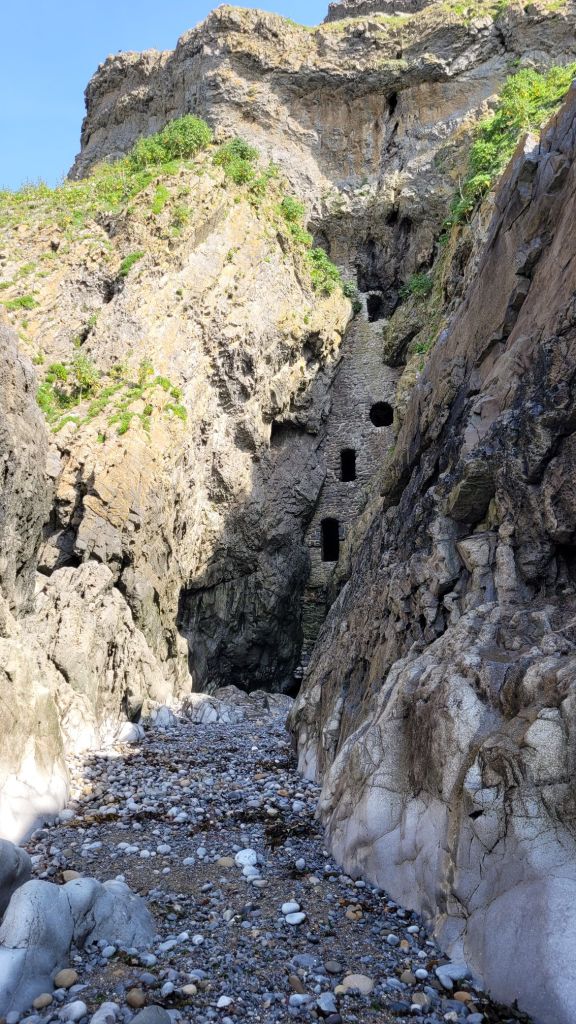
We now follow the coastal path around to the Culver Hole. If you are afraid of heights, this path down may be a little scary. But there were lots of people of all ages exploring here today so don’t be too scared off..
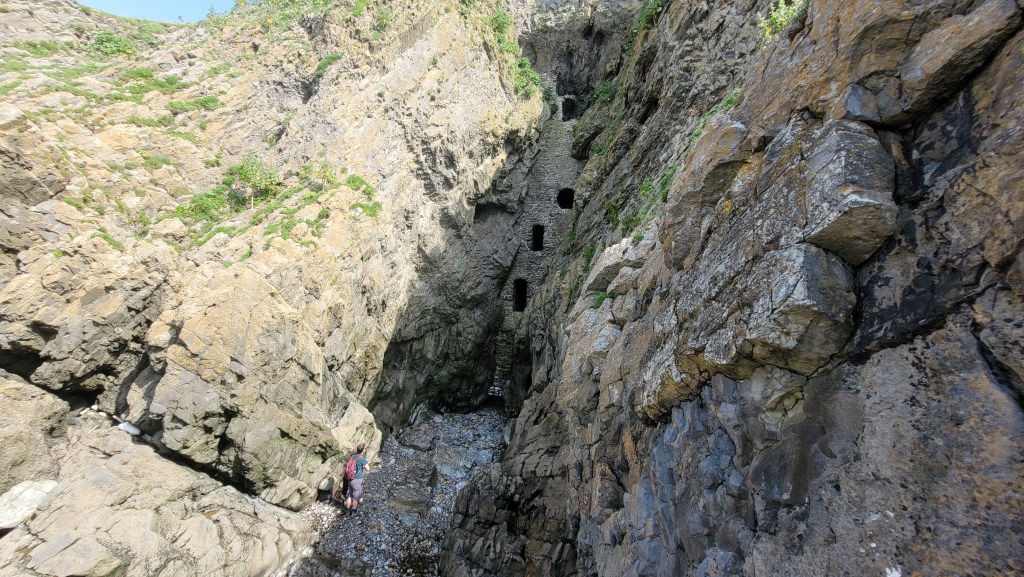
Despite the exciting legends of smugglers using Culver Hole to hide their booty, this structure is believed to have been built in medieval times as a shelter for domesticated pigeons which were an important source of food, providing meat and fresh eggs. The word ‘culver’ derives from the Old English word ‘culfre’, meaning pigeon.
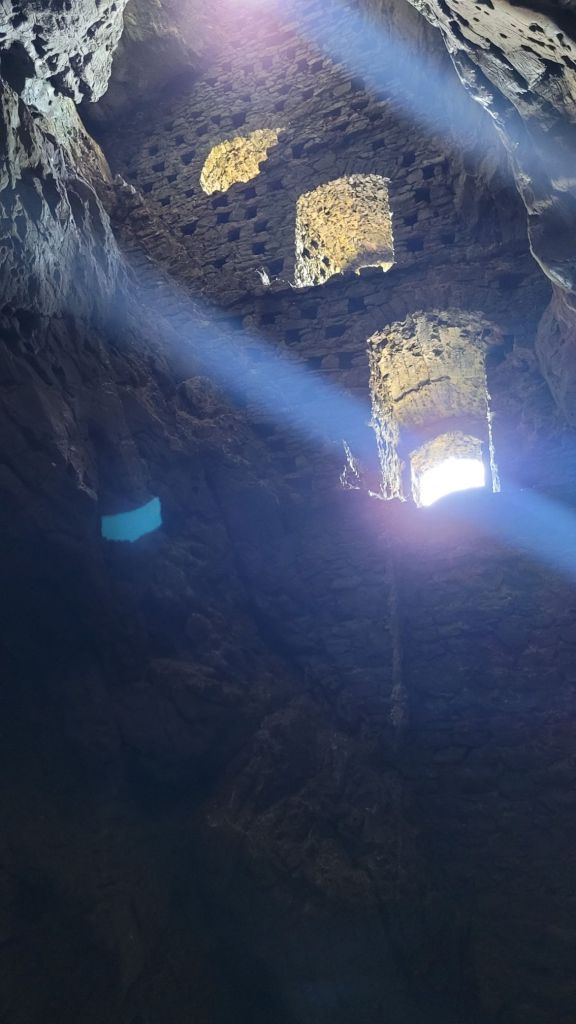
The Dovecot is an unusual feature where a natural cave, the mouth of which is between 3 to 6m wide, has been closed off by a 16m high wall, 3.6m thick at its base and tapering upwards. There are two round-headed windows and a circular opening that pierce the wall, with roughly 30 tiers of nesting boxes and a narrow stairway within.
It has also been suggested that Culver Hole was a medieval stronghold, or having been part of a castle. The castle of Port Eynon is mentioned in 1396 but it’s location is unknown; it’s thought the belief that Culver Hole was a fortified portion of it is probably due to a fancied resemblance to the works on the face of the cliff at Castell Carreg Cennen in Carmarthenshire.
Here is the video we made covering The Salt House and Culver Hole:
 CoralJackz - That History Couple
Leave a comment