
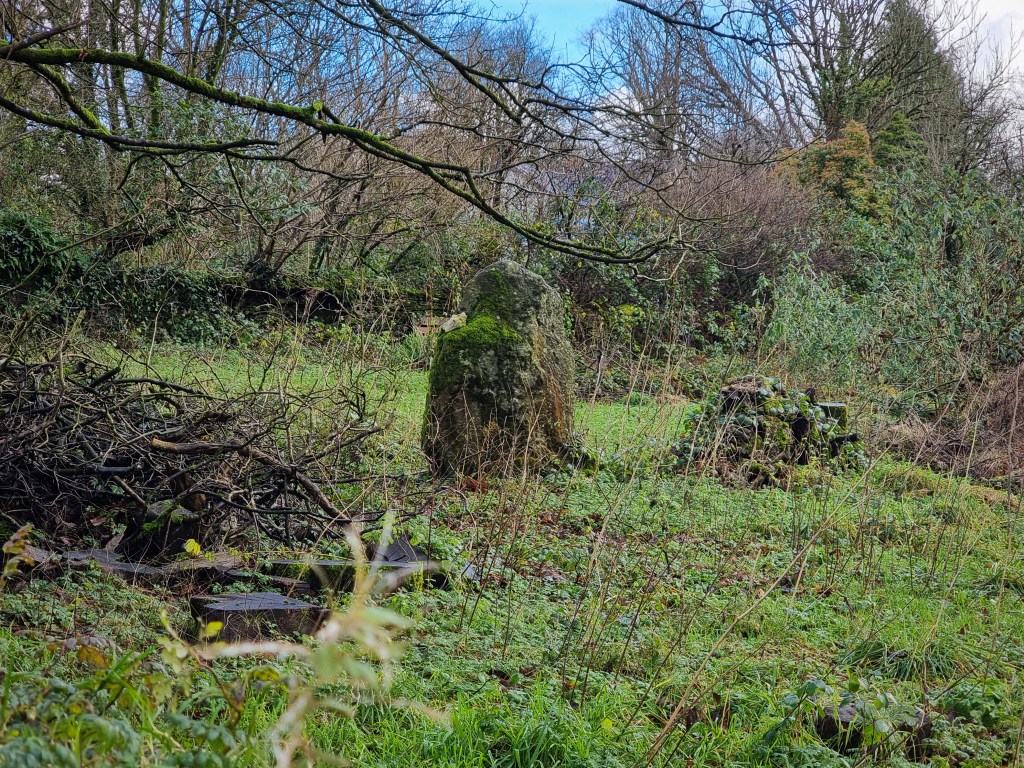

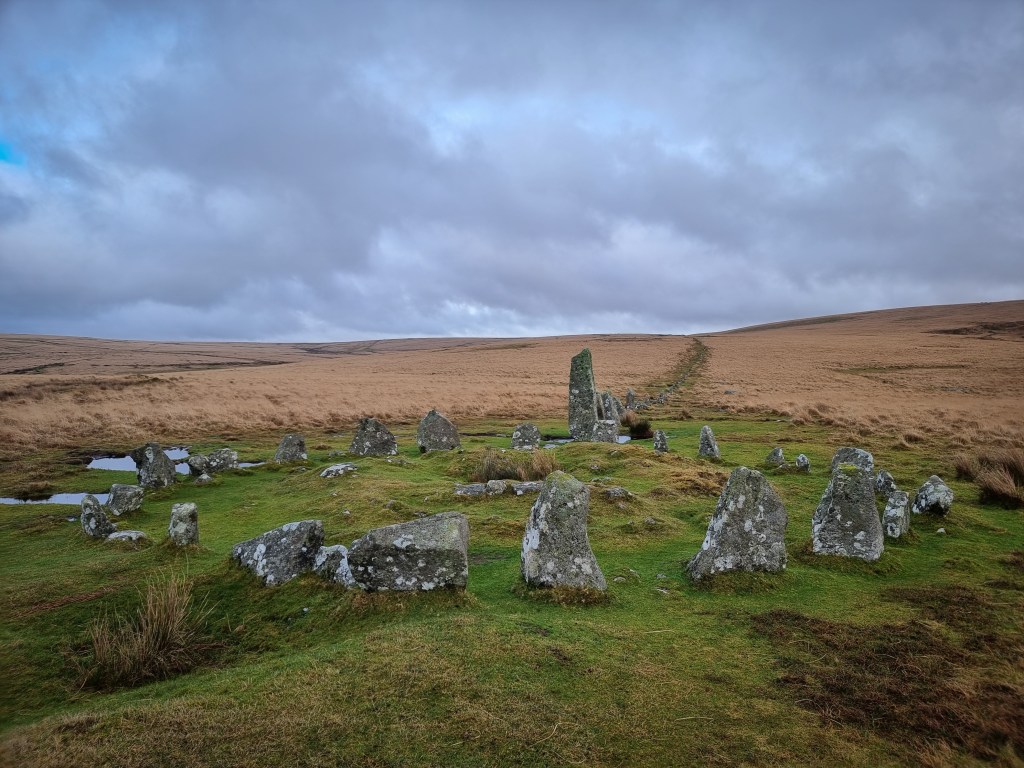
Temple Druid and Prysg Farm are home to a complex of Late Neolithic and Bronze Age monuments, including a possible henge enclosure, standing stones which are now scattered about, as well as the remains of one or more neolithic cromlechs.
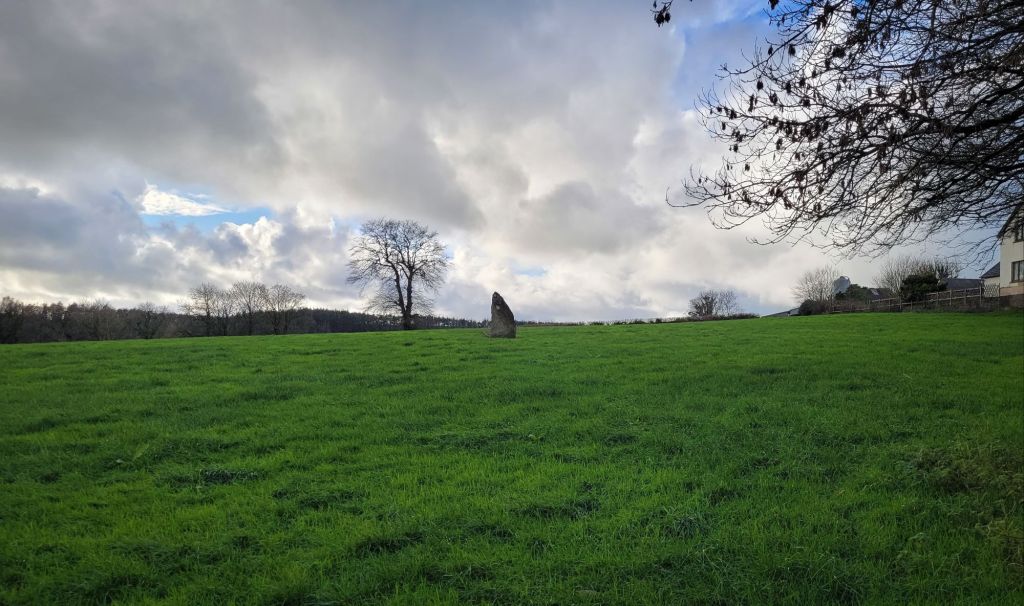
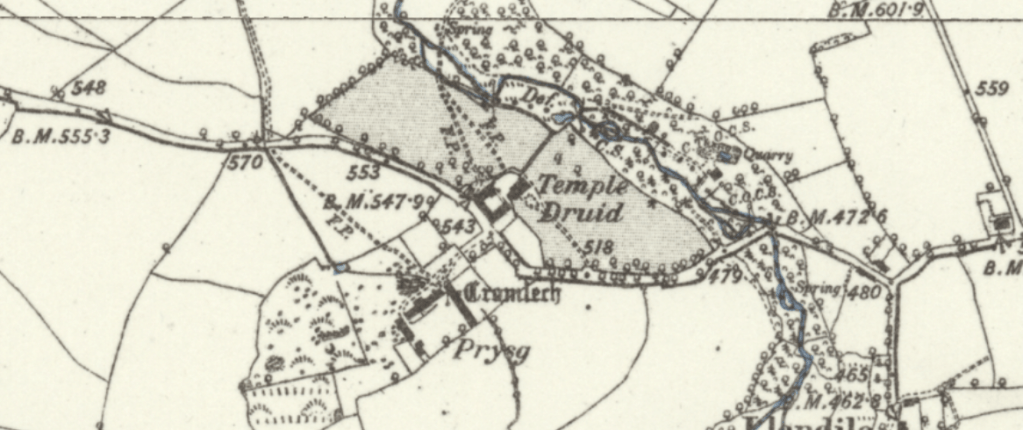
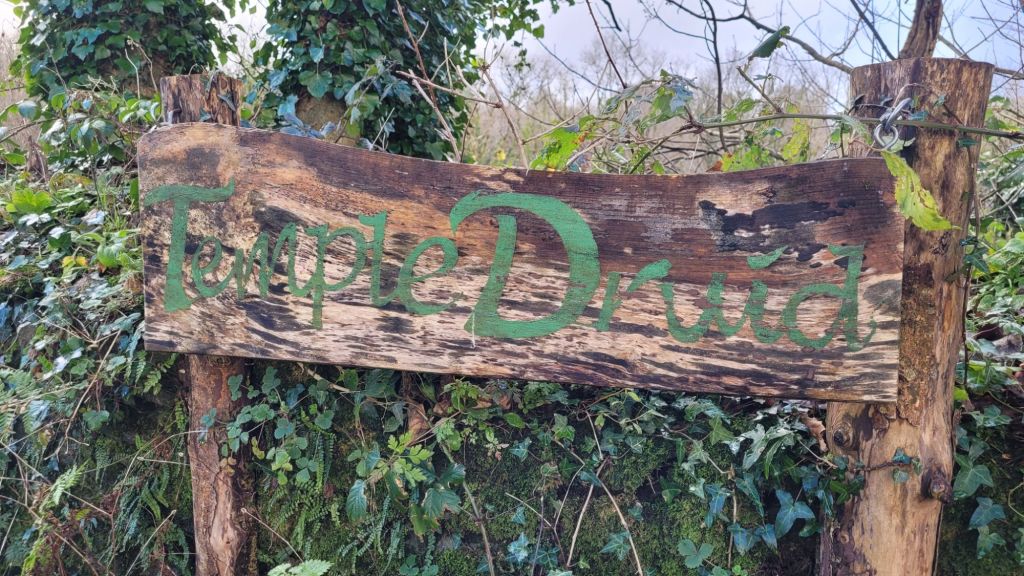
Temple Druid is a grade II listed John Nash house. The present house is not the original and was erected here on the site of an existing farm called Bwlch y Clawdd (Pass of the Embankment). It was renamed in honor of the neolithic monument that stood near the house in a field named Maes-y-Carreg – Field of the Stone. (It was fashionable in the 18th and 19th centuries to attribute all pre-Roman monuments to the Druids.) There are several old records of the cromlech, but it was destroyed around the year 1800.
Historical records:
The following was written by Richard Fenton, from ‘A Historic Tour Through Pembrokeshire’, published in 1810:
“Having left Manclochog, after a ride of a mile I come to Temple Druid, a place that has changed hands as often as Shenstone’s celebrated creation, the Leasowes, a fate that seems to have attended some of the most beautiful spots in the kingdom, and for which it is difficult to assign a good reason. The farm was originally called Bwlch y clawdd, from the principle pass here through one of the extreme boundaries of Cemaes ; but on its being purchased by Mr. Pryce, the new and very appropriate English name of Temple Druid was given it, there being then just above the house a large Cromlech, or supposed Druid altar, now destroyed and removed, the farm-yard having superseded the mystic precinct, and a dunghill the Temple of the Druid ; but, with my dimensions taken when it was perfect, I was favoured by my friend Mr. Williams, of Ivy Tower, to whose notes and curious observations, communicated on several occasions in the most handsome manner, I am happy in an opportunity of acknowledging my obligations. The incumbent stone was above thirteen feet in diameter, eighteen inches thick at the sides, two feet in the centre, and about four feet from the ground, raised on upright stones. Before it was removed, it had for some time served the disgraceful office of a pig-sty ; but before its final destruction, I was told, had been advanced to the more honourable rank of a receptacle for calves.
The house of Temple Druid, though purchased for a hunting seat, yet was built on an elegant plan, finished to accommodate itself to the taste and the habits of its first late modern possessors, always accustomed to fashionable life. To the gentleman who first raised it succeeded another Nimrod, his rival in the chace, and in every thing that involved luxury and expense. The next possessor likewise might have said to have had a passion for the chace, but on a different element, being a navy officer, who knew nothing of country life or agriculture, and had scarce ever seen any other green field than that of the ocean, the only one however he had been accustomed to plough, yet, as he-
“In the weak piping time of peace
Had no delight to pass away his time
Unless to spy his shadow in the sun”,
Some demon whispering, was persuaded to purchase this place and turn farmer, where he was literally a fish out of water, an improvement on Commodore Trunnion, for every thing he did or planned had a nautical bearing. His house might have been said to be in a perfect state of blockade, every avenue to it being stopped, and only one gangway left open to his cabin, and that so ill contrived, that you might as easily have entered through the poop lanthorn. But being called to serve his country in a character he could do honour to, he soon slipped his cable, was under way and in action, happy to escape from this moored hulk he had been too long chained to. The present proprietor, and I believe, the next succeeding purchaser, is a gentleman who, after many years residing in India, is now retired with a competent fortune and an intelligent active mind ; and from the partiality with which he speaks of his late purchase, it is to be hoped that he will be induced to remain there long enough to make it resume the character that in his predecessor’s time it had nearly lost, and to become a most valuable acquisition to that secluded part of the county. Whilst it continued in the occupation of Mr. Pryce, the farm was brought into a high state of cultivation ; and its out-buildings, fences, gates and every other necessary appendage of luxury, use, and convenience, were on a great scale. Nor were wood, water, and pleasure-grounds neglected. It is situate in a pleasant sequestered dingle, with a gentle fall to a pretty mountain stream full of trout that murmurs by ; and if sport and retirement be the object, no situation is better calculated to produce it.” – https://archive.org/details/b22013179/page/354/mode/1up?ref=ol&q=temple+druid
Gardner Wilkinson, 1871 :
“Three-quarters of a mile south-east of Maenclochog are two embankments about eight feet apart, apparently belonging to Castell Fforlan ; and in the fence to the north of Temple Druid is a “longstone” from 7 to 8 ft. high. At Temple Druid a cromlech formerly stood (with a capstone about 13ft. in diameter) on three supporters, as I learnt from an old man who had assisted in taking it down ; and several “longstones” may still be seen in the neighbourhood. Temple Druid, I must observe, is not a name of great antiquity, having been given to the spot from its vicinity to the cromlech, according to Fenton, not very long before that monument was destroyed. Three miles east of Maenclochog is Monachlochddu (once the abode of monks, as its name implies) ; and about half a mile to the north-north-east is a circle, composed of sixteen stones, the largest of which does not exceed 3ft. 2 in height. Two of these have fallen. The diameter of the circle within the stones is 75 ft. About 400ft. to the north-east are two “longstones”, 5ft. 6 high, standing 48 ft. apart (pl 3, fig 1).”
– https://babel.hathitrust.org/cgi/pt?id=coo.31924087796771&seq=303&q1=manorbeer
The Gelli Dywyll Stone:
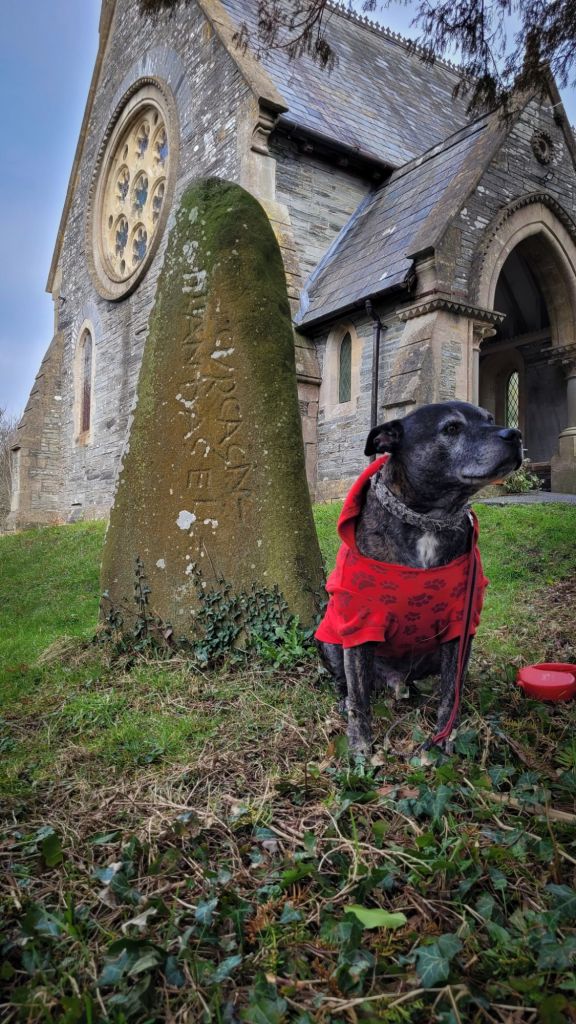
In 1743 an early medieval stone is recorded standing on the road adjacent to Temple Druid. Around 1893 the stone was moved to St Llawddog’s Church in Cenarth where it still stands today. You can read more about the Gelli Dywyll Stone here.
“The Gelli-Dywyll Stone – Curcagni fili Andagelli – “On a stone 6ft long on the roadside by Mr. William Lewis’s house, called Bwlch y clawdd, in ye parish of Maen Clochog, in Pembrokeshire, I found this inscription A.D. 1743”. In a notice of this inscription in the Gent. Mag. For 1776, it is said that the stone then stood on the lawn of Capt. Lewis’s house in Carmarthenshire.” – https://journals.library.wales/view/2919943/3010814/65#?xywh=-931%2C219%2C4349%2C2264
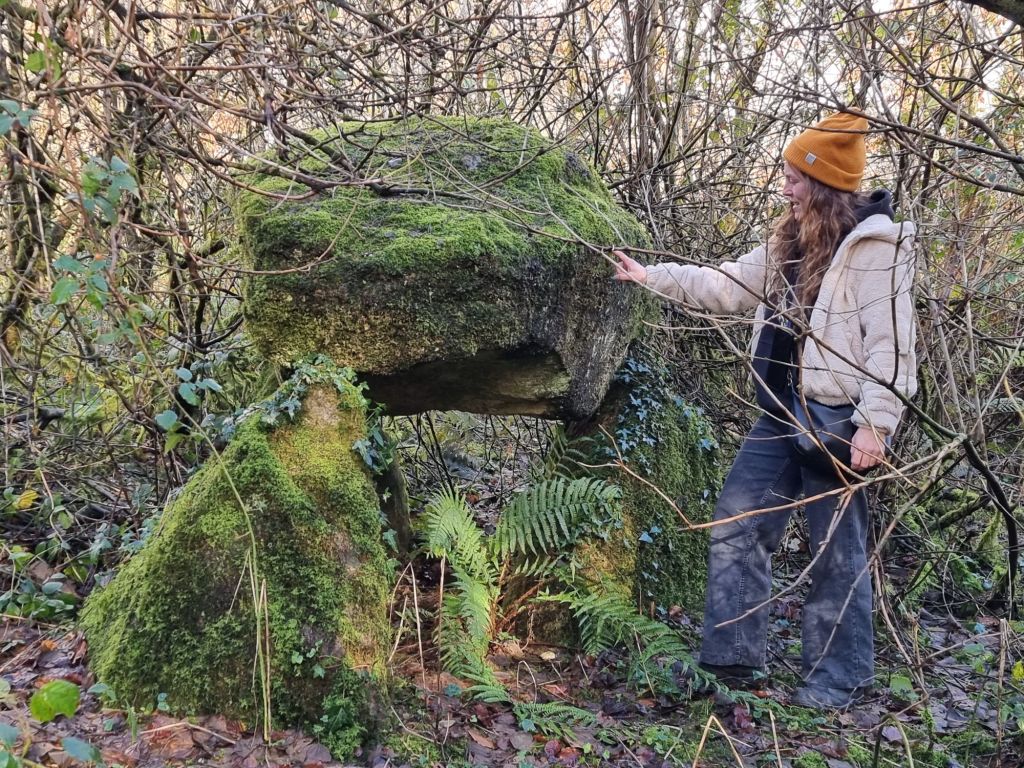
While walking on a public footpath next to Temple Druid, we also found a modern cromlech hidden in the bushes..
 CoralJackz - That History Couple
Leave a comment