
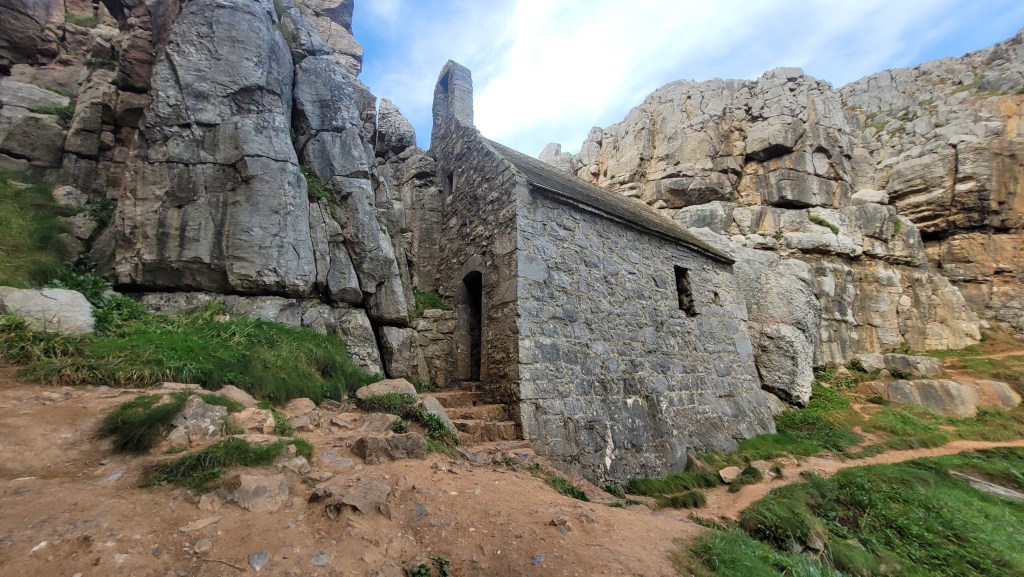

St Govan’s Chapel – Pembrokeshire, Wales
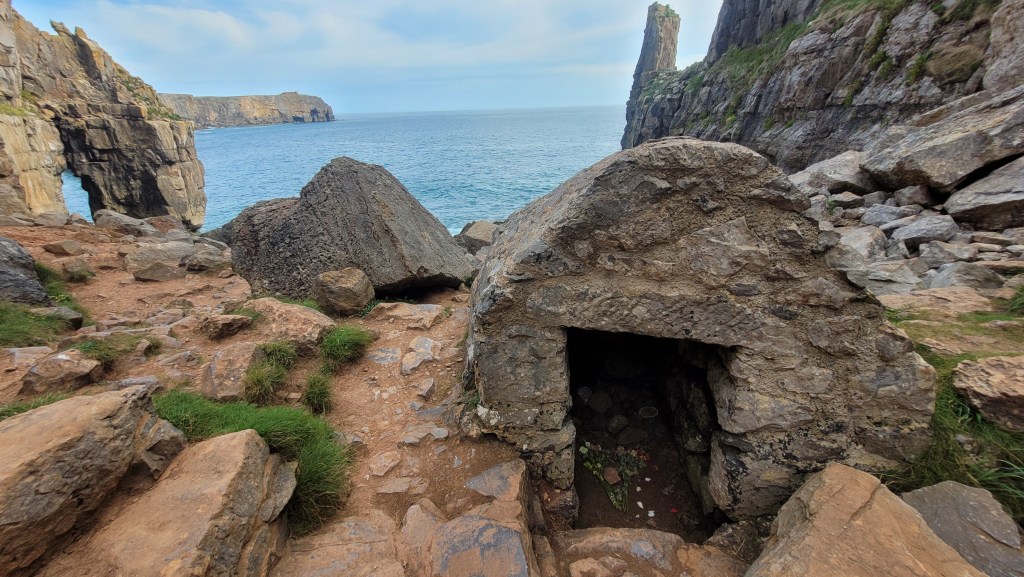
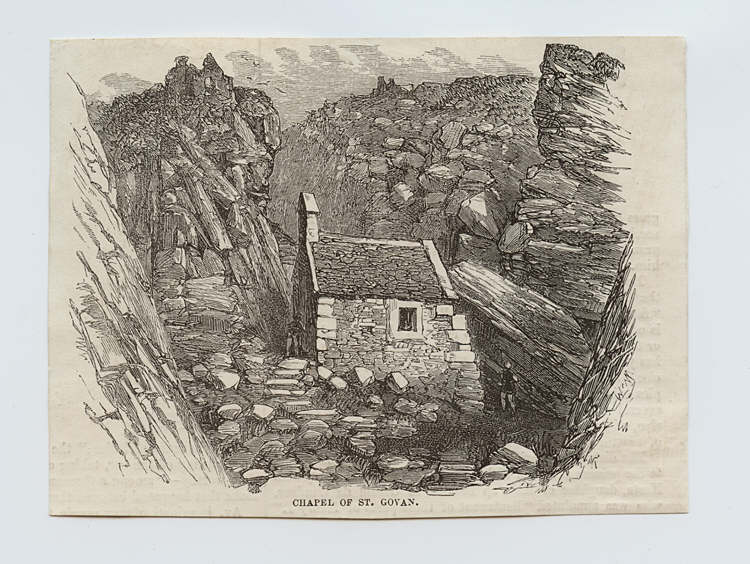
The ancient chapel is dedicated to St. Govan, thought to have been a celtic missionary from Ireland, who sailed to Wales late in his life to live as a hermit in a cave where the chapel now stands. There are some who believe Govan was actually Sir Gawain, the faithful Knight of King Arthur who retired to these cliffs..
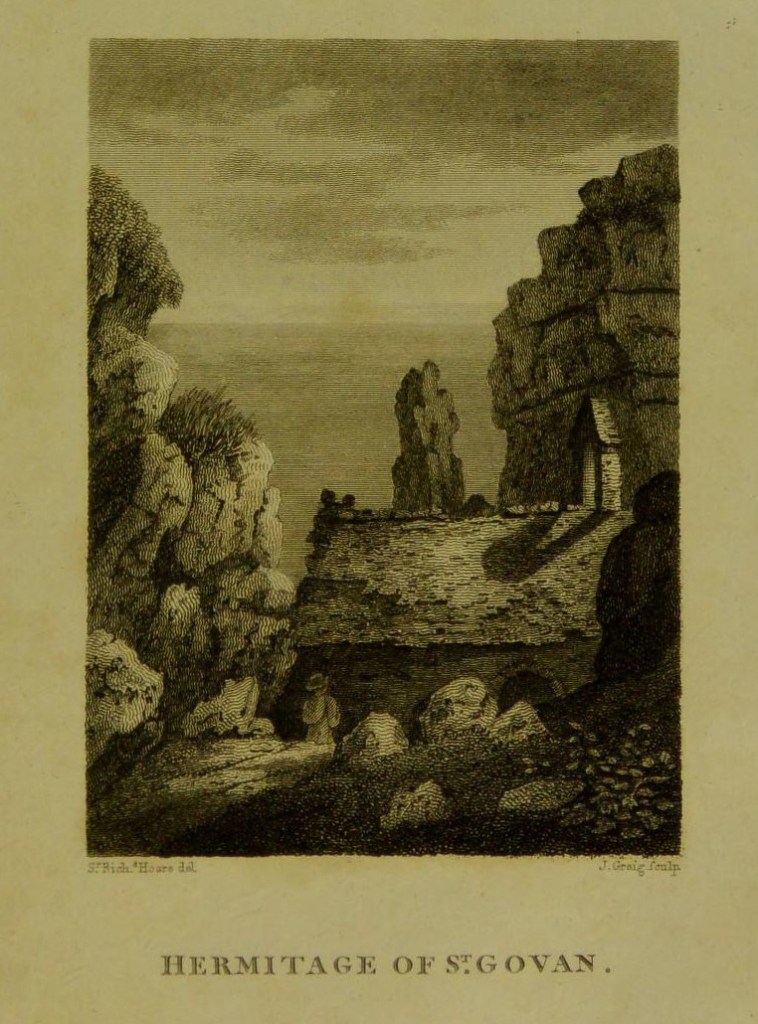
Inside the chapel to the left of the alter, is a doorway. This leads to an interesting excavation in the rock. Part of it is hollowed out and gives the appearance of an imprint of a human skeleton, particularly the ribcage. One old story says that, whilst being chased by persecutors, the rock opened up to allow the saint to hide inside. When the danger was over, the crevice opened up and never closed again, leaving the imprint of his body. He then built a hermitage in this spot. There are many different versions of these stories, though and some say he was hiding from pirates or bandits, or the locals..
There are also many versions of the story of the bell.. One is that during stormy seas, passing ships would seek shelter here, only to crash into the rocks. The locals would steal the bounty from these ships.. some would even lure ships in with lanterns. Govan would help the ship’s and began using a bell to warn them away from the shore. The locals were angry at Govan and stole his bell. He was distraught and wished for the bell to return. Angels flew the bell back and, to secure it from future thieves, encased it in stone. When Govan struck the bell, it rang out a thousand times louder than it did in it’s original form.
Another version of the tale says that Govan would use a bell to warn people of oncoming pirate attacks, and that it was actually pirates who had stolen the bell. We don’t really know where these stories originate. The case of the bell is slightly confusing, there are a few versions of the story and various ideas of which stone is actually the fabled bell rock.
Nearby the chapel is also an ancient well which was considered sacred for its healing powers. They also say, it’s impossible to count the steps that lead to the chapel!
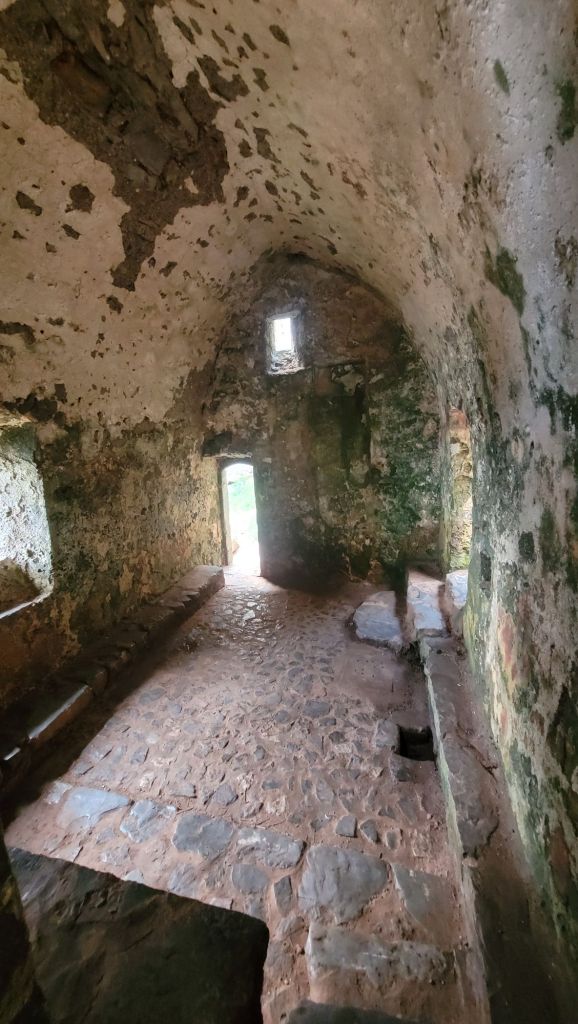
Richard Fenton described St Govan’s Chapel in his book A Historical Tour Through Pembrokeshire, published in 1810:
“Arrive at the horse-block, the only fixed directory to the path leading down to St. Govan’s chapel and well, which entered soon brings you to a flight of limestone steps, worn smooth by the feet of the curious, the superstitious, and the invalid, who for ages have visited this pious seclusion.
There is a popular belief that these steps, like the stones composing the circle of Stonehenge, cannot be numbered ; but in my descent I made them fifty-two, a tale agreeing with that of Ray, A.D. 1662. The chapel occupies the whole pass down towards the sea, being placed exactly across it ; you enter it by a door in the north-west angle, and make your exit by another in the western angle, which are both arched. It is an ancient structure, rude and unornamented, twenty feet in length and twelve in breadth ; has an altar, consisting of a large slab of limestone raised on a solid piece of masonry, where some will have it the hermit Saint is buried. To the right of the altar in the south wall is a niche for holy water, and to the left in the east wall, an arched door-way opening to a curious excavation in the Limestone Rock, just large enough to contain a middling sized man in rather a crouching posture. It is hollowed out so as to shew a narrower part for the neck and head, and a more expanded space for the body, having shallow grooves round the sides like the matrice of a skeleton. There are numerous superstitions annexed to this miraculous cell, such as that it opened at first to afford shelter to a saint closely pursued by his pagan persecutors, and after the chance was given up and the danger over, to let him out again, never closing afterwards, and retaining a faint impression of the body it had once enfolded ; that ever since it is of so accommodating a nature, as to admit of the largest as well as the smallest man, contracting or dilating to fit its inhabitant ; and that, if you frame a wish whilst in it, and do not change your mind during the operation of turning about, you will certainly obtain it ; and therefore it is not to be wondered that the interior of this marble case should bear the finest polish…
…Here, most probably, some devotee in the early ages of Christianity, mistaking his road to Heaven, might have signalized himself by his austerities and niched himself in this cleft of the rock ; perhaps one of the Gobbanuses Irish saints, disciples of Fursaeus, one of whom mentioned as a hermit, was said to have gone into Britain. The chapel, in an age subsequent, when much profit was made by the commemoration of such rigid anchorites, might have risen on the spot, which the pious recluse by his mistaken zeal was supposed to have sanctified. At the north side of the chapel on the floor there is a little cavity, shewing some appearance of moisture as of an oozing from some spring at the top of the cliff, and filtering through there forms a muddy deposit, used and held to be of sovereign efficacy in complaints of the eyes, though it is shrewdly suspected that the venerable Sibyl who superintends the supposed miraculous waters, by an alchymy peculiarly her own, has the merit of contributing the principle part of their virtues. Leaving the chapel, I continue to descend several stone steps til I arrive at the sainted well, where crippled patients bathe their limps, many of whom come from the remotest inland parts of the principality to seek relief here, and leave their crutches behind a votive offering on the altar, such as I perceived placed there when I last paid a visit to this hermitage. In the further prosecution of my way downward, I was shewn a large fragment of limestone, there being no stone of any other quality there, which struck with a stone rings like a bell ; as do two or three more that occur at intervals in the winding descent to the sea. The superstitions thus account for it ; pirates happening to land there plundered the chapel of its bell, and on carrying it off, the stones it rested on or happened to touch, ever after most miraculously uttered a bell sound. There is on the outside of the chapel a small arched opening for suspending a bell, and a hole in the stone roof within for the bell-rope that rang it to pass through.” – https://archive.org/details/b22013179/page/416/mode/1up?ref=ol&q=bell
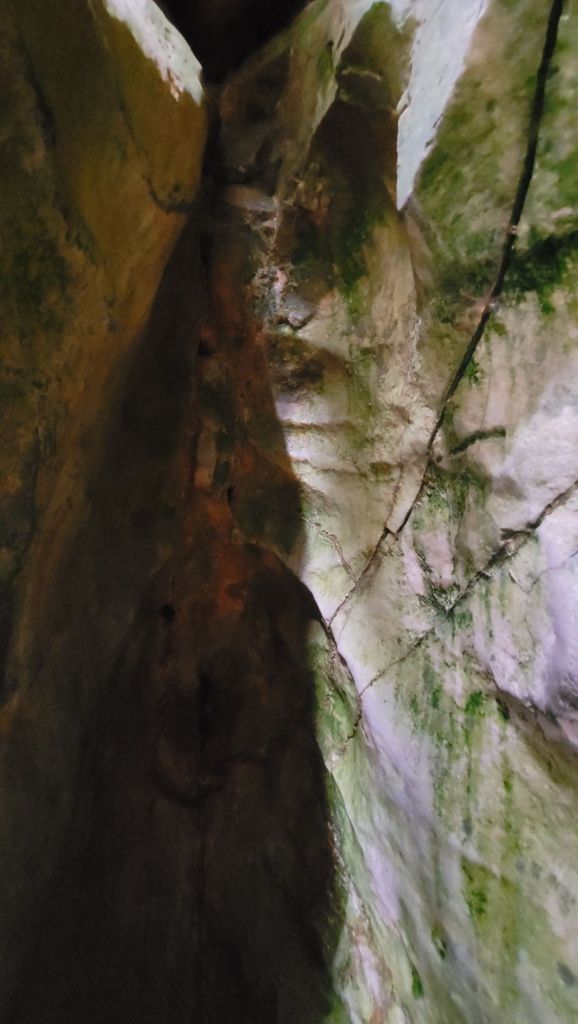
Wirt Sikes has an interesting description of the chapel and its legends in his book ‘British Goblins : Welsh Folklore, Fairy Mythology, Legends and Traditions’, published in 1880:
“In the same parish of St. David’s, there was a flight of steps leading down to the sea, among which were a certain few which uttered a miraculous sound, like the ringing of a bell. The story goes that in ancient times a band of pirates landed there and robbed the chapel. The bell they took away to sea with them, but as it was heavy they rested it several times on their way, and ever since that day the stones it rested upon have uttered these mysterious sounds when struck.
Also in this parish is the renowned Expanding Stone, an excavation in the rock of St. Gowan’s Chapel, which has the magic property of adapting itself to the size of the person who gets into it, growing smaller for a small man and larger for a large one. Among its many virtues was that if a person got into it and made a wish, and did not change his mind while turning about, the wish would come true. The original fable relates that this hollow stone was once solid ; that a saint closely pursued by Pagan persecutors sought shelter of the rock, which thereupon opened and received him, concealing him till the danger was over and then obligingly letting him out.
This stone may probably be considered as the monkish parallel for the magic stones which confer on their possessor invisibility, as we find them in the romances of enchantment. In the ‘Mabinogion’ such stones are frequently mentioned, usually in the favourite form of a gem set within a ring. ‘Take this ring’, says the damsel with yellow curling hair, ‘and put it on thy finger, with the stone inside thy hand ; and close thy hand upon the stone. And as long as though concealist it, it will conceal thee.’ But when it is found, as we find in following these clues further, that this Stone of Invisibility was one of the Thirteen Rarities of Kingly Regalia of the Island of Britain ; that is was formerly kept at Caerleon, in Monmouthshire, the city whence St. David journeyed into Pembrokeshire ; and that it is mentioned in the Triads thus ; ‘The Stone of the Ring of Luned, which liberated Owen the Son of Urien from between the portcullis and the wall ; whoever concealed that stone the stone or bezel would conceal him’. The strong probability appears that we are dealing with one and the same myth in the tale of magic and in the monkish legend. Traced back to a period more remote than that with which these Welsh stories ostensibly deal, we should find their prototype in the ring of Gyges.
The Stone of Remembrance is another stone mentioned in the Mabinogion, also a jewel, endowed with valuable properties which it imparts not merely to its wearer but to any one who looks upon it. ‘Rhonabwy’, says Iddawc to the enchanted dreamer on the yellow calf-skin, ‘dost thou see the ring with a stone set in it, that is upon the Emperor’s hand?’ ‘I see it’ he answered. ‘It is one of the properties of that stone to enable thee to remember that thou seest here to-night, and hadst thou not seen the stone, thou wouldst never have been able to remember aught thereof’. Still another stone which was on the tail of a serpent, and whose virtues were such that whosoever should hold it in one hand, in the other he would have as much gold as he might desire. Peredur having vanquished the serpent and possessed himself of the stone, immediately gave it away, in that spirit of lavish free-handedness which so commonly characterizes the heroes of chivalric British romance.” – https://archive.org/details/britishgoblinswe00sikerich/page/366/mode/1up?q=gyges
In his book, The Last Dragon, A Book of Pembrokeshire Folk Tales (1992), Brian John tells the story of a dragon linked with St Govan’s Head:
“Samson and the Pestiferous Beast-
There are not many tales of dragons in Pembrokeshire, although a number of old legends refer to worms, basilisks, serpents or flying snakes. Some of these strange creatures had stings in their tails, and some were fire-breathing monsters which laid waste the countryside. Sometimes they lives in wells or pools, and the Welsh word, Afanc is thought by some to refer to a sort of water monster. Another dragon-like creature was the Gwiber or flying snake. Dragons had a liking for beautiful princesses in particular, and they also tended to assemble hoards of treasure, which they guarded with great ferocity. They were very difficult to kill, having thick scaly hides, and only heroes and saints were able to get rid of them.
One of the saints associated with Pembrokeshire is Samson, who lived in the early sixth century AD. He was Abbott of the monastic community of Caldey Island, and spent a great deal of his early life there. One of the miracles associated with him concerns a “pestiferous beast” which was probably a dragon or Draig. According to legend, this beast was of vast size, and destroyed two districts of South Wales with its deadly breath. It lived in a cave, probably on the banks of the River Cleddau. Samson was urged to rid the area of the beast, so he agreed to see what he could do. He set out from Caldey with only a young boy to help him, and approached the dragon’s lair. On smelling the approach of human being the dragon let out a mighty roar, and started breathing fire and brimstone. But then Samson started to talk to the monster, and it became as docile as a new-born lamb. According to the legend, “it did not lift up its terrible wings, nor gnash its teeth, nor put out its tongue to emit its fiery breath.” To the amazement of the young lad who was with him, Samson took the linen girdle which was round his waist, tied it round the dragon’s neck, and led it from its cave. Then, as if he was taking a puppy for a walk, he led the gigantic creature to the top of a high cliff on the sea coast (probably at St. Govan’s Head), untied the girdle, and instructed it to leap into the sea. This it did without hesitation, and disappeared beneath the swirling waves, never to be seen again in South Wales.
According to some ancient authorities, the dragon swam across the sea to Ireland, where it came ashore and began to guard the fabulous treasure of O’Rourke. But that is another story…” – https://www.peoplescollection.wales/sites/default/files/documents/Brian%20John%20-%20The%20Last%20Dragon.pdf
 CoralJackz - That History Couple
Leave a comment