
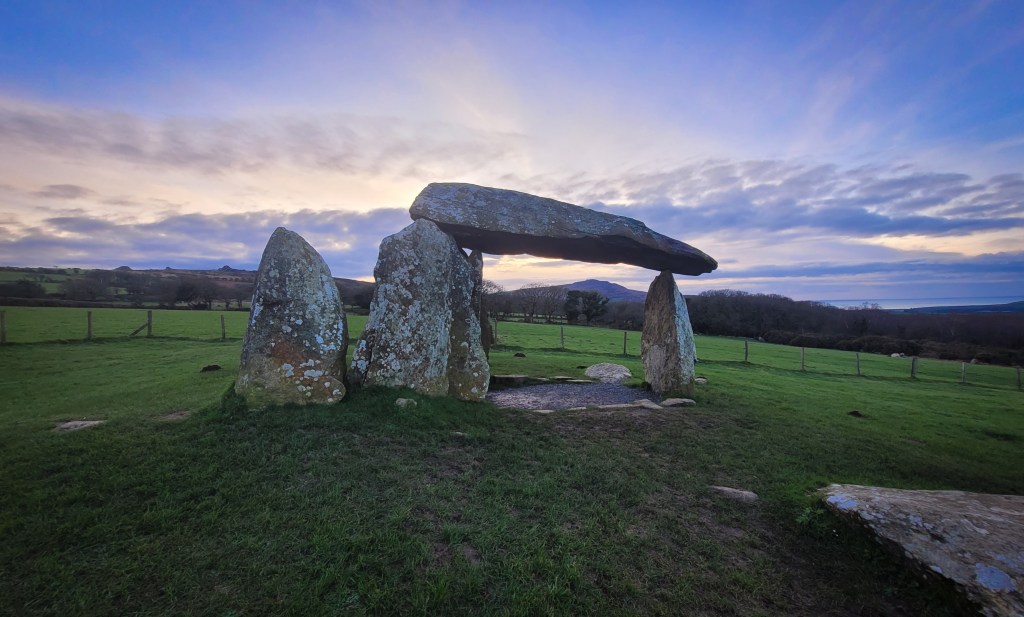

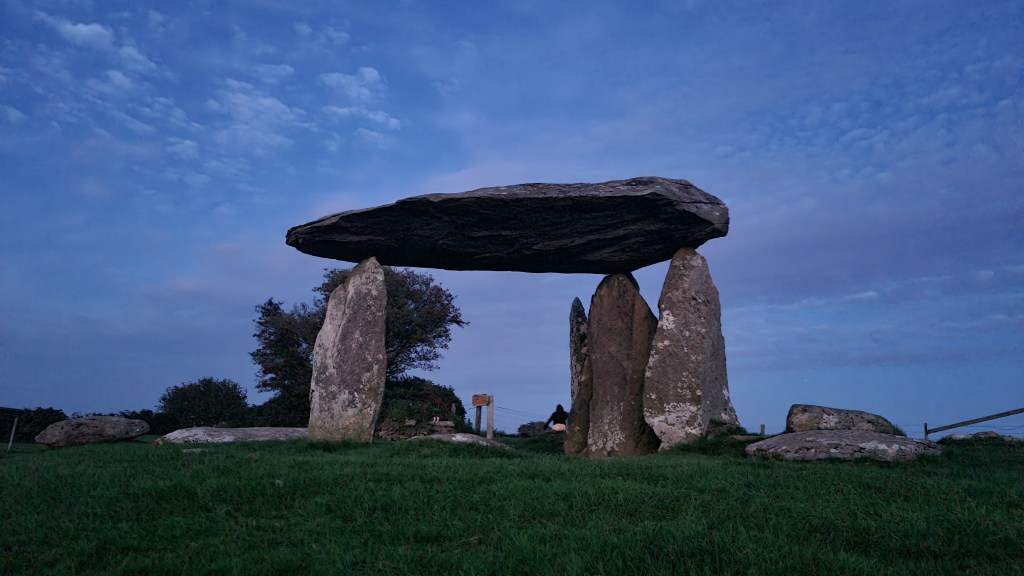
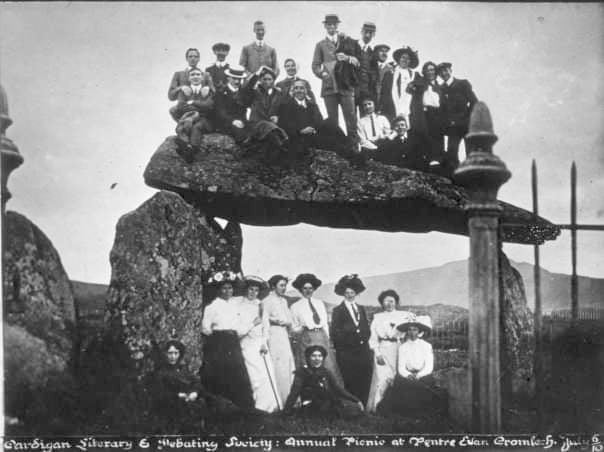
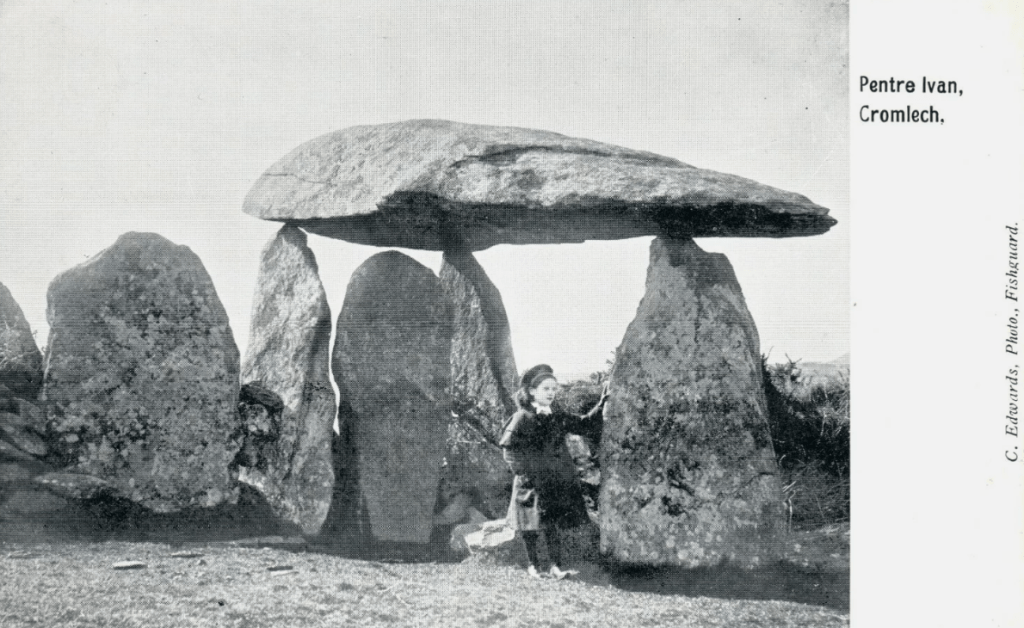
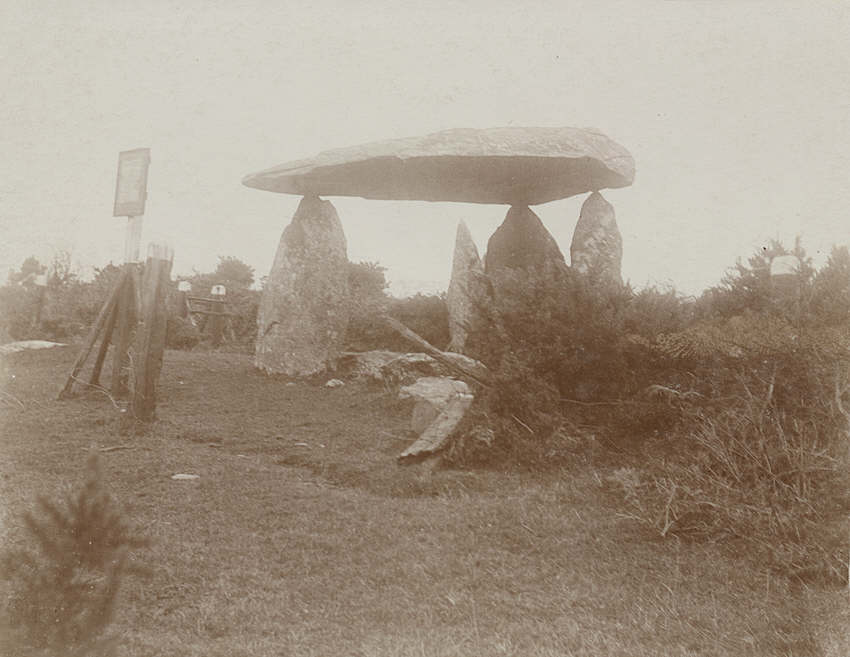
Pentre Ifan is a neolithic Portal Dolmen in Pembrokeshire, Wales. In this post, we’ll be covering the early antiquarian records of the monument, as well as the oldest photographs and illustrations. We will do a more general post regarding Pentre Ifan and its archaeology and legends. We cover the excavations that took place here in the 1930s, but will also create a separate page dedicated to the excavation.
We also have a video over on our YouTube channel where we discuss the history, archaeology and legends of Pentre Ifan –
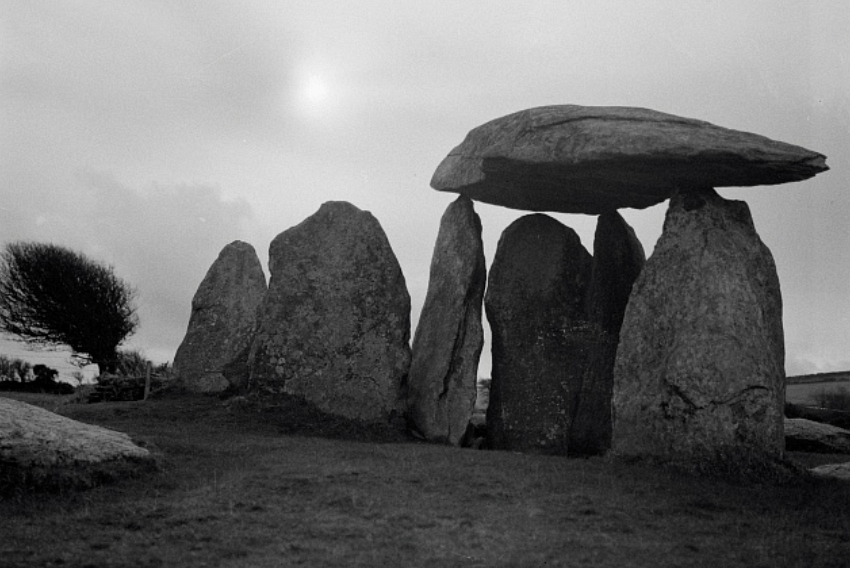
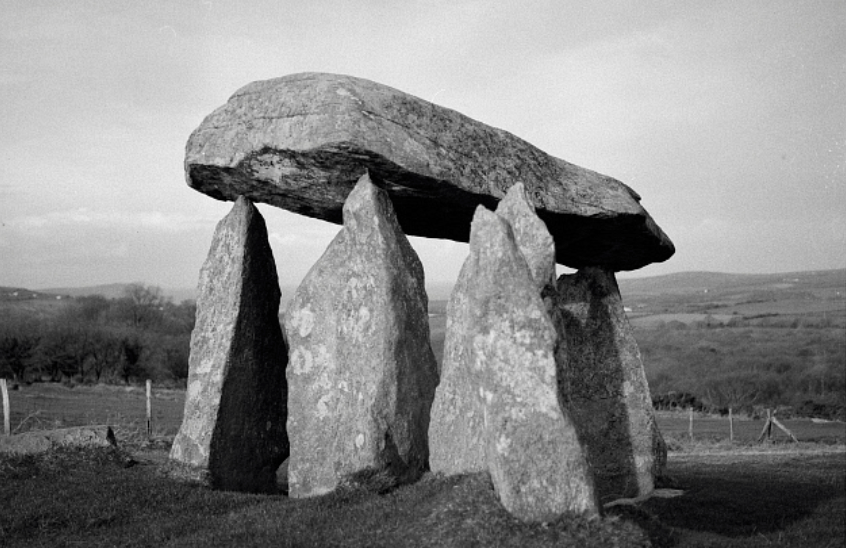
This iconic monument is considered one of the finest surviving of its kind in Wales. It is characterized by a striking silhouette and impressive size, and boasts impressive views of the surrounding landscape. The name Pentre Ifan translates as “Ifan’s Village”. On some older maps, it also appears as Evan’s Village, reflecting the English form of the Welsh name Ifan (John or Evan).
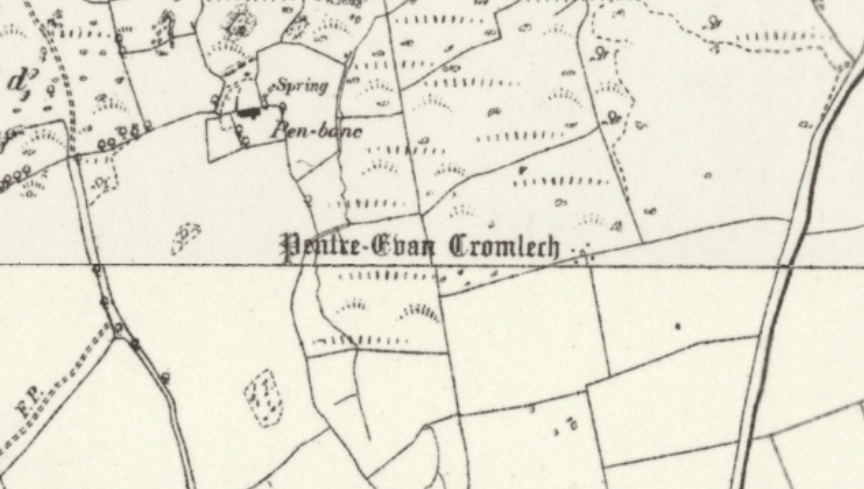

Early records of Pentre Ifan:
The earliest account we can find seems to go back to the early 17th century, by Pembrokeshire historian George Owen. In 1613 in The Description of Pembrokeshire, George Owen of Henllys (1552-1613) reported:
“Another thing worth the noting is the stone called Maen Y Gromlech upon Pentre Jevan lande. It is a huge and massive stone, mounted on high, and set on the topps of 3 other high stones, pitched, standing upright in the ground, which far passeth for bigness and height, Arthur’s Stone, in the way betweene Hereford and the Haye, or Lech y Aft, nnere Blaen Porth, in Cardiganshire; or any other that ever I sawe, saving some in Stonehenge, upon Salisburie Plaine, called Chorea Gigantum, being one of the chiefe wonders of England. The stones where on this is layd are soe high, that a man on horseback may well ryde under it without stowping. The stone that is thus mounted is 18 foote long, and 9 foote brode, and 3 foote thicke at one end, but thinner at the other; and from it, as it is apparent since his placing there, is broken a piece of 5 foote brode, and 10 foote long, lieing yet in the place, more than 20 oxen would draw. Doubtless this stone was monumented long tyme since, in memorie of some great notable person, which was the ancient rite, for that it hath pitched stones standing one against the other round about and close to the huge stone, which is mounted high to be seene afarr off, much like to that which is written..
..but there is noe reporte or memorie, or other matter to be found, of the cause of the erecting of this trophea. They call the stone Gromlech, but I thinke the true etymologie is Grymlech, the stone of strength, for that great strength was used in the setting of it, to lye in sorte as it doth. There are other stones in 2 or 4 other places in the countrey adjoining, as Llech y tribedd, neere Riccardstone, and one in Newport, neere the bridge; another beneath the towne, but not comparable to this, either in bigness, or in standing soe high..” – https://archive.org/details/s2id13293910
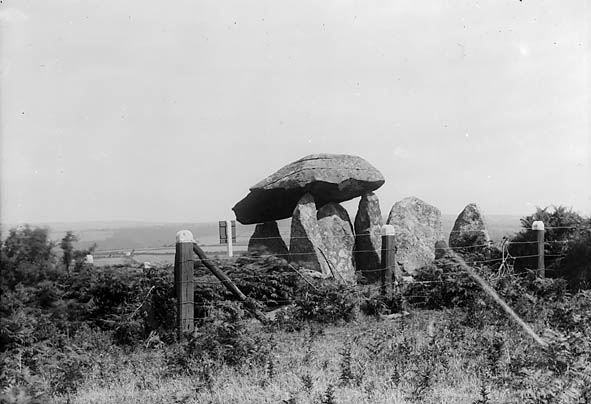
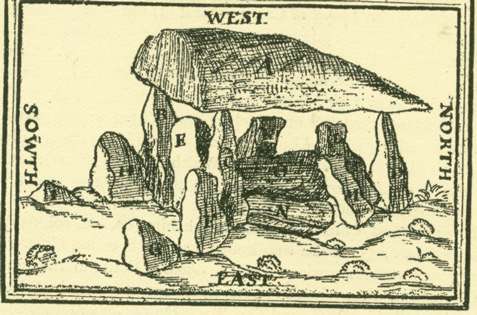
The following is quoted from A Historical Tour Through Pembrokeshire, published in 1810 by antiquarian Richard Fenton, who also provided an illustration:
“Pentre Evan, that here next presents itself, now a mere farm-house, was once the principle mansion, not only of this particular district but of this country, in the reign of Henry the Seventh, when Sir James ap Owen, one of his strenuous adherents, occupied it in the true style of baronial magnificence. Some years ago I remember to have seen fragments of buildings of superior architecture and portions of the chapel ; it lay in the midst of an extensive wood called Cilrhydd, of which old George Owen, at a period when his eye was accustomed to foresty scenes in several parts of Pembrokeshire, and chiefly in his own lands, rapturously exclaims, “It is a wonder to see such faire timber.” On this tenement nearer the mountain, at whose base it is situated, stands a Cromlech, taking its height and its other dimensions into account, unquestionably the largest Druidical relic in Wales. It rests on two coarse coumnar stones, naturally tapering to a point, with one, as is generally the case, between, which does not quite touch at the south end, and a single upright at the north end, there being but three actual supporters. There are two other rude columns near the south-west corner that once seemed to have had a sorrespondence with some which are now fallen. The tallest supporter is above eight feet high, and the lowest above seven, so that you have a singular view of Carn Englyn through, and it admits of a person on horseback riding under…
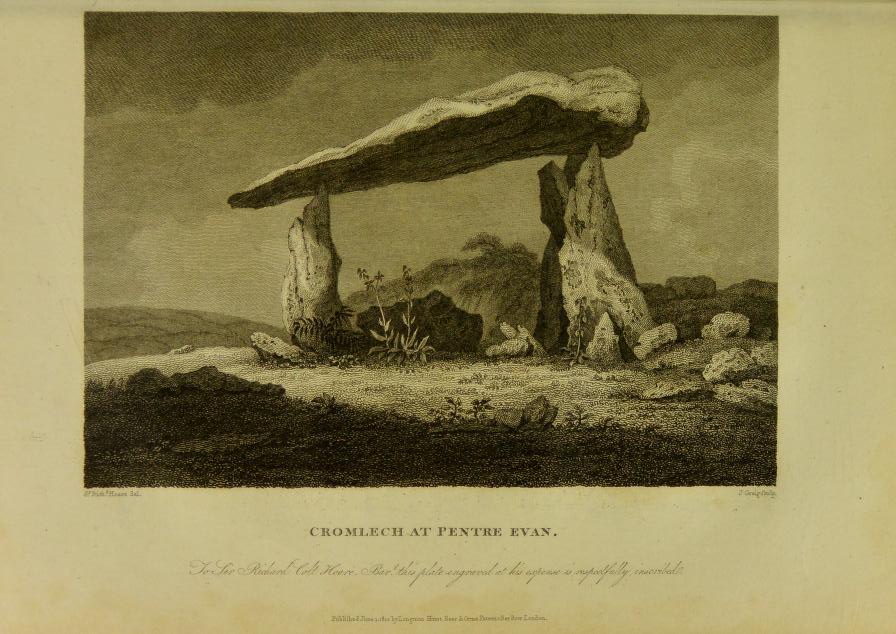
…The incumbent stone is immense, much thicker at one end than the other, and has a declination to the north-west. It occupies part of a mountain plain full of large stones, and some of them seemingly overturned monuments of the same character with this. Even the immediate accompaniments of the present were more numerous, and appeared to have been placed in mysterious order, as I find from the account given of them two centuries ago by a correct antiquary of that day and neighbourhood, which I here subjoin in his own forcible language, when talking of the remarkable monuments in this country (r). “Another things,” he says, “worth noting is the stone called Maen y Gromlech in Pentre Jevan lande. It is a huge and massive stone mounted on high, and set on the topps of the other high stones pitched, standing up-right in the ground, which far surpasseth for bignes and hight Arthur’s stone in the way betweene Hereford and the Hay, or Llech yr Ast neere Blaenporth in Cardiganshire, or any other that ever I sawe ; saving some in Stonehenge upon Salisburie Plain, called Chorea Gigantum, being one of the cheefe wonders of England. The stones whereon this is layd are soe high that a man on horeback may well ryde under it without stowping, and the stone that is thus mounted is eighteen foote long, nine foote roade, and three foote ticke at the one ende, but somewhat thinner at the other ; and from it, as is apparent since its plasing there, is broken off a peece of five foote broade and ten foote long lieing yett in the place. The whole is more than twenty oxen could draw. There are seven stones that doe stand cirlce-wise, like in form to the new moon, under the south end of the great stone, and on either syde two upright stones confronting each other. Doubtless it was mounted long tyme sithens in memorie of some great victorie, or the buriall of some notable person, which was the ancient rite, for it is mounted on high to be seene a far off, and hath divers stones round it set in manner much like to that which is written in the first book of Machabees, cap. xiii. onlie that this our trophee is of ruder forme. They call the stone Gromlech, but I thinke that the true etymologie is Grymlech, that is, the stone of strength, for that great strength was used in the setting it to lye in sotre as it doth.” – https://archive.org/details/b22013179/page/561/mode/1up?ref=ol&q=pentre+evan
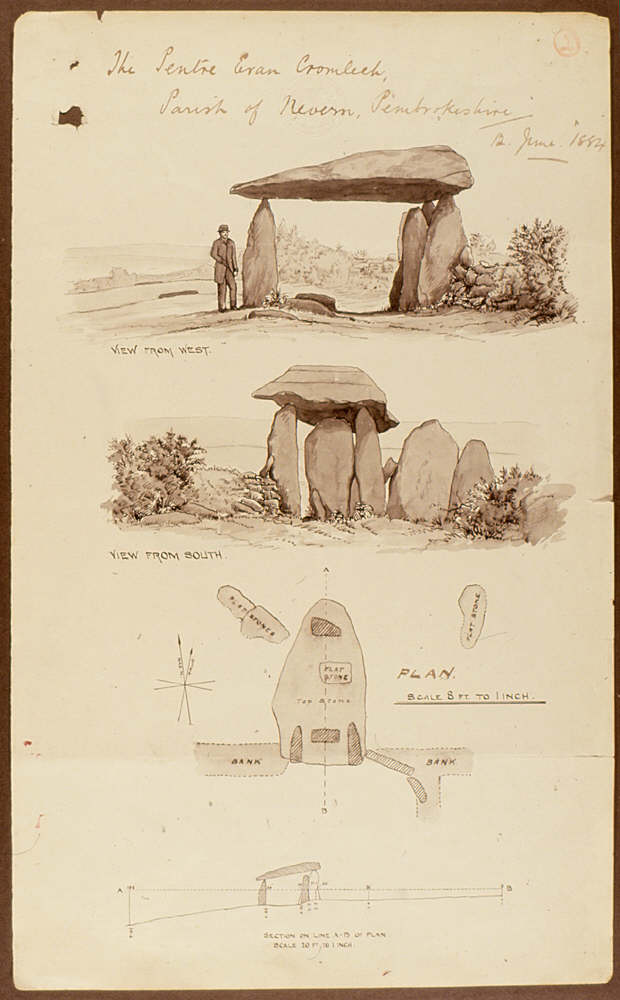
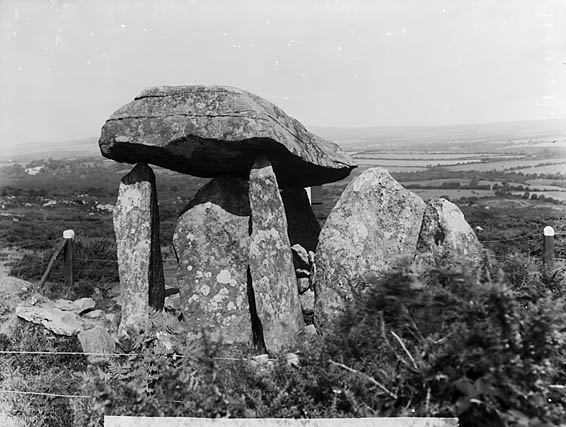
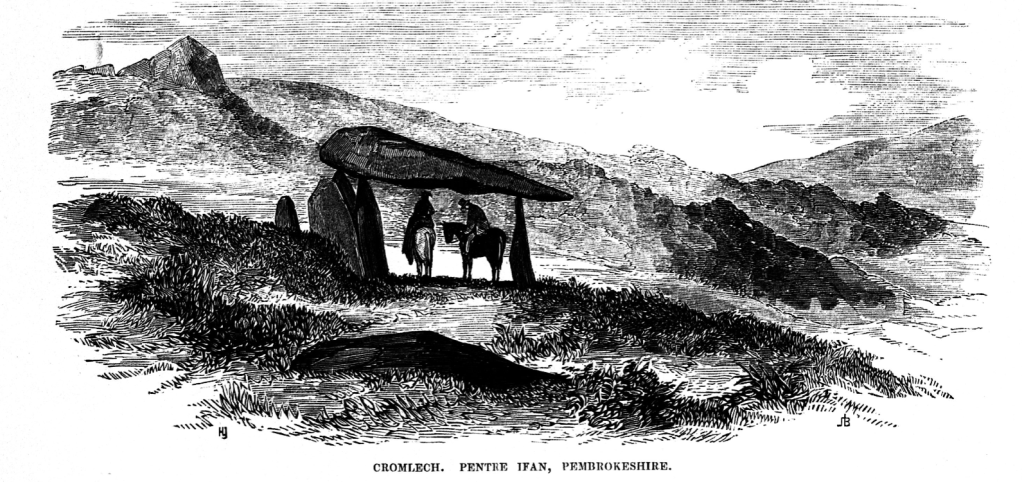
Harry Longueville Jones records Pentre Ifan in Archaeologia Cambrensis, July 1865, and also provides an illustration:
“The whole ridge of Carn Ingli, in the barony of Cammaes, is worthy of careful antiquarian examination ; more careful, we mean, than what it has hitherto received. It will be found, like the far larger range of Precelly, to present many striking features connected with the early history of the district ; and it is to be hoped that a complete account of both ridges will ultimately be compiled for the Association.
On the north-eastern slope of this ridge, upon ground which until lately was unenclosed, stands the great cromlech of Pentre Ifan, so called from the ancient neighbouring mansion. It is one of the largest in Wales ; and its size may be judged of from the fact that, when the Association visited it in 1859, five persons on horseback were ranged beneath the capstone at one and the same time. It seems to have formed one of several other sepulchral chambers, covered by a common mound ; traces of these others, and of the carnedd of stones, being visible in the immediate vicinity ; but the enclosures of the land have been brought close to the south side of the mound, or have cut through it ; and hence the disappearance of its contents and materials is easily accounted for.
The stones are all of the same kind as the rocks towering on the ridge not far behind them ; and they may have been forced down by the rude mechanical appliances of early times without much difficulty. Still the cap-stone is one of unusual magnitude, and the whole monument has an appearance as grand as it is picturesque.
Although the covering tumulus has disappeared, and though from the height of the capstone above the soil it may be supposed that the very foundations are laid bare, yet it might lead to the discovery of remains, if the soil all around were carefully probed and examined.
Here the cromlech stands some five or six miles away from the sea ; and it probably served as a resting place to a chieftain and his family dwelling in comparative security, though at what period of the history of Wales it would be vain to conjecture. The adjacent district offers a tempting field of operations for any one interested in the early inhabitants of Pembrokeshire ; and it would not be surprising if other remains, now not known, were brought to light by sufficient research.
H. L. J.” – https://journals.library.wales/view/2919943/2996467/76#?xywh=-466%2C137%2C3318%2C3408

In 1872, E.L. Barnwell makes record of Pentre Ifan in Archaeologia Cambrensis, and also provides the same illustration as H.L.J.:
“Pentre Ifan or Evan cromlech stands on the north eastern slope of the Carn Ingli ridge, on the crest of which are numerous remains of circles and other traces of human occupation, although now a wild heath, far removed from dwellings of any kind. Lower down, however, enclosures have of late years been made ; so that although the ground on which this relic stands is open and uncultivated, yet imediately behind it are a high bank and hedge, which do not appear in the cut here reproduced from the volume of 1865. This dolmen is the highest in Wales ; and, when perfect, was probably the largest also, if any inference may be drawn from existing remains. In the Additions to Gough’s Camden (1789, vol. ii, p.521) will be found a description of it as it was in the time of George Owen, the historian of Pembrokeshire, who lived nearly three centuries ago. Fenton has also given an extract from the same writer, accompanied with an engraving of it as it was in his own time, some seventy or eighty years ago, and which does much more justice to the imposing character of the structure than the small though accurate one here given..
.. After mentioning its huge proportions, he goes on,-“There are seven stones that do stand circle-wise, like in form to the new moon, under the south end of the great stone, and on either side two upright stones confronting each other. Doubtless it was mounted long tyme sithens, in memorie of some great victory, or the burial of some notable person, which was the ancient rite ; for it is mounted on high, to be seen affar off, and divers tall stones round it, set in manner much like that which is written in the first book of Maccabees (cap.xiii), onlie that this our trophy is of ruder forme. They call the stone (* This is probably one of the earliest instances of the name cromlech being applied to such ruined chambers, although it occurs twice in the Welsh Bible of 1588 (see Isaiah, ch. v and lv11), followed by creigiau, “the holes and clefts of the rocks” of the English version.) Gromlech ; but I think the true etymologie is Grymlech, that is the stone of strength, for that great strength was used in the setting it to lye in sorte as it doth.”
From the Additions to Camden we learn that a circle of rude stones, 50ft in diameter, surrounded “the large stone 18 ft. long, 9 broad, and 3 thick at one end, supported by three large rude stones about 8ft. high, with five others which do not contribute to its support. The area under this stone is neatly flagged. A piece about 10 ft. long and 5 broad, more than twenty oxen could draw, broken off the larger stone, lay by it.”
Sir Gardner Wilkinson has also given an account of this monument in the volume already alluded to. His measurements vary but little from those above stated, except that he gives the length and breadth of the capstone 16 1/2 ft. and 9 ft. 4 ins., and about 2 1/2 ft. at the southern and thickest end. He states also that the capstone is supported by two only of the upright stones the third being two inches shorter than its companions. “The two highest are 7 ft. 9 ins., and the northern supporter is 7 ft. high.” These measurements may be relied on as the correct ones. The dimensions given in Camden have evidently been taken roughly. “Adjoining it, at the south eastern corner, are two large upright slabs quite unconnected with the support of this monument ; and three fallen stones lie towards the north end, partly beneath the capstone, and another a short way from it, to the south west.” Sir Gardner thus accounts for nine stones independently of the capstone ; but there are several others close to it, although excluded from sight by the high bank behind the chamber…
…These have all formed parts of the original structure, and have been removed, out of the way, under and along the banks and hedges of the enclosed field. Some of these are about 8 or 9 ft. long. The late Rev. H. Longueville Jones thought that originally there was more than one chamber, which is not unlikely ; but at any rate it is quite certain, from the present remains, both standing in their original positions and scattered about, that we have in the Pentre Evan monument the remains of a very large chamber or chambers. The flagged area (now, indeed, stripped of its flagstones) is sufficient proof of itself that there was a chamber, in spite of Mr. Fergusson’s bold statement that there never could have been one. The slabs which Sir Gardner speaks of as quite unconnected with the support of this monument, must have been connected with something. It is evident these were placed in their position for some purpose, which was probably to support the capstone of a secondary chamber, unless we suppose one long chamber covered by two or more capstones. George Owen speaks of a fragment of the present capstone, 10ft. long. If he is correct, this would make the original length of the capstone nearly 30 ft. ; but at present there are no traces in the existing one of any such fracture, so that it is not impossible he was mistaken, and that the stone he saw was the capstone of that part of the structure where the slabs mentioned by Sir Gardner Wilkinson stand. It was a mistake easily made by George Owen, who never suspected the prolongation of the existing chamber towards the south, or the existence of a second chamber, as we find in the Plas Newydd monument.
The size of this monument, and the bare, rocky nature of the ground, have induced some to think that it was never covered up, although they must be at a loss to explain what it could have been built for, and for what possible use, if it had not been protected in some way or other. There are, however, some scanty traces of the former envelope, unless they have been removed since Mr. Longeuville Jones visited the spot. There is a curious pitched path leading through a wood from the lower ground, in the direction of this dolmen. Nothing is known of its history, and even local tradition is silent. All that can be said of it is that it was apparently made at a time when the population of the district was located more on the higher grounds than at present, and that this pitched way was for their especial accommodation. It may also have been the ordinary trackway of the district before other means of communication existed…
…The late Rev. J. Jones, better known by his bardic name of “Tegid”, and some time vicar of Nevern, stated in 1847, that in the field adjoining the land where the cromlech stands, about two hundred and fifty yards to the north east, was a huge recumbent stone, “evidently” (to use his own words) “intended for an altar, but broken in the act o being lifted up or hoisted.” At one end of the stone were two large artificial holes, for the insertion of poles used in lifting up the stone, or supporting it when lifted up. Close at hand there was a rock, or a rock like stone, with large holes in it, made apparently to rest the ends of the poles in them while the stone was being lifted up. (Arch Cambs 1847 p 374) Both Fenton and Sir Gardner Wilkinson appear not to have heard of such a curiosity.” – https://journals.library.wales/view/2919943/2999961/48#?xywh=32%2C1649%2C2204%2C2264&cv=47


This cromlech, like others locally, is estimated to have been constructed around 6000 years ago and is commonly referred to as a burial chamber or portal tomb. But the evidence that it was ever covered over and used for burial is somewhat lacking
Excavations took place in 1936 and in 1958, followed by further research in 1972, that suggests the site was developed over three main phases. The first phase consisting of a single standing stone, a large earthfast boulder and a firepit. The second phase being the raising of the capstone, to create the portal dolmen we see today, along with creating some kind of stone platform around the monument.
And the third stage being the conversion of the portal dolmen into a Long Cairn, expanding the existing platform to create a long mound and placing two additional standing stones at the entrance or forecourt. The evidence for these phases comes from the discovery of rows of individual pits which lay under and around the mound, and would therefore predate it. Kerbstones for the mount were also found, but not in a complete sequence, which aligned more to the pits than the stone chamber. Although scant, these finds are consistent with other sites; where a fire pit and a single stone, or small cluster, appear to predate the later cairns. Radio carbondating of charcoal samples at nearby Carreg Coetan Arthur, gave dates ranging from 3900BC to 2900BC, the latter being taken from material blocking the forecourt, suggesting the original use of the monument ceased around this time.
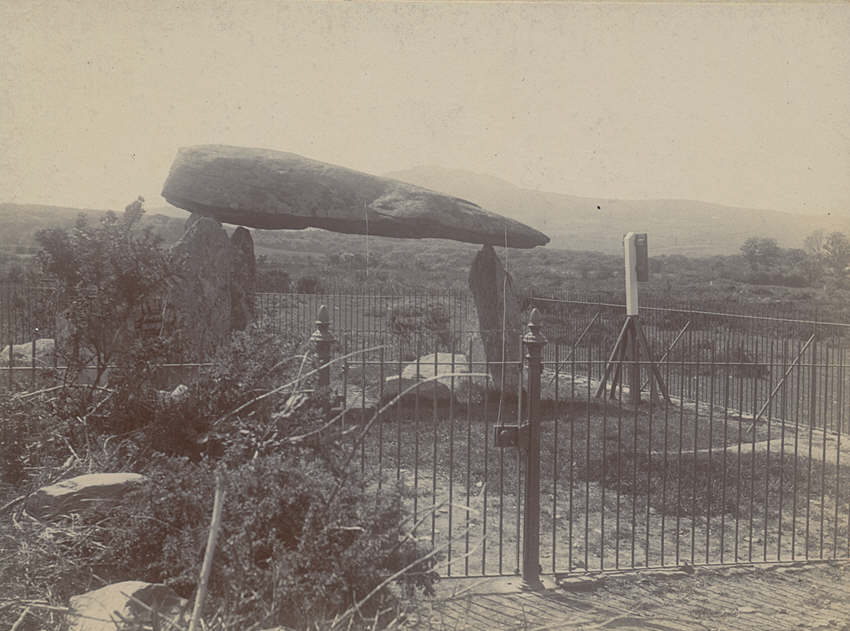

These excavations revealed slight traces of a trapezoidal cairn of boulders about 40m long by 8m wide at the southern end, surrounded by a slight ditch and edged by evenly spaced stone-holes along part of its south side suggesting that originally it may have been bounded or framed with a ring of upright stones. While there is a suggestion, that the monument may have been blocked up with dry stone walling near the end of its use, there is no evidence that the monument was ever covered by the mound. There have been smaller monuments, in Wales and Ireland, found fully covered with internal chambers made up of single and multiple dolmens, but Pentre Ifan differs both in scale and design.



Accessing the site:
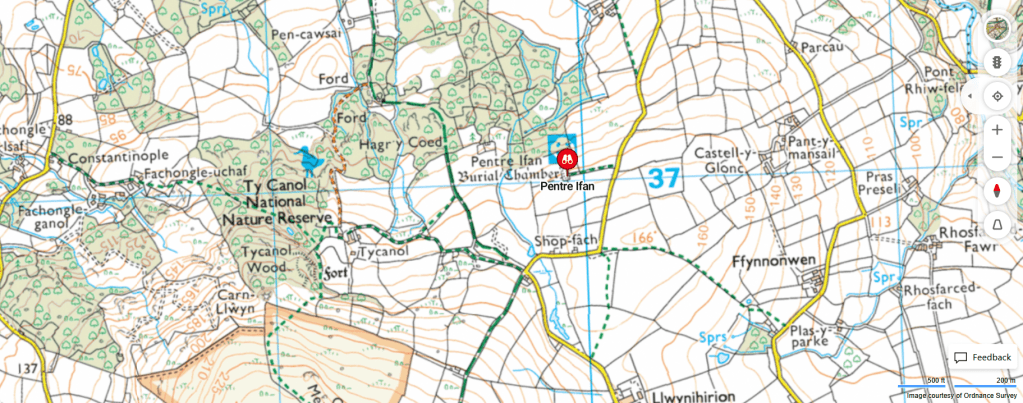
Pentre Ifan can be accessed easily be parking in the provided parking spaces next to the entrance to the field. Spaces are limited and this spot can get quite busy.. However, most people seem to stay for a short time so a parking space tends to free up quickly. The walk to the monument is very short!
 CoralJackz - That History Couple
Leave a comment