
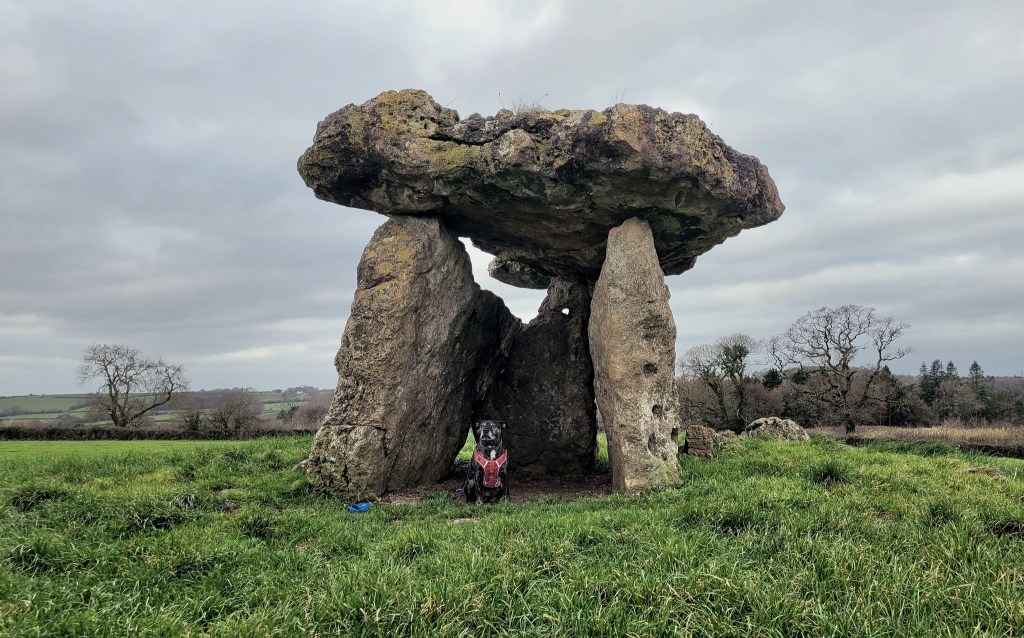

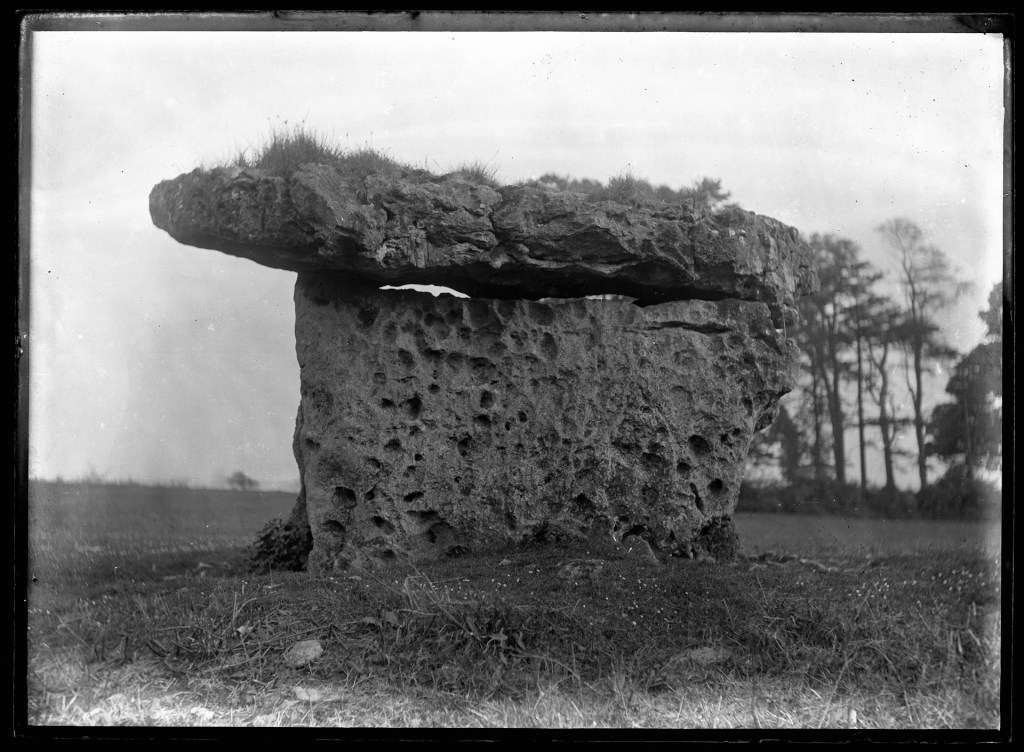
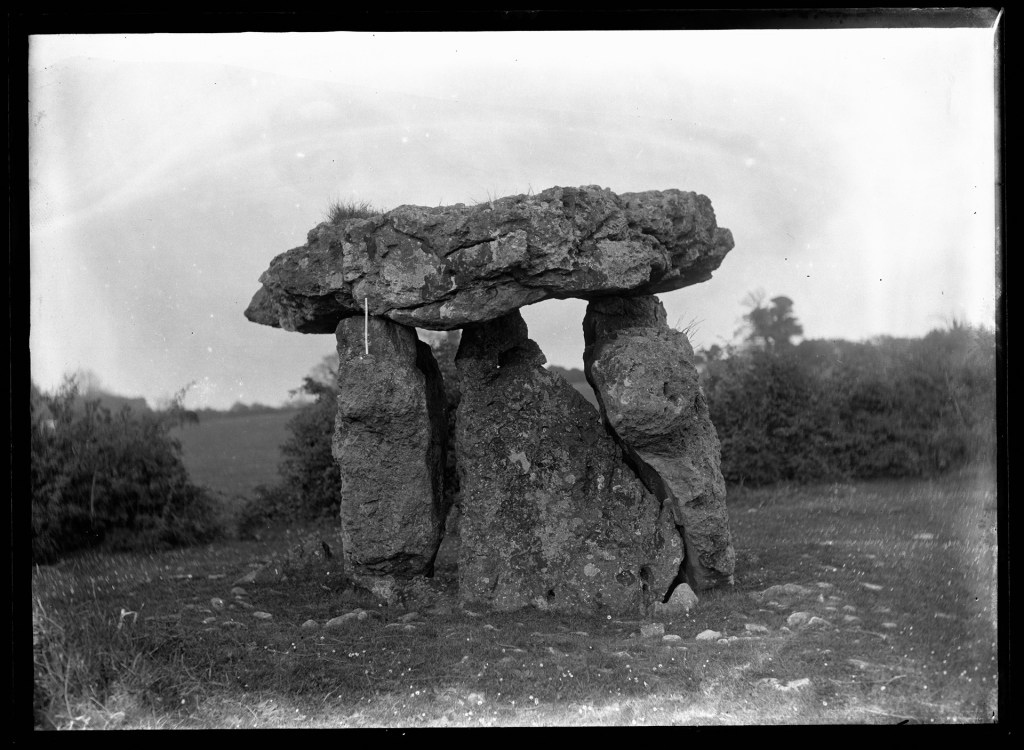
Less than 10 miles from Cardiff city centre in Wales is the village of St. Lythans. Here is where we find a neolithic cromlech, otherwise known as Maes y felin (The mill field), named after the field in which it sits. Another name for the monument is Gwal y filiast, a name shared by a handful of cromlechs in Wales. We cover the legend behind this name in *this post*, as well as in a couple of our Youtube videos.
Here, we’ll cover the old records and images of St Lythans Cromlech, as well as the finds from excavations that took place. If you would like to see our video in which we explore the history, archaeology and legends of St Lythans, here it is below –
Coflein description of the site:
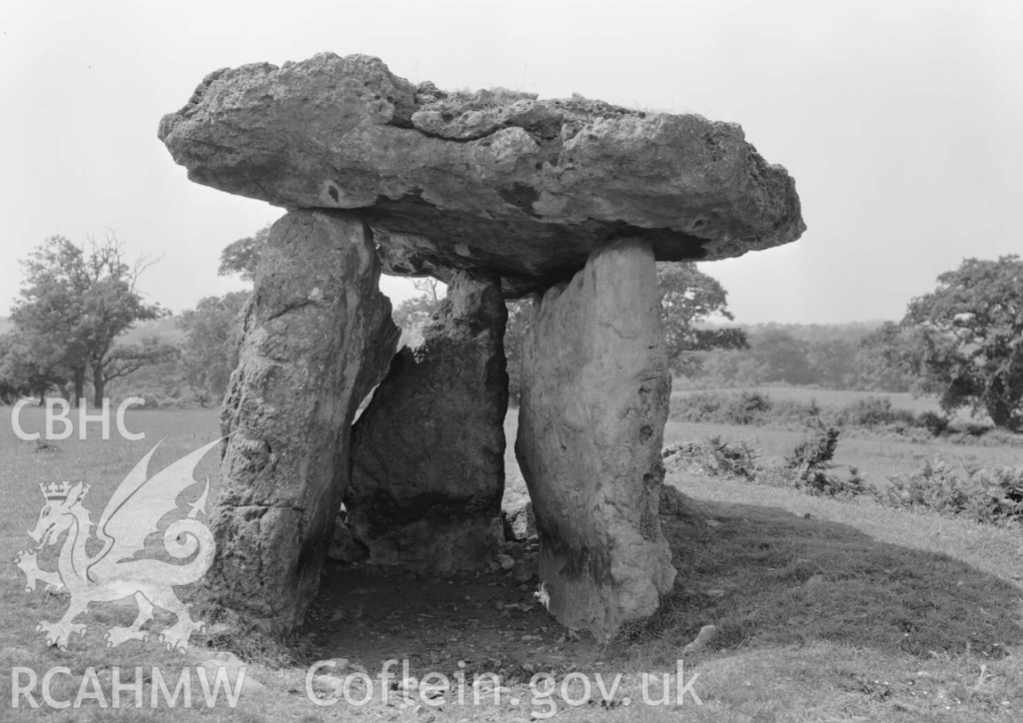
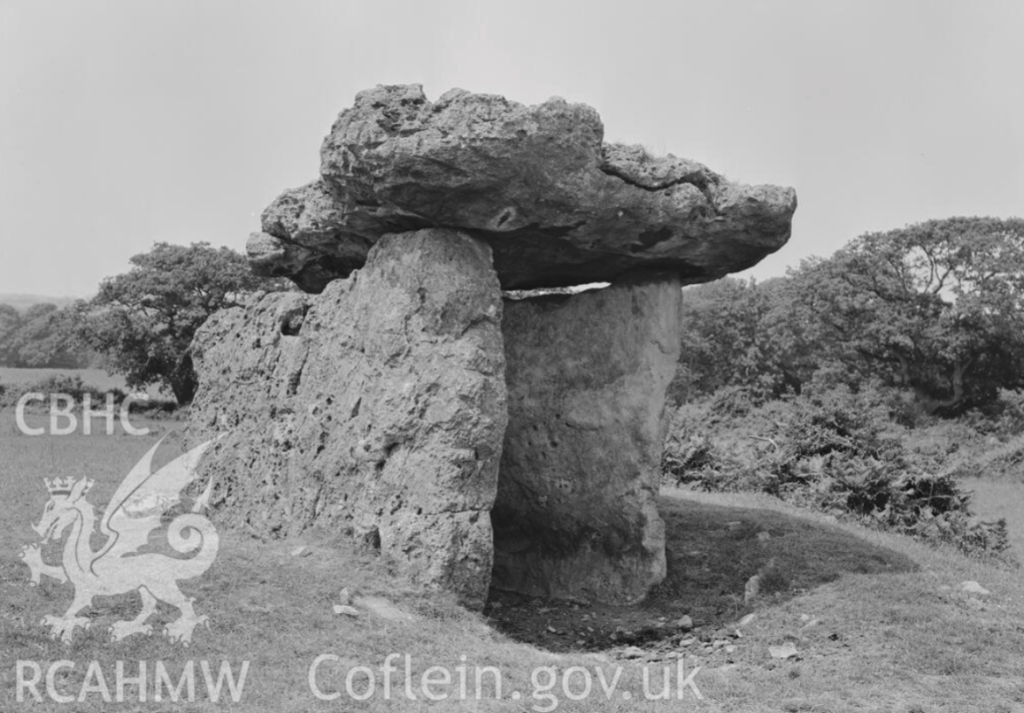
“The remains comprise a rectangular chamber set in the E. end of a long mound, which is spread to about 27m E-W by 11m, with a maximum height of about 1m. The sides of the flat top seem parallel, about 7m apart, and the W. end tends to a square shape, suggesting that the whole monument may have resembled Tinkinswood in plan, but there is no trace of revetment. The burial chamber is also similar in position and general form, though more trapezoid in plan, and with a greater minimum internal height of 1.8m at the W. Both sides are formed by single massive slabs, which are earthfast only at their E ends; the end slab is triangular, leaning inwards and tapering almost to a point. All three slabs support the single great capstone, which is pitched slightly upwards to the E; all are of the same mudstone used at Tinkinswood, but were probably available locally. Human remains and coarse pottery were found in 1875 in the debris thrown out from the interior, which partly fills the hollow of the original forecourt in the E end of the mound.” – https://coflein.gov.uk/en/site/227289/images?pg=2
Old records and images of St Lythans cromlech:
In 1834, Samuel Lewis makes record of the cromlech in ‘A topographical dictionary of Wales..’ Simply stating, “there is a cromlech on St. Lythan’s common.” – https://archive.org/details/topographicaldic12lewi/page/n205/mode/1up?q=cromlech
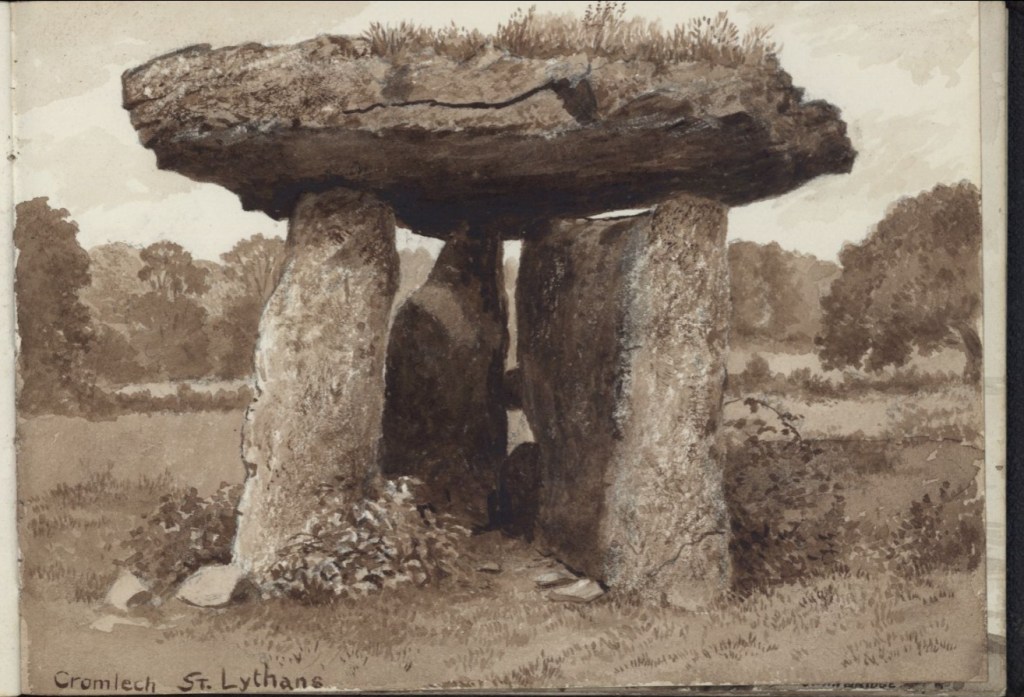
In 1875, J.W.Lukis records the cromlech in Archaeologia Cambrensis:
“..about three quarters of a mile from this spot, following the road southwards to St. Lythan’s, you arrive at a cross road, close to which, on turning to the left and near to a small cottage, stands in all its grandeur in the field above the fine megalithic structure of St Lythan’s, very good drawings of which are given in No. 17 of this Journal.
Here, too, I also found children playing ; on my asking them what they called these “big stones”, they replied, “Stoney House”. The name given in the Ordnance map of the locality is Maes y Felin.
Its dimensions are, height to top of capstone 11ft. 8 in. length 14ft. 8 in. by 10ft., and 2ft.6 in. in thickness ; height of south prop 9ft. 11in. by 11ft 6 in., and 1ft. 6 in. in thickness ; the north prop measures 9ft. 10 in. high by 10ft. wide, and 1ft. 9in. thick; the western prop is 7ft. 6 in. high by 4 ft. 8 in. wide.”- https://journals.library.wales/view/2919943/3000879/86#?xywh=-6%2C908%2C2164%2C2223
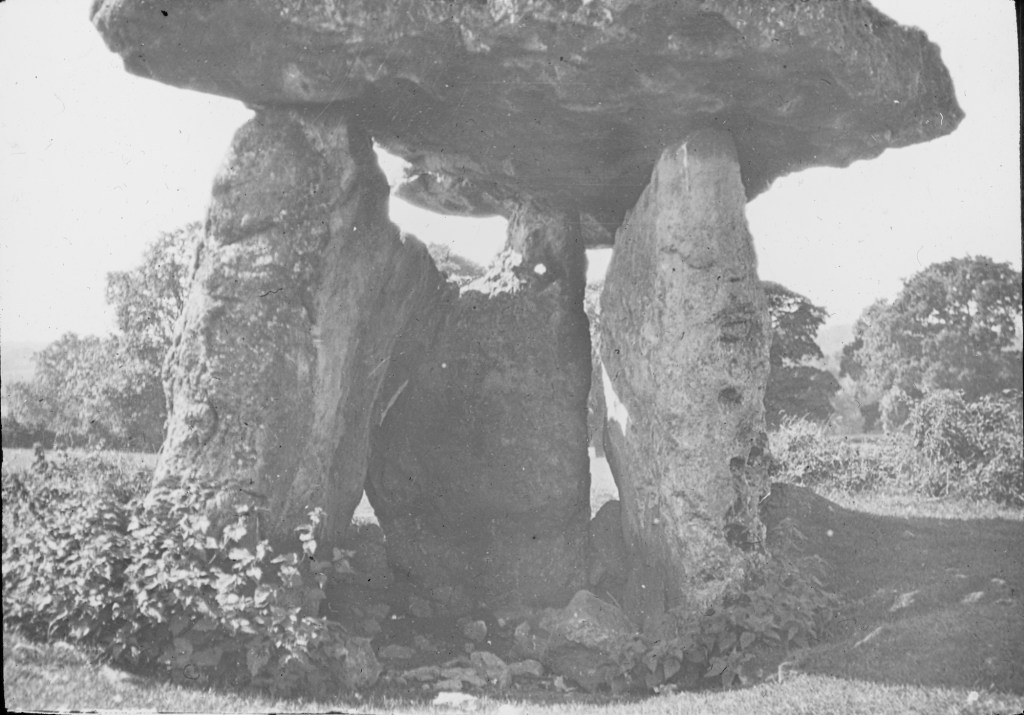
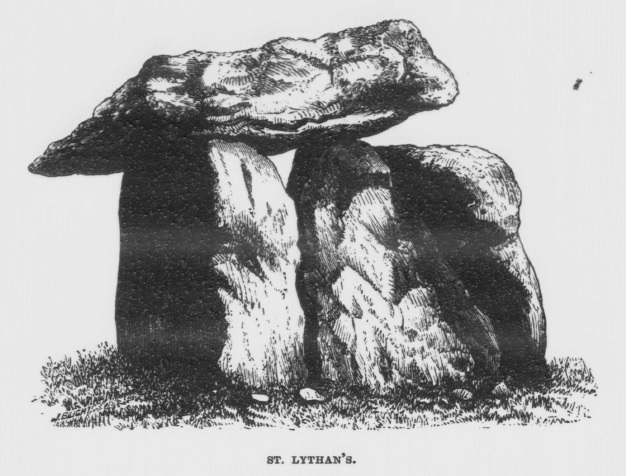

The following is quoted from Archaeologia Cambrensis, 1915, written by John Ward, F.S.A.:
“Five-sixths of a mile to the south-west, and near the village of St. Lythans, is another great chamber, which, although smaller than that of Tinkinswood, is more imposing, as it is loftier and is not dwarfed by trees in its immediate vicinity. It is known, by way of distinction, as the Maes-y-felin Cromlech, from the name of the adjacent farmhouse. Its great slabs were probably obtained from a spot about 100 yards to the south, where there is still to be seen an exposure of the cromlech bed.” – https://journals.library.wales/view/4718179/4726082/289#?xywh=249%2C747%2C2028%2C2083&cv=288
Discoveries at the site:
In 1875 the chamber had been cleared and some record was made. Finds included bone, struck flint and pottery. In 1992, severe erosion of the soil beneath and around the cromlech, resulted in the discovery of a polished stone axe fragment as well as several flint flakes.
The following is written by Toby Driver, published in Archaeologia Cambrensis, 1992:
“Between April and September 1992, eleven prehistoric flint flakes and a polished stone axe fragment became exposed in the severely eroded cairn surrounding the St. Lythans chambered tomb, following wet weather and the action of livestock. The finds were recovered by the author to prevent further loss or damage, and the axe fragment and five flakes were accurately measured on site prior to removal. (Fig 1).
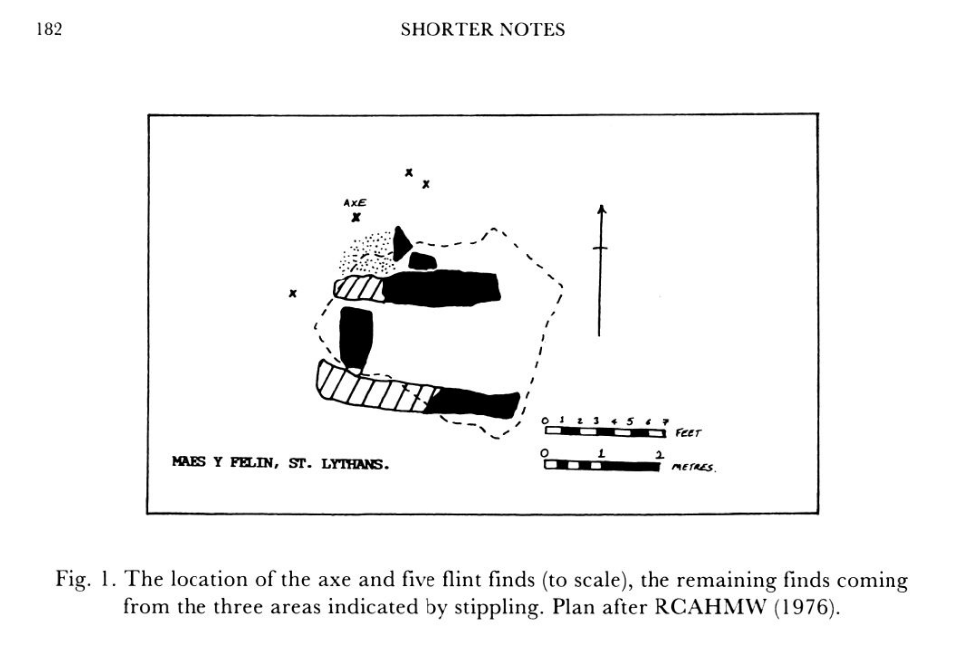
The polished stone axe fragment (Fig. 2, A), recovered from the NW side of the chamber, is the central section from what was once a small but very highly polished stone axe with fine bevelled edges and an oval section. The stone is whitish, a pitted grey where broken, but has not been petrologically identified. The breaks are not modern, and the fragment is partially covered with a flecked brown patina. Eleven small flint and chert flakes were also recovered, the largest (Fig. 2, B) 35mm long and partially retouched.
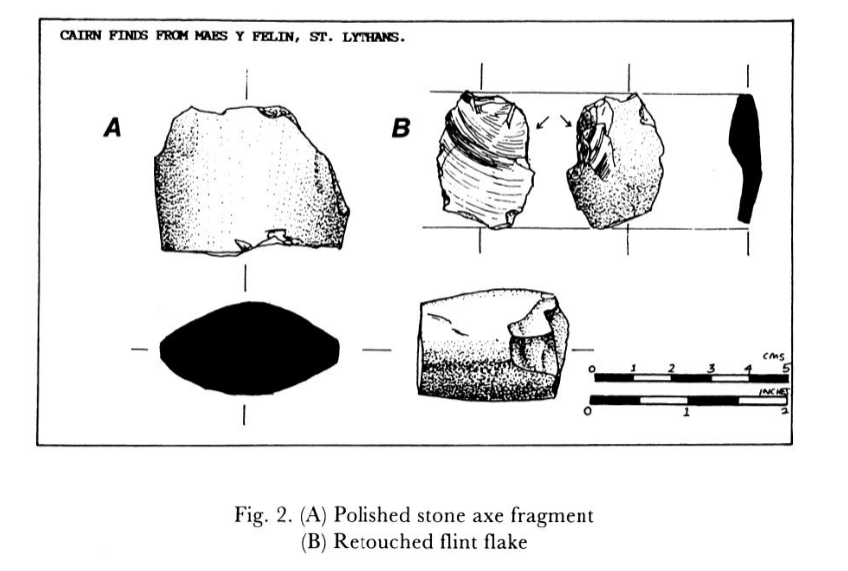
These artifacts and details of their find spots have been placed in the National Museum of Wales in Cardiff with the permission of Cadw, the landowner of this guardianship monument. They join a fine leaf-shaped arrowhead 25mm long by16mm (not illustrated) found independently in the same erosion feature and handed to the National Museum. Together these artifacts are a significant addition to the “human remains and coarse pottery” (Houlder 1976, 39; Fig. 13) found at the chamber when the forecourt spoil was investigated in 1875.” – https://journals.library.wales/view/4718179/4750733/187#?xywh=64%2C878%2C2137%2C2195&cv=186
In 2011 an excavation took place at St Lythans cromlech to determine the length, depth and width of the mound and see if any features of a forecourt survived.
The following is quoted from https://cadw.gov.wales/sites/default/files/2019-05/South%20Wales%20Vale%20of%20Glamorgan_EN.pdf :
“In the latter part of November, the focus of the project shifted to St. Lythans. Although human remains and pottery were found at the site in the nineteenth century, this was the first time the tomb had ever been scientifically excavated and we began the three-week-long dig with a great sense of excitement.
Our trenches provided a wealth of evidence about the structure of the tomb. Although the cairn had been badly damaged by thousands of years of stone robbing and recent ploughing, it was clear that the cairn was constructed from locally collected limestone slabs and boulders and was originally 30m (98ft) long and 12m (39ft) wide.
Just as at Tinkinswood, the mound was surrounded by a low, drystone revetment wall, with more impressive drystone walls flanking the approach to the chamber from the eat, creating a forecourt.
A trench in the forecourt area yielded up a number of important artefacts, including fragments of human bone and teeth, part of a bone needle, a fragment of a Neolithic polished stone axe and sherds of Neolithic Grooved Ware pottery. All have been sent for analysis by specialists.
One of our most exciting results was the recovry of charcoal samples from the prehistoric ground surface beneath the monument. Radiocarbon dating of these samples should give a clearer understanding of the dating and sequence of construction at St Lythans.”
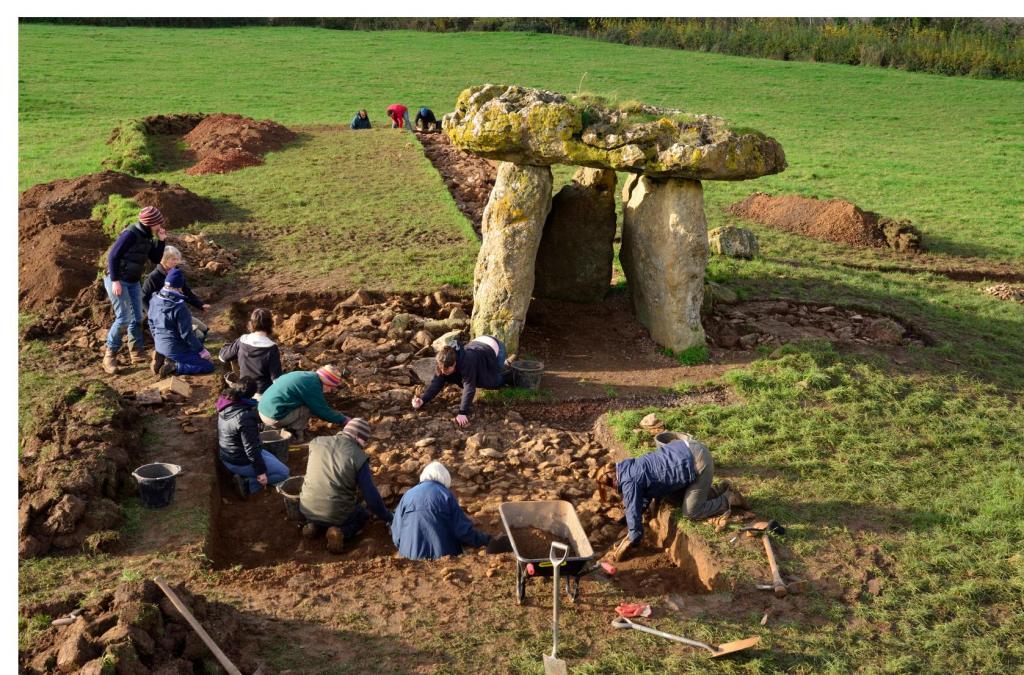
“The results of the excavation showed that the monument measured 30m in length from the eastern-most edge of the exposed façade to the western end of the long cairn and was approximately 12m wide. Three structural elements of the monument were identified, a long cairn, a possible structural/earlier round cairn and a forecourt façade. Whilst excavating the collapsed façade material, pieces of Grooved Ware pottery, struck flint and a fragment of a bone needle were recovered. It was humbling to see that four courses of intact façade was preserved beneath this material. The size and extent of the façade were not established during the excavation, however it does not appear to be a deep U-shaped façade comparable to that at Tinkinswood, rather a shallower, more open façade, possibly with splayed ‘horns’.” – https://bryncellidduarchaeology.wordpress.com/school-outreach-the-make-and-break-project/
 CoralJackz - That History Couple
Leave a comment