

On this page we provide historical records and images of the site, as well as archaeological information and excavation details.
Grid Reference: SH58862284
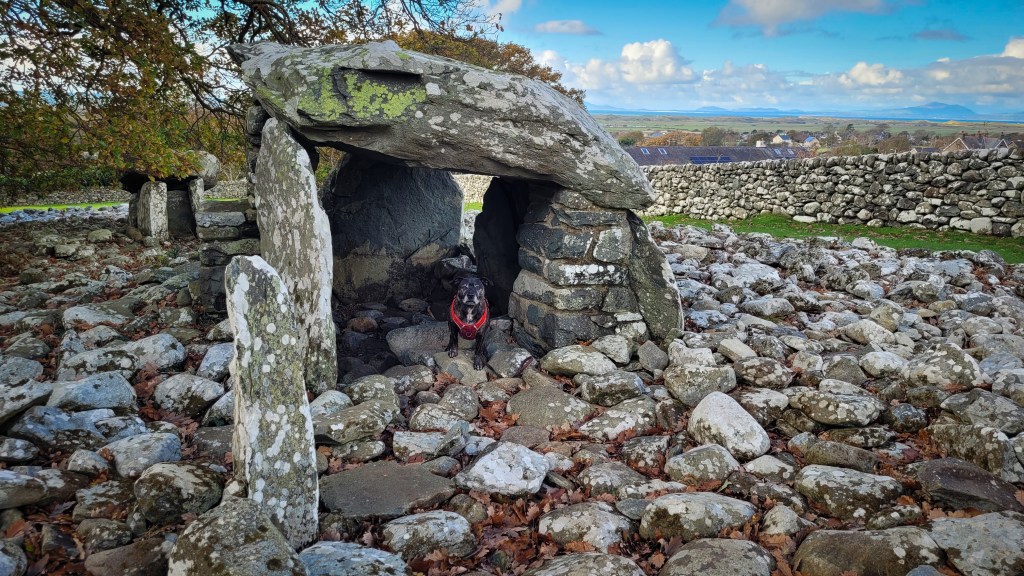
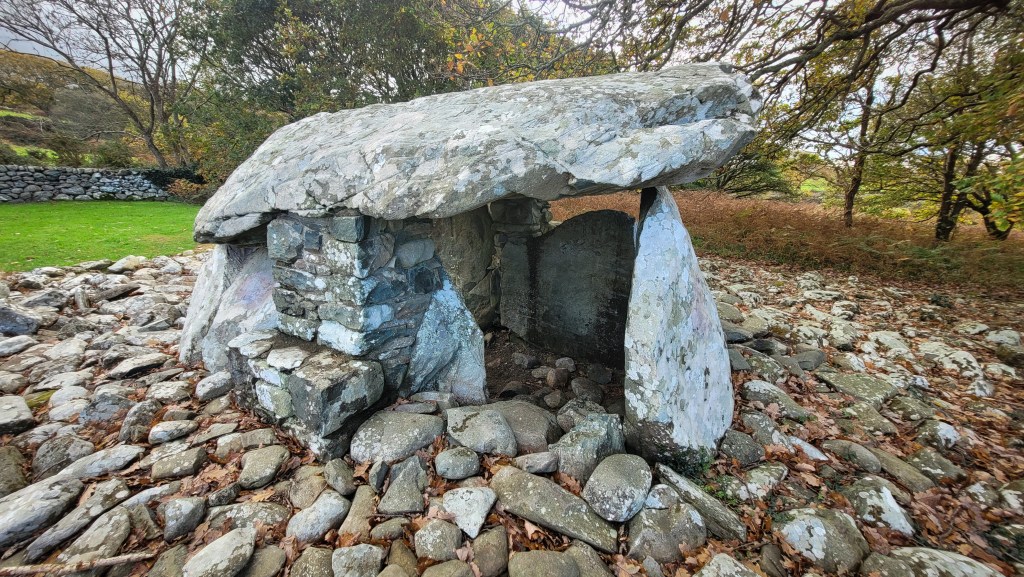
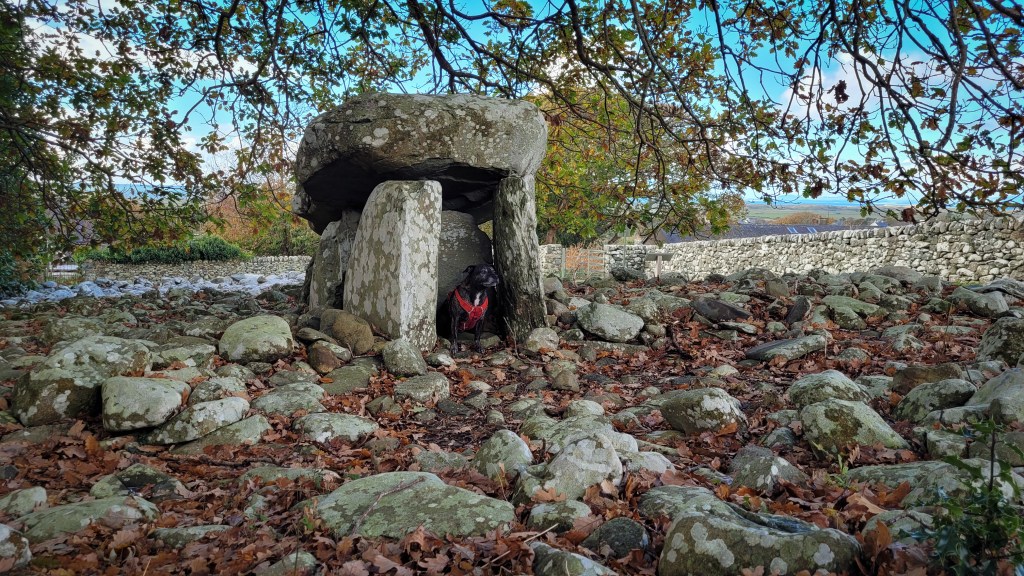
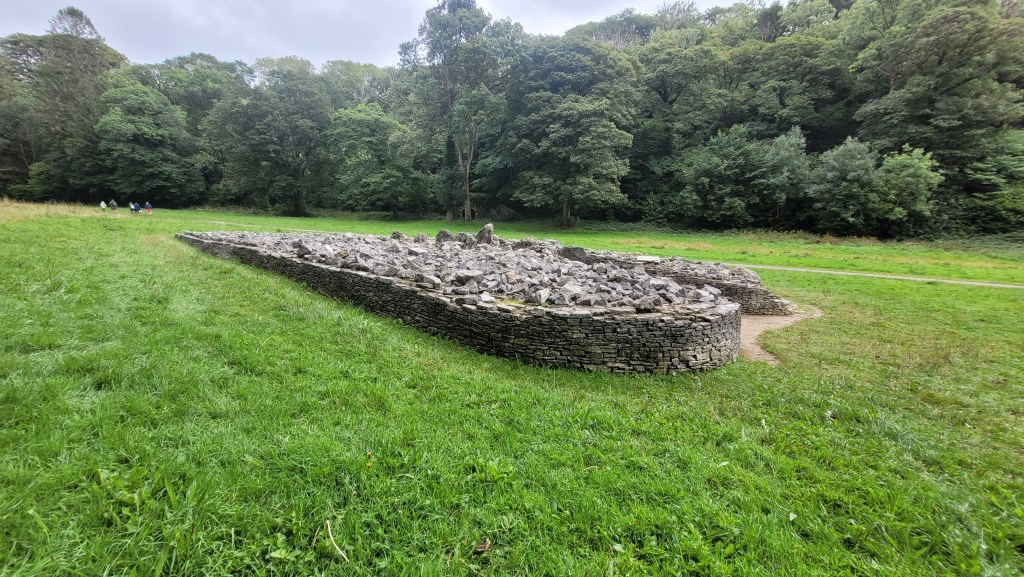
Situated in the village of Dyffryn Ardudwy in Gwynedd, Wales are a pair of dolmens, (or cromlechs as they are often called in Wales), estimated to date to around 3500BC. Excavations in the 1960s revealed that the monument was built in two phases, with the smaller chamber being constructed first. Finds included fragments of pottery, a stone pendant, and traces of human cremation. The site’s appearance today has been altered by later stone-quarrying for local walls and buildings, and by restoration work that took place after excavations – including the addition of support pillars to stabilize the surviving capstones.
Archaeological background:
Excavations in the early 1960s, led by Thomas George Eyre Powell, revealed two successive stone chambers beneath a single long cairn. The following is quoted from Megalithic Enquiries in the West of Britain, published by Lynch, Frances, Powell, Thomas George Eyre, Powell, T G E, Corcoran, J X W P, Scott, J G, 1969 –
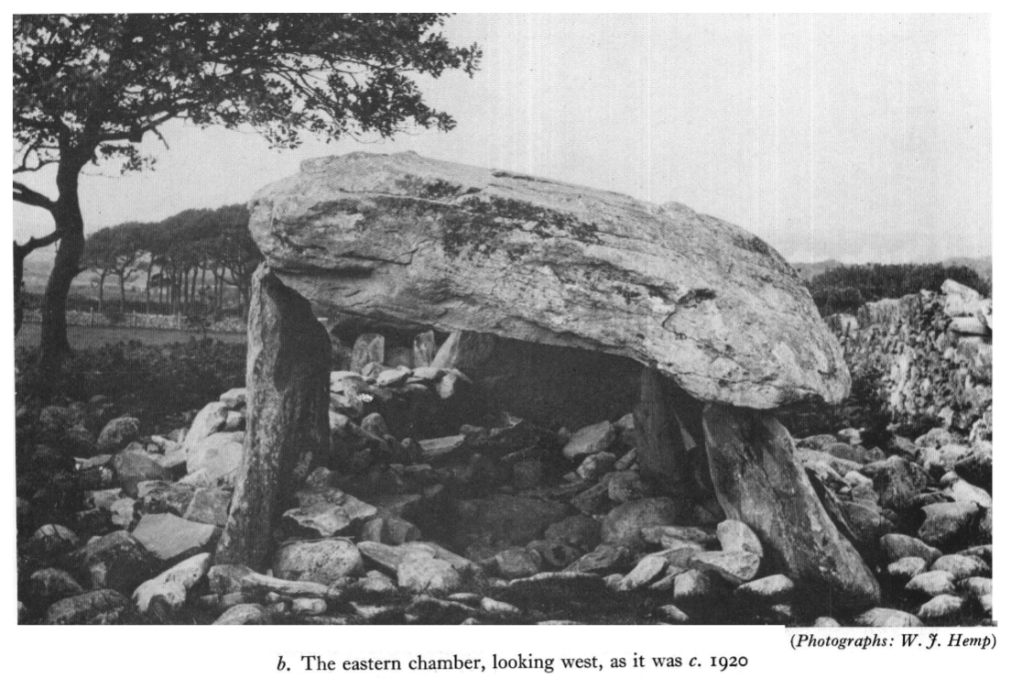
“It consists of a cairn, about 100ft long, containing two chambers both of which face uphill to the east. The West Chamber is a small Portal Dolmen of classic design with a completely closed entrance. Excavation revealed a low facade feature of laid, not upright, stones defining a wide, V-shaped forecourt. In the middle of this area was a pit containing a quantity of broken pottery of fine Neolithic ware. The entire area had subsequently been covered over with cairn material, but there was no sign of sloped blocking. This chamber originally possessed a small oval cairn. The slightly wedge-shaped Eastern Chamber is much larger, and is divided into two parts by a low cross-slab with broken upper edge. The area west of this slab is the burial chamber proper, and had been much disturbed. The sepulchral area was some 7ft by 6-5 ft. The cross-slab, set between the easternmost orthostats, does not reach the southern side of the chamber and the gap was evidently filled by another stone, now missing. A break in the north wall was found to be original, partly filled by two flat slabs superimposed. These have been interpreted as a footing for dry-stone walling, possibly providing a side entrance which could e fairly easily reopened for the insertion of burials after the formal entrance had been blocked.
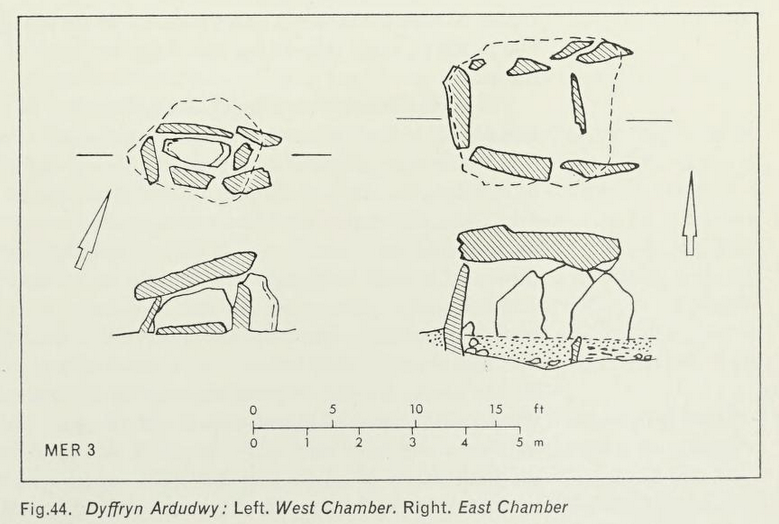
The blocking in the entrance occupied the area east of the cross-slab as far as the end of the eastern orthostats, and consisted of at least two layers of sloped stones leaning towards the cross-slab and resting on horizontal ones. Three feet east of the southern portal stone was a single pillar-like upright, probably to be connected with other smaller uprights standing to the south-east, which may be interpreted as defining a rather insignificant forecourt area. The northern side of the forecourt was lacking in truly comparable features. Across this forecourt, east of the sloped blocking, ran a counter-sloped bank, triangular in section, which was masked with ordinary cairn material to the east.
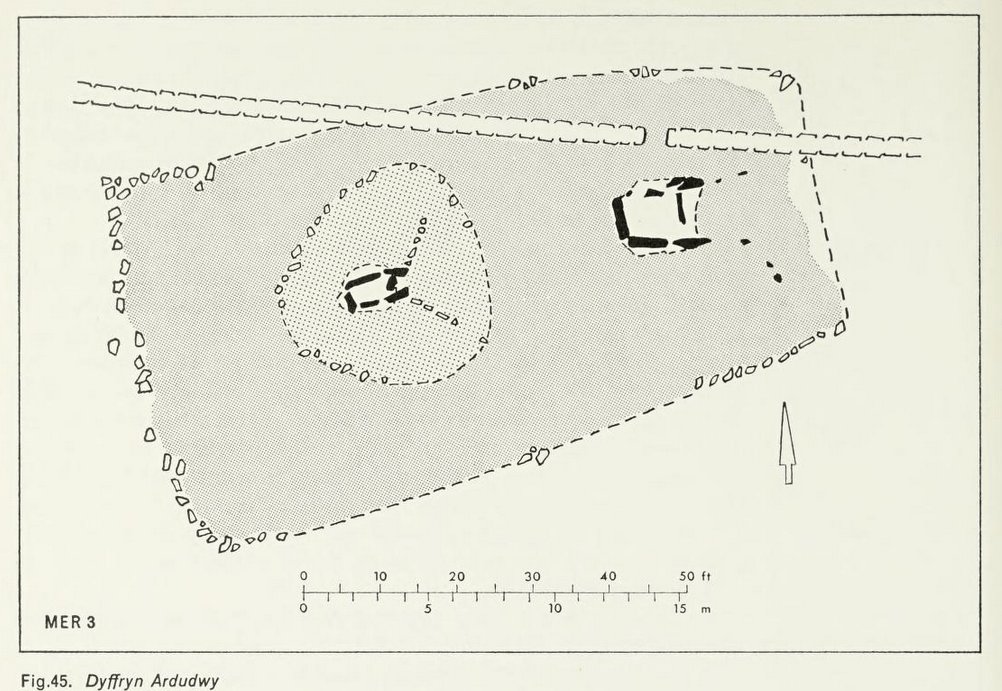
The cairn constructed around this East Chamber was roughly rectangular in plan ; it enclosed the West Chamber cairn, and extended some distance beyond it. This larger cairn was in fact somewhat broader at the west (back) end than it was in front of the East Chamber. This feature may best be explained by difficulties in making accurate alignments where the West Chamber cairn intervened. The edge of the larger cairn was marked by small boulders resting on the original surface. The fact that the two chambers at Dyffryn Ardudwy are markedly different in design would seem to indicate that they belong to two different building episodes, although the interval may not have been very great.
In the writers opinion the East Chamber is not the work of people influenced by foreign ideas. It appears to be an adapted form of the Portal Dolmen, one in which the high portal stones and the closing slab have become less important, but in which the essential ideas of demarcated portal and blocking remains. The contrast, too, between this roughly made cairn and the carefully built long cairns higher on the hills, at Carneddau Hengwm is surely significant.” – https://archive.org/details/megalithicenquir0000unse/page/136/mode/1up
Here is the link to the full excavation report – https://sci-hub.se/10.1017/S0261340900010602

Historical records and images of the site:
The following is written by E.L.Barnwell, in 1869, published in Archaeologia Cambrensis:
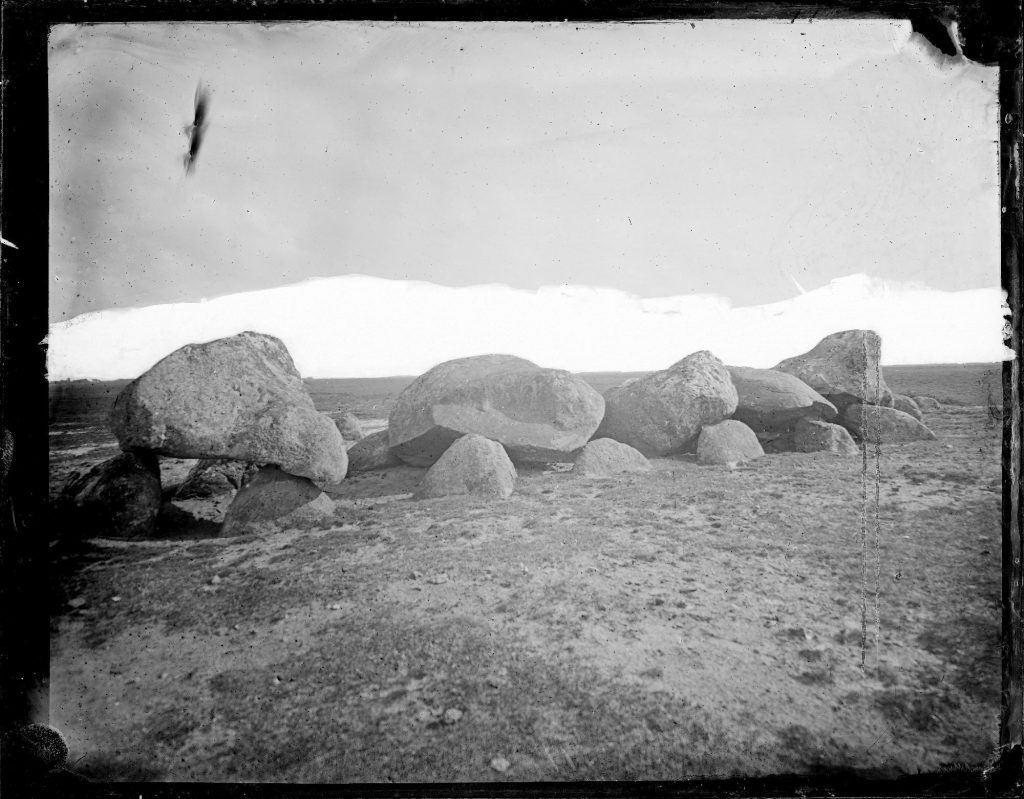
“We now proceed to lay before the members a brief mention of some that have not yet been thus noticed, and we commence with those that stand on the estate of Corsygedol in Merioneth. They are all of them in a state of greater or less ruin ; but as far as the care of the present owner of the estate can secure them, they are not likely to be still further mutilated or destroyed. There is, however, one easy and simple precaution which will occur to most. Around these cromlechs is a large collection of stones which once composed carns. If a low wall was built with these stones round the cromlechs, with a small wicket or steps for an entrance, they would be protected from cattle, and more likely to be respected by visitors and neighbours.
The two chambers, of which cuts 2 and 3 give faithful representations, are on the right of the main road from Barmouth to Harlech, and not very far from the village school. The lower one (No. 2)…
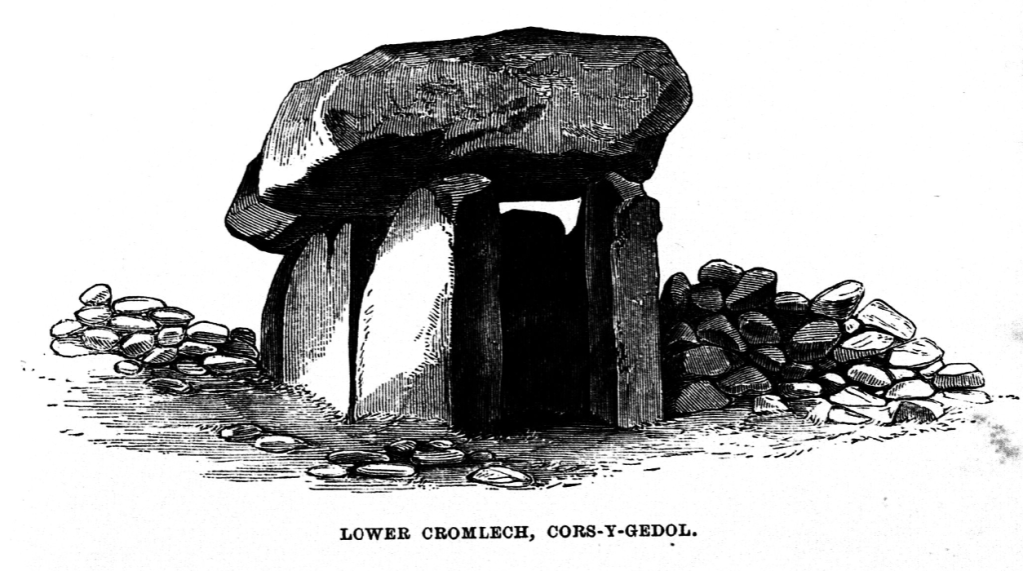
…has its chamber still perfect, a very unusual circumstance. There may, however, have been a second chamber originally, as the side-walls project nearly two feet beyond the slab that closes the chamber ; but as there no traces of such an addition, it is more likely that this projection of the sides is accidental, while the enlargement of the extent of the chamber could not have been considered of importance, otherwise the cross-stone might have been easily put back. The chamber itself, consisting of six stones, is about 7 ft. long, measured exteriorly, and about 6 1/2 ft. broad. The diagonals of the covering slab are 8 ft. 7 ins. and 7 ft. 3 ins. The supporters rise on an average about 3 1/2 ft. above the ground. The entrance seems to be where the side-stones project, and the slab which closes it does not touch the capstone, so that its removal might be effected without danger to the ponderous roof. It faces the east, and is another confirmation of Mr Lukis’ statement. The whole dimensions of the structure are moderate enough ; but the preservation of its chamber gives a peculiar value to this example. Around it are thickly strewn the stones which once composed the carn under which it was covered ; and as the same thing occurs in the cromlech near it, and as the two monuments are hardly ten yards apart, there can be little doubt but that both of them were originally covered up by one and the same mound of stones, for there would not have been sufficient space to have permitted two carns, if they were to be built of sufficient height and size to cover each cromlech…
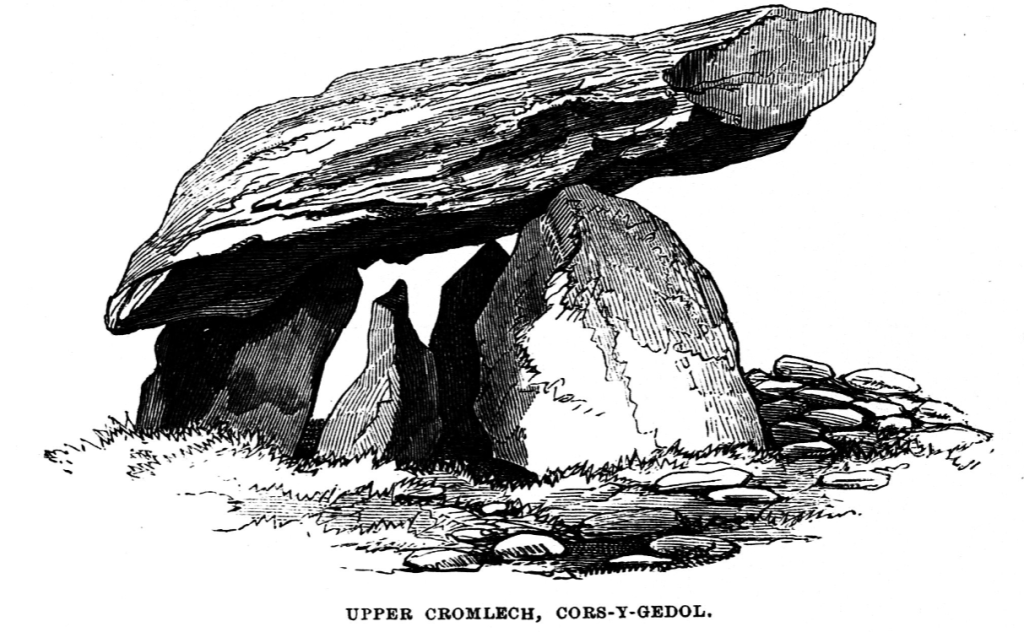
…The upper cromlech is larger, but not so perfect as No. 1. All the supporters on its south side have vanished. Measured on the outside, the length of the structure is nearly 14 1/2 ft. and its breath about half the length ; thus presenting a contrast to the smaller chamber, which is nearly square. The diagonal measurements of the capstones give 13ft. 2 ins. and 12 ft ; the maximum breadth being 9ft.and the average thickness 2ft. The height of the tallest supporter is 4 1/2 ft..
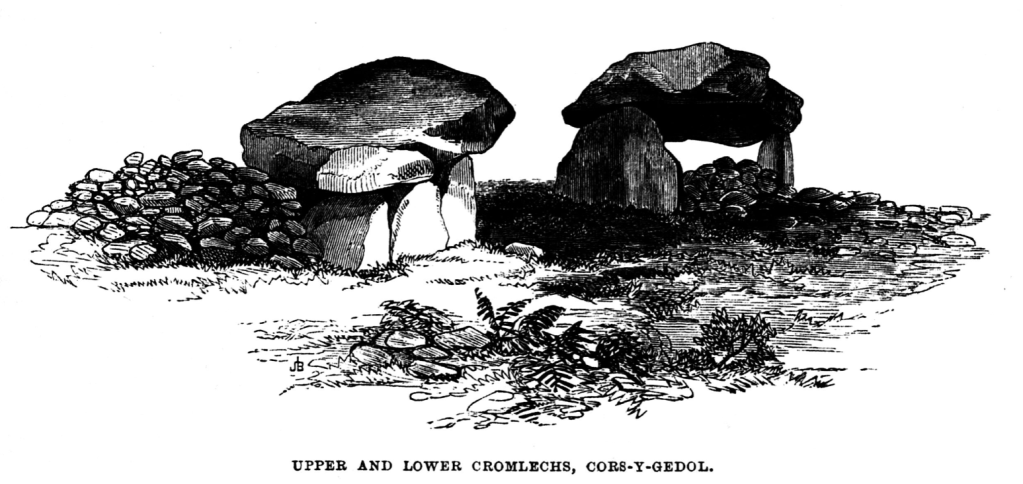
..The position of the two cromlechs is given in cut No. 4, in which it will be seen that the upper one is represented in a different point of view from the figure in cut 3. On the edge of one of the uprights of the lower cromlech is a series of lines, or rather grooves, which has an exceedingly artificual appearance ; and if artificial, the appearance of being as old as the cromlech. But as rock exist in the locality, marked with the same kind of grooves, it is not improbable but that the grooves under consideration are the effects of natural causes.
Both in the field in which are the cromlechs, and in the adjoining one, innumerable carns and remains of carns, which extend down the slope nearly to the seashore. A reference also to the Ordnance Map of the Vale of Ardudwy, from Barmouth to the Two Traethau, will shew, from the number of cromlchs, and fortified posts (and there are many of the latter not given), that the whole district must have been densely inhabited at a very early period. Even after the destruction of such monuments, which has been going on for centuries, the number of those remaining, especially the cromlechs, is remarkable ; so that there are, perhaps, few parts of the Principality where they are to be found in equal numbers and importance.” – https://journals.library.wales/view/2919943/2998546/36#?xywh=-330%2C-21%2C3385%2C3522
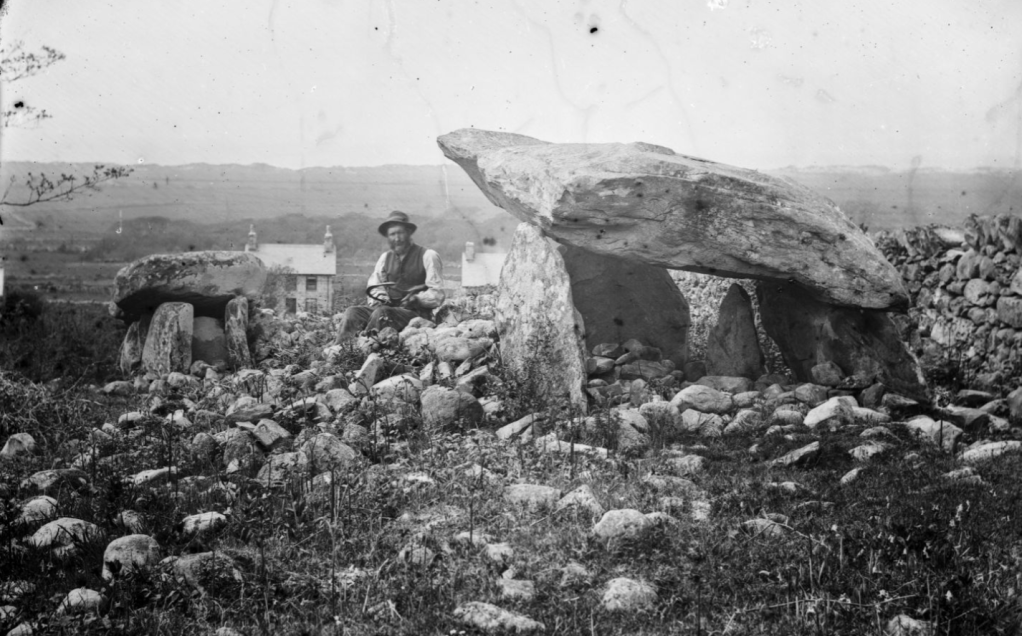
The following is quoted from ‘An Inventory of the Ancient and Historical Monuments and Constructions of the County of Merioneth’ (1921):
“Of the prehistoric monuments of the county by far the most numerous are the ruins of the circular stone enclosures which are known, as well from traditional report as from actual scientific exploration in various parts of Britain, to have been the dwellings of a primitive people. There can be little doubt that many of the Merionethshire examples are genuine remains of early man, but it is equally certain that a considerable proportion are not of the antiquity with which they are generally credited. A number of these in the parishes of Llanaber and Llanddwywe were visited in late autumn when many were found to be partically water-logged, and in their then condition, were altogether beyond possibility of occupation as dwellings for however short a time.
On the uncertain problem of whether all cromlechs were originally covered by earth or stones the study of the Merionethshire examples does not help towards a definite solution. The great carneddau at Hengwm were manifestly intended to cover the huge cists which, partially exposed, remain still in position, but it may be questioned if the Dyfrryn cromlechau were ever so hidden.” https://archive.org/details/inventoryofanci06roya/
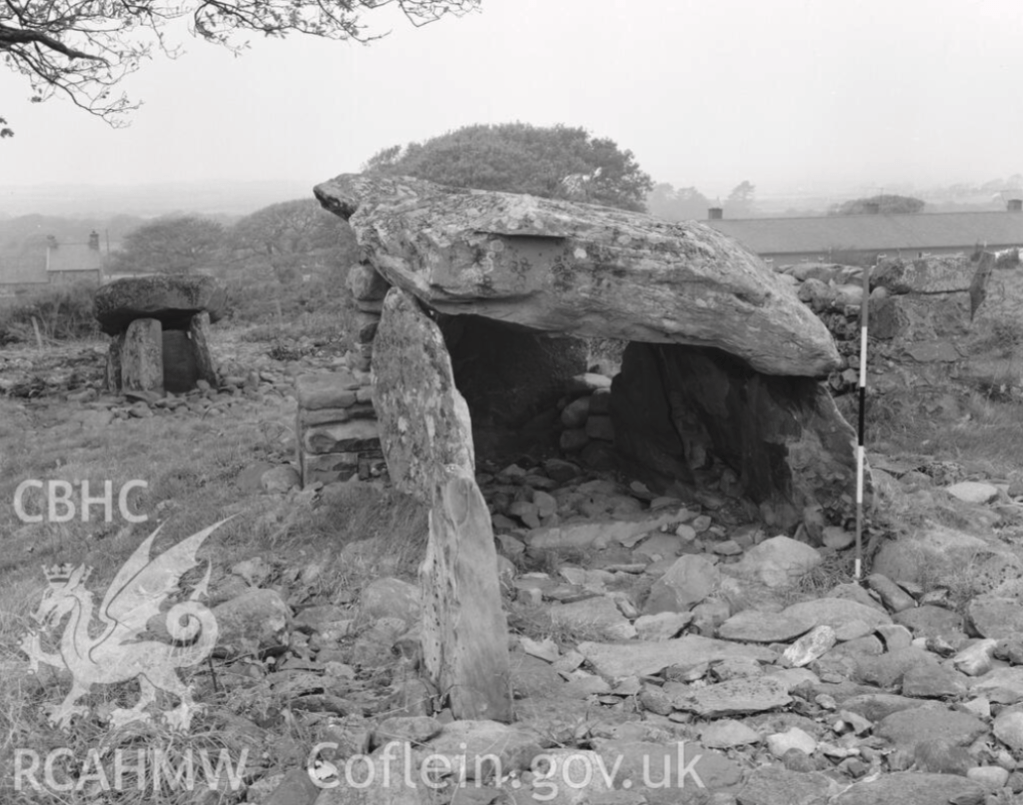

Above Images 1963 Coflein – https://rcahmw.ibase.media/en/view-item?i=112210&WINID=1761737624090
Below is the video we made covering the Dyffryn Ardudwy site. Since making the video, we have acquired a lot more information regarding the site, so will probably make an updated video soon –
‘Reuniting the Dyffryn Ardudwy Pendants’ 1999 – https://journals.library.wales/view/4718179/4752816/211#?xywh=-358%2C256%2C3416%2C1806



Leave a comment