
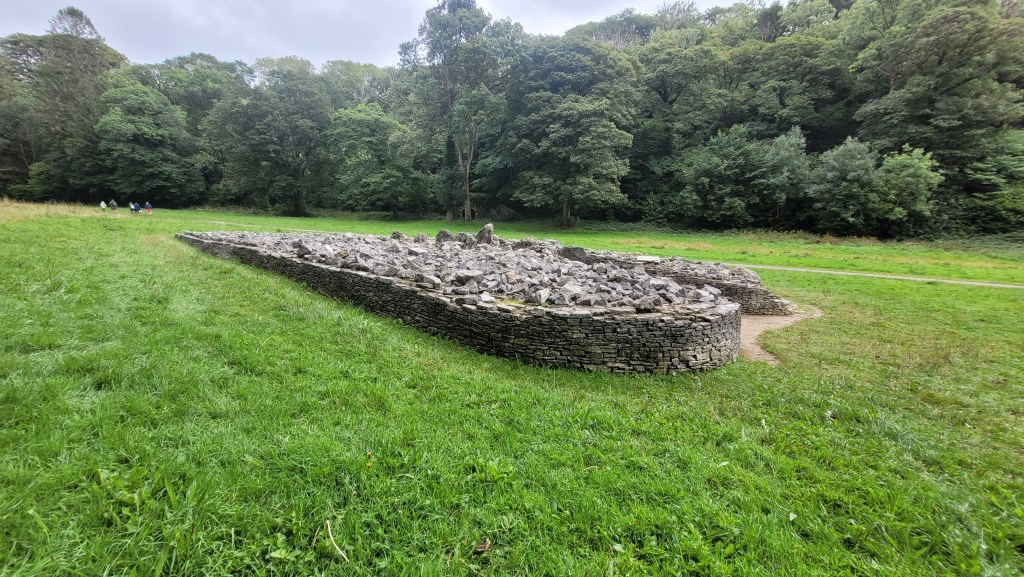

Map Ref: SS53738984
Parc Cwn long cairn, also known as Parc le Breos burial chamber is a partly restored Neolithic chambered tomb located on the Gower Peninsula, Wales.
Professor Glyn Daniel writes that the monument was discovered in 1869. “Workmen, robbing the barrow to obtain stone for roadmaking, came across the chamber and found portions of a skeleton. Mr Henry Hussey Vivian, the owner of the site at the time, ordered the workmen to stop at once, and later in the same year, together with Sir John Lubbock excavated the barrow with the assistance of a large party from the Cambrian Archaeological Association led by Lord Dunraven. These excavations revealed the plan of the chamber and the forecourt, and brought light the remains of twenty-four skeletons and some fragments of pottery. The barrow is locally known as ‘The Giants’ Grave’ and I was told by villagers of Parkmill that ‘very big bones’ had been found in it, a piece of folklore told of many barrows ; but in this instance it is worth recording that Dr Morton Douglas who reported on the bones found in the chamber during the 1869 excavations, described on of the skeletons as ‘of gigantic proportions’. The folklore may possibly represent some exaggerated memory of the actual excavation, the more so as the sepulchral nature of the site was probably unknown before 1869.”
Glyn Daniel led excavations which took place in 1937. He identified the site as a chambered long barrow, helping to place it within the Severn-Cotswold tradition. The site was then re-excavated in 1960-61 by Richard Atkinson, who recovered further archaeological material and partially restored the monument. The surviving passage, four chambers and lower stone walls were preserved, but no covering was added. Atkinson published a brief account of his work, but a full excavation report was never produced.
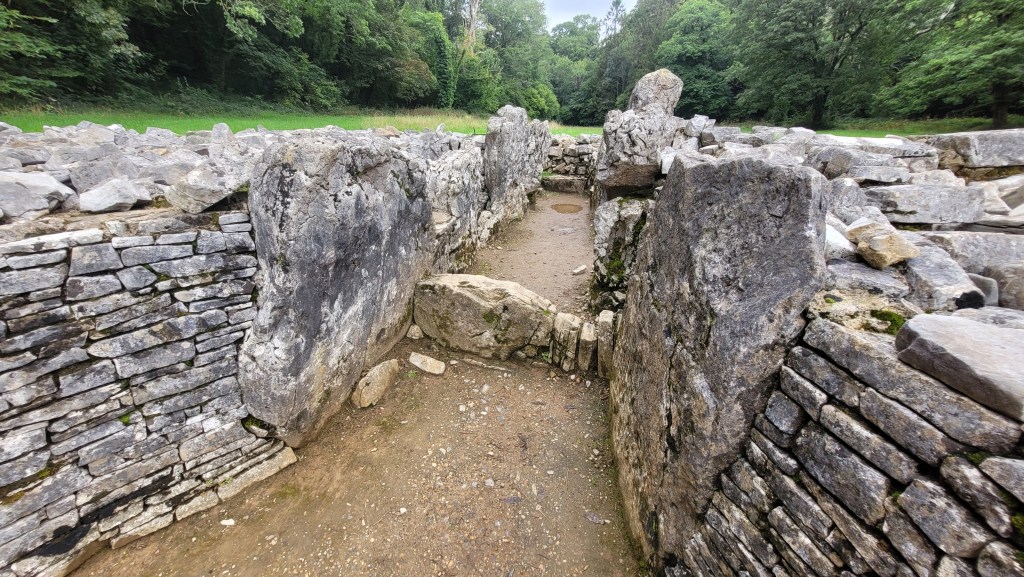
In 1998, Alasdair Whittle and Michael Wysocki, with other specialists, re-examined evidence and human remains from the site. Radiodated carbon samples show the tomb was accessed by many generations, predominantly over a period of 300–800 years, this period of use began around 3800bce and therefore the monument is dated at around 6000 years old. As with many ancient sites, the original construction date is hard to prove and remains disputed. In this case partly due to the fact that other bones gave dates of 6640-6410 BCE and 11050-10200 BCE, the latter being from the end of the Ice Age.
The main theory is that these much older bones were moved from nearby caves which overlook the site. Supporting this theory are a quantity of animal bones which were also found in the tomb.. including 8 dogs, pigs, sheep, cattle, a cat and a deer. Some of the remains also showed marks from scavenging animals, indicating that the bodies may have lain exposed in the nearby caves before the bones were collected and deposited inside the tomb.
Excavations at Cathole Cave – https://repositorio.unican.es/xmlui/bitstream/handle/10902/17931/ExcavationsCatholeCave.pdf?sequence=1&isAllowed=y
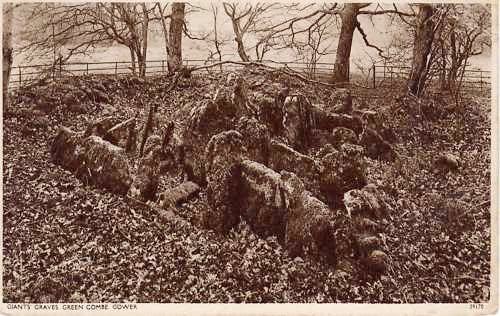
Old records of the site
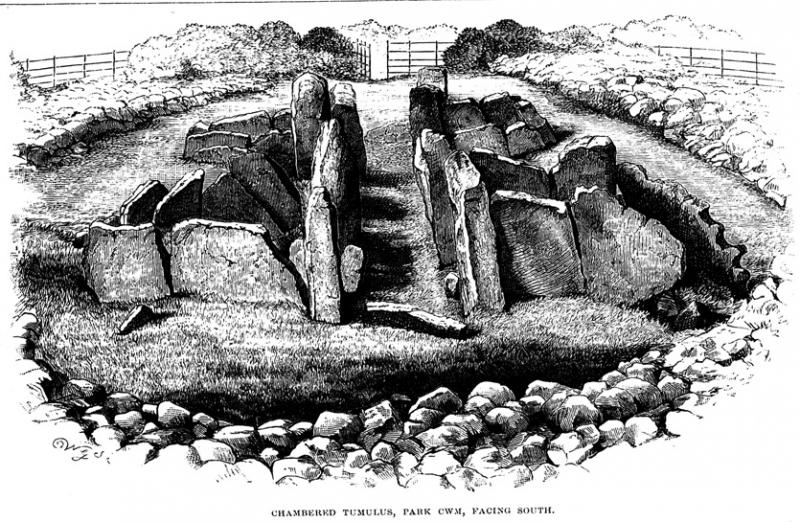
The following description and images is from James Fergusson, ‘Rude Stone Monuments in All Countries’ (1872):
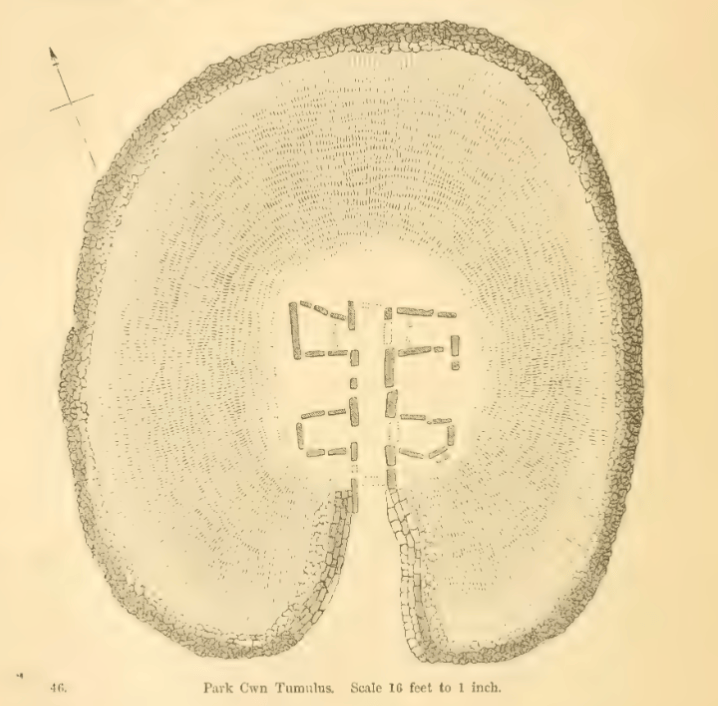
..Even a cursory examination of these West Coast dolmens would, I think, be sufficient to prove to any one that the theory that all were originally covered with earthen mounds is utterly untenable. That such chambered graves as those at Uley in Gloucestershire, or Stoney Littleton in Somersetshire, were always intended to be so covered up is clear enough. So was this one at Park Cwn, in the peninsula of Gower, recently opened and described by Sir John Lubbock. It is only four chambers arranged on each side of the central passage. One of its most remarkable characteristics is the beautiful masonry of the retaining walls on each side of the funnel-shaped passage leading to the cells. These are so carefully built that it is evident that they were meant to be seen, and the entrance to be kept open. Indeed, unless we fancy it was the monument of some fight, which there seems no reason for supposing, it is evident it must have been kept open till forty deaths had occured in the family of the chief to which it served as sepulchre, as at least that number of bodies were found in the chambers, but in a dreadfully confused condition, as if the grave had been rifled before, but no implements or trace of metal were left to indicate even approximately its age.” – https://ia902809.us.archive.org/20/items/rudestonemonumen00ferg/rudestonemonumen00ferg.pdf
The following is quoted from Archaeologia Cambrensis, 1886:
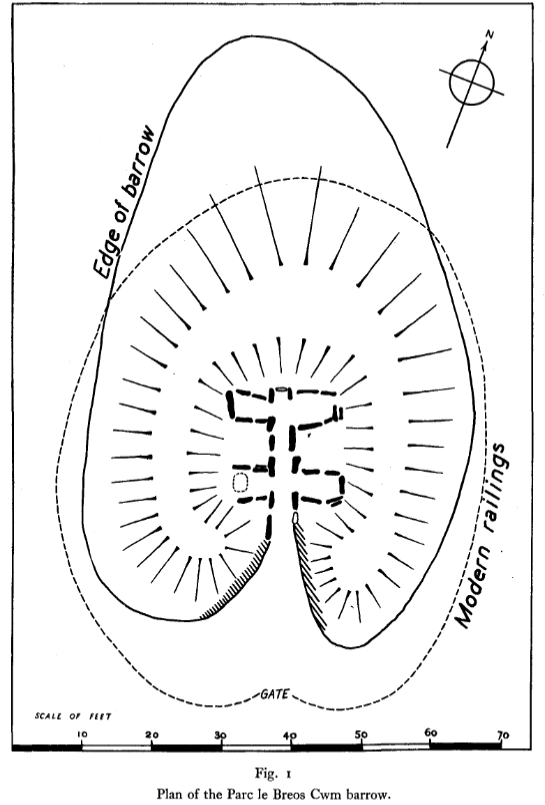
Today the excursion was into South Gower, in order to see the rarest prehistoric monument in the peninsula – the famous chambered cairn of Park Le Breos. There the members were met by Sir H. Hussey Vivian who had travelled from London to receive his visitors. The cairn is not found, as is usually the case, on the high ground, but is situated in the bottom of a secluded and well-sheltered dingle. Here Sir Hussey Vivian read a paper, which he had contributed to the Archaeologia Cambrensis in 1871, supplemented by more recent observations down to date. As we purpose reprinting the whole paper in a future number, it will suffice to state here that “this valuable prehistoric tomb was discovered in 1869, and opened under the eyes of Sir John Lubbock and Sir Hussey Vivian. It consists of a central avenue, the entrance to which in funnel shaped, and very neatle constructed of dry masonry, 16ft long; at the mouth 12 ft wide, contracting to 3ft 6ins; at this point it joins the central aisle, from which branch off the chambered cells, two on either side. This aisle is built of large stone slabs, and is 17 ft long, with a uniform width of 3 ft. The chambers are 6ft by 2ft, and the interstices between the slabs are carefully packed with small stones. When the cairn was opened, it contained the remains of at least twenty human being, two of them having been aged persons, two children, two females; while the remainder were persons in the prime of life. The bones were too fragmentary to decide what was the shape of the crania. With the human remains were deer and swine’s teeth, and fragments of sun-dried pottery. The chambers contained two and three bodies, the remainder were arranged in the central aisle.
A short discussion ensued between Sir Hussey and Mr Laws as to whether the cells had been covered with slabs or not; the latter contending that they must have been so covered, the former as urgently maintaining the negative: the opinion of the Members was in favour of the covering slabs.
The “Cat Hole” cave, about 200 yards to the north of the cairn, was next visited ; but it was not possible to go far into it, owing to the foul air.” – https://archive.org/details/archaeologiacam52assogoog/page/n382/mode/1up
Here is the video we made covering this site:


Leave a comment