
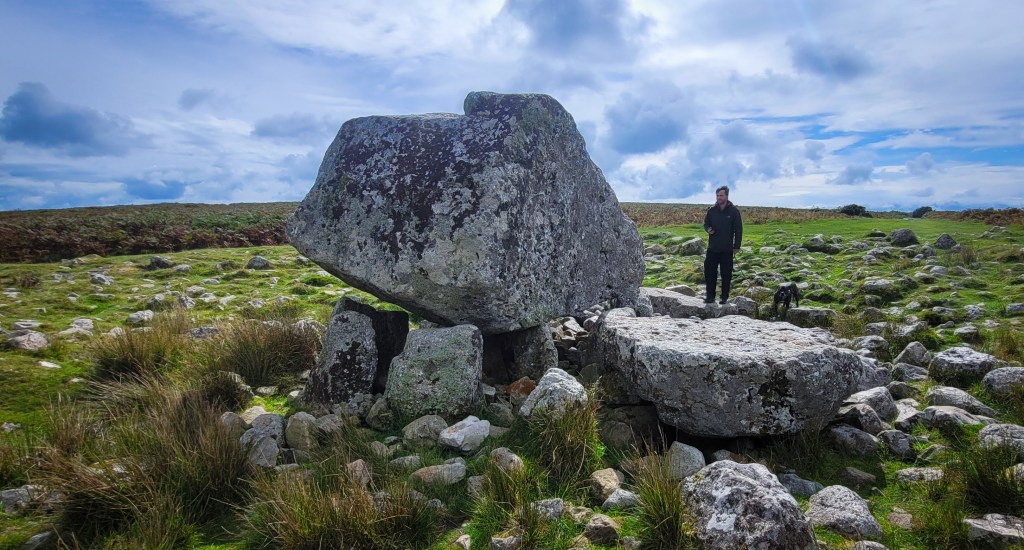

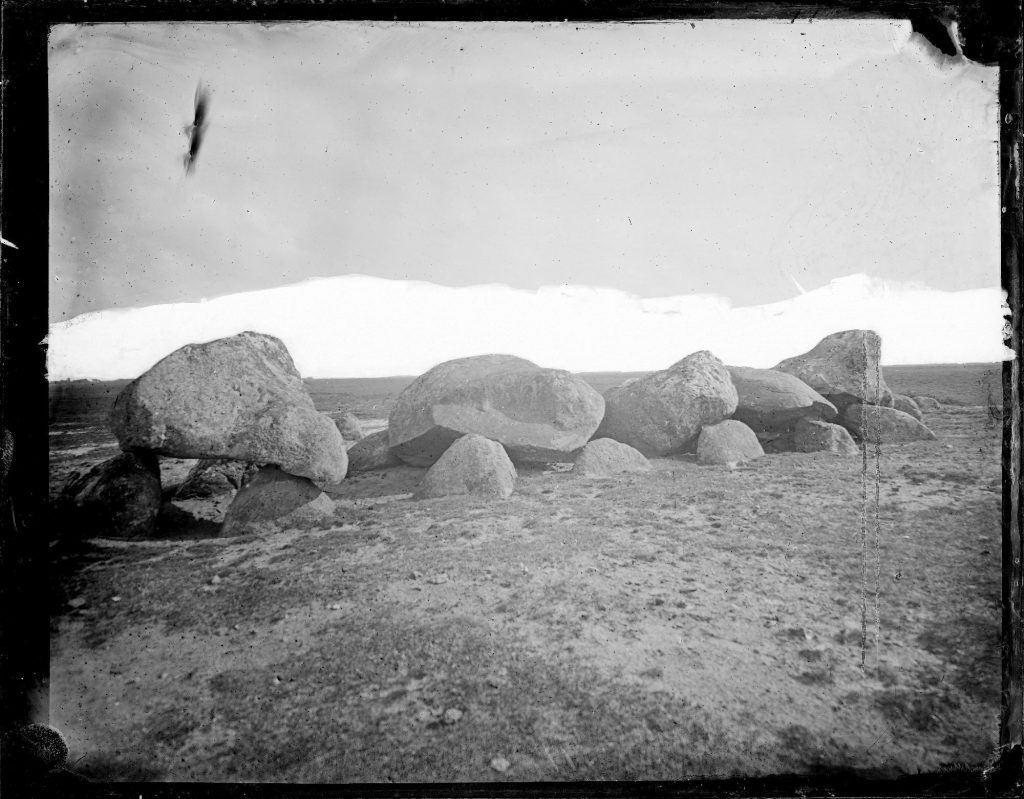
An iconic Neolithic monument in Gower Peninsula in Wales is situated on the ancient ridgeway of Cefn Bryn, known locally as the Backbone of the Gower. The monument is named Maen Cetti, meaning ‘The Stone of Cetti’. Its commonly used name today is Arthur’s stone, linking to a popular story that the capstone is a pebble that King Arthur found in his shoe when he was on his way to fight the battle of Camlann. He plucked it out and threw it and it landed at this spot on Cefn Bryn.
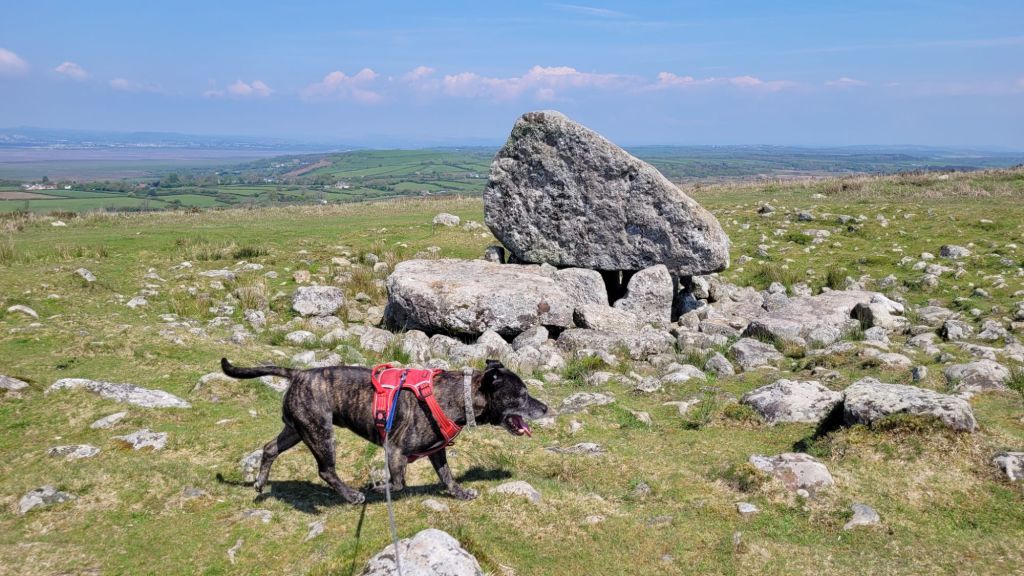
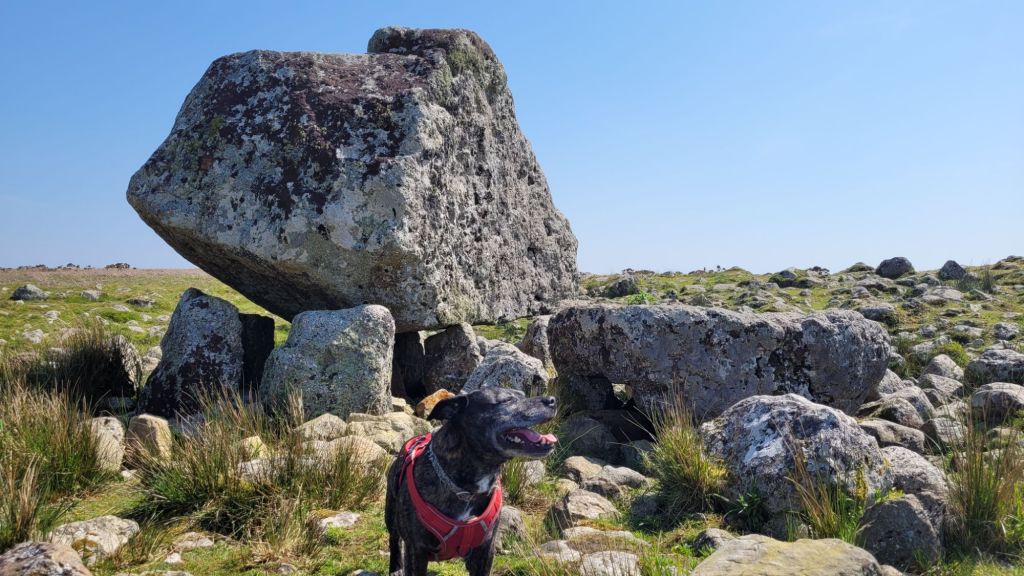
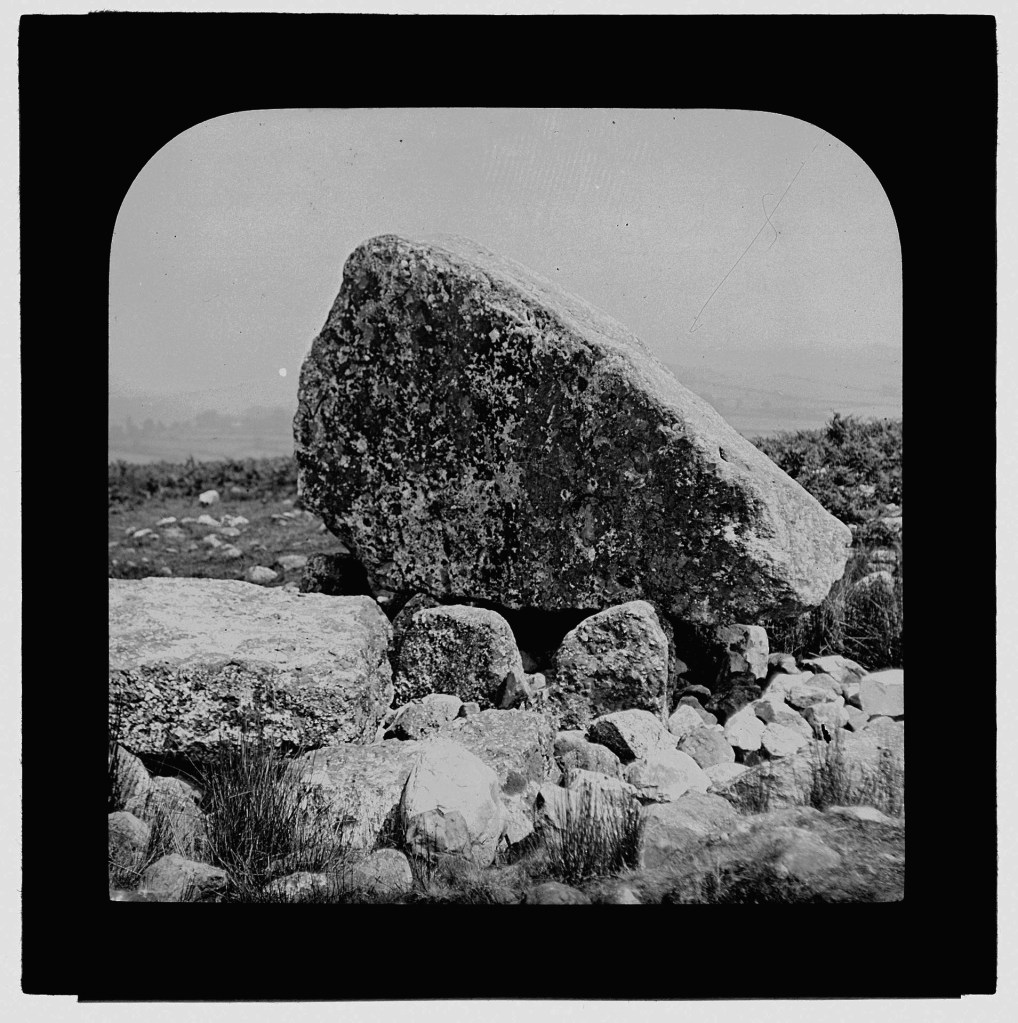
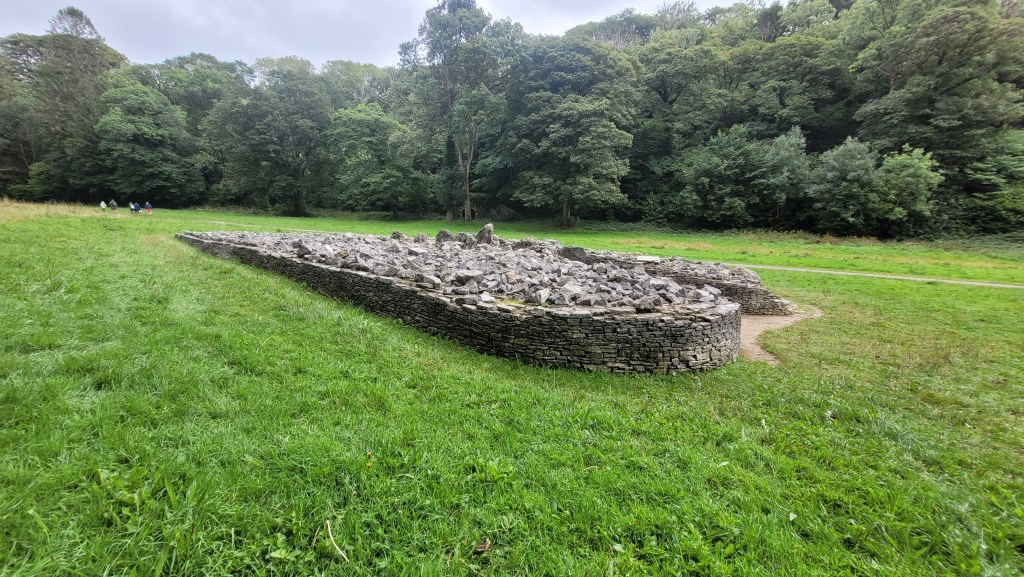
The dolmen, or cromlech as they are called in Wales, is dated to approximately 2500 BCE. It stands at the centre of a ring cairn measuring 75 feet in diameter. The huge capstone weighs around 24 tonnes and is 14 feet long, 7 feet 2 inches in depth and 6 feet 6 inches in breadth, supported by four of the ten uprights. The capstone is split into two pieces with part of it laying on the ground. Taliesin Williams, the archdruid who often wrote under his bardic name, Ab Iolo, commented that St David split the stone with his sword to prove that it was not sacred. In his book, A Topographical Dictionary of Wales, published in 1833, Samuel Lewis gives a vague indication of when the stone was actually split: “..within the recollection of persons still living, a huge fragment, which had been broken off with great labour, by means of wedges, and intended for a millstone, was found totally unfit for that purpose.”
S. Baring-Gould also mentions the destruction of the capstone in A Story of South Wales(1905):
“At one time it was much larger, but pieces have been broken off for millstones, for which they are unfitted, being composed of puding-stone. One very large piece , 30 ft. in circumference, was take n off by wedges, but not completely; those ‘who began to mutilate the stone abandoned the task, but wind and rain completed what they had begun.”
This cromlech has been described as the ‘Wonder of the World on Gower’. The raising of the huge stone onto its supporting stones has been summed up in ancient records as one of ‘the three arduous undertakings accomplished in Britain’, hence the proverb Mal gwaith Maen Cetti (like the labour of the Stone of Cetti).
Antiquarian Edward Brayley writes: “Arthur’s Stone is celebrated in the Welsh Triads (which are notices of remarkable historical events and other matters conjoined in threes) as one of the three stupendous works effected in Britain ; of which Stonehenge is another, and Silbury Hill perhaps the third. In the Triads it is called the Stone of Sketty, from a place of that name in its neighbourhood ; and, “like the work of the stone of Sketty,” has grown into a Welsh proverb to express undertakings of great difficulty.”
Many antiquarian records of Maen Cetti also talk of a sacred spring, or “holy well” beneath the cromlech which at some time became a place of Christian assembly for instruction and prayer, gaining the name ‘Our Lady’s Well’.
Antiquarian records and old images:
William Camden Britannia 1695 version:
“Another monument there is on a mountain called Cefn Bryn, in Gower, which may challenge a place also among such unaccountable antiquities, as are beyond the reach of history; whereof the same worthy person that sent me his conjecture of the subterraneous noise in Barry Island, gives the following account:
…as to the stones you mention, they are to be seen upon a jutting at the northwest of Cefn Bryn, the most noted hill in Gower. They are put together by labour enough, but no great art, into a pile; and their fashion and posture is this: there is a vast unwrought stone (probably about twenty ton weight) supported by six or seven others that are not above four foot high, and these are set in a circle, some on end, and some edge-wise, or sidelong, to bear the great one up. They are all of them of the lapis molaris kind, which is the natural stone of the mountain. The great one is much diminished of what it has been in bulk, as having five tuns or more (by report) broke off it to make mill-stones; so that I guess the stone originally to have been between 25 and 30 tuns in weight. The carriage, rearing, and placing of this massy rock, is plainly an effect of human industry and art; but the pulleys and levers, the force and skill by which ’twas done, are not so easily imagined. The common people call it Arthur’s Stone, by a lift of vulgar imagination, attributing to that hero an extravagant size and strength. Under it is a well, which (as the neighborhood tell me) has a flux and reflux with the sea; of the truth whereof I cannot as yet satisfy you, &c. There are divers monuments of this kind in Wales, some of which we shall take notice of in other counties. In Anglesey (where there are many of them) as also in some other places, they are called krom-lecheu; a name derived from krwm, which signifies crooked or inclining; and llech a flat stone: but of the name more hereafter. ‘Tis generally supposed they were places of burial; but I have not yet learned that ever any bones or urns were found by digging under any of them.” – https://www.exclassics.com/camden/camden0084.htm
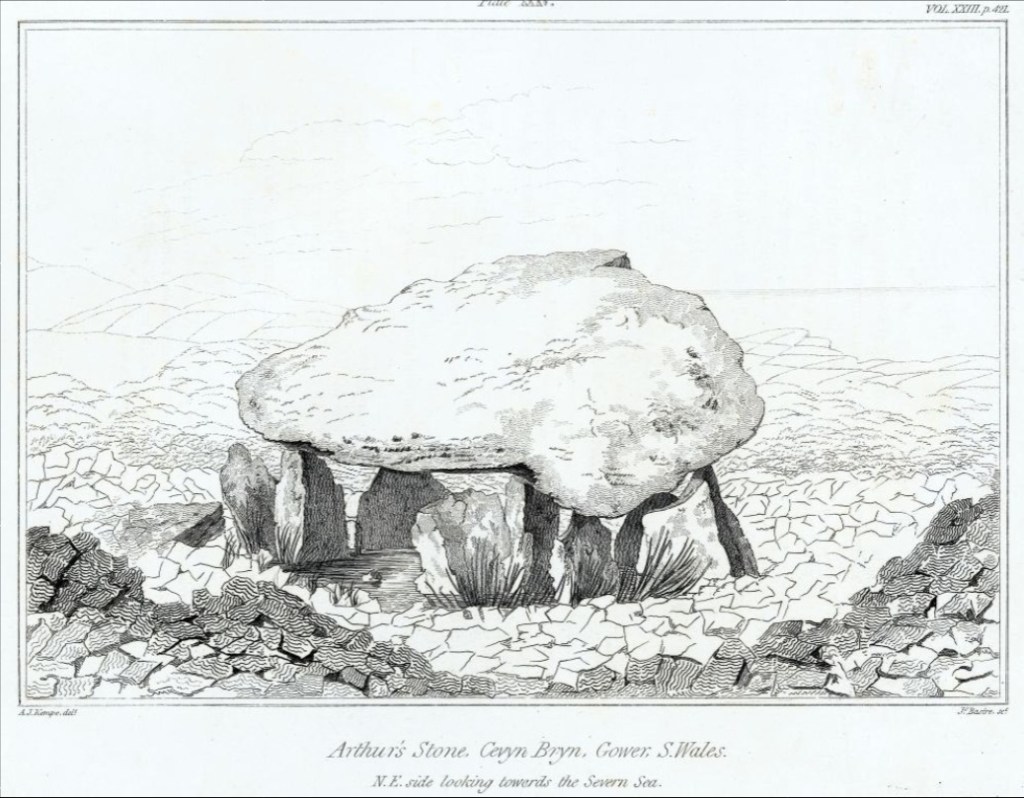
The following (including illustration) is quoted from, The graphic and historical illustrator; an original miscellany of literary, antiquarian, and topographical information, by Edward Brayley, published in 1834:
“About ten miles west of Swansea, on the top of a mountain called Cefyn Bryn, in the district of Gower, is a Cromlech, known by the name of Arthur’s Stone ; most probably from the practice into which the common people naturally fall, of connecting every thing remarkable for its antiquity, the origin of which is obscure or unknown, with the most prominent character in some memorable period of their history.
Cevyn Bryn, in English ” the ridge of the mountain,” is a bold eminence, called by Lhvyd, in his additions to Camden’s Glamorganshire, ” the most noted hill in Gower,” overlooking the Severn sea; and, upon the north-west point of it this cromlech stands. It is formed of a stone, is fourteen feet in length, and seven feet two inches in depth, being much thicker, as supposed, than any similar remains in Wales. Generally speaking, its shape is irregular; but one side has been rendered flat and perpendicular, by detaching large pieces to form mill-stones. It has eight perpendicular supporters, one of which, at the north-west end, is four feet two inches in height; the entire height of the structure is therefore eleven feet four inches. The supporting stones terminate in small points, on which the whole weight (which cannot be less than twenty-five tons) of the cromlech rests. Some few other stones stand under it, apparently intended as supporters, but not now in actual contact. All the component stones are of a hard compact lapis molaris (mill-stone), of which the subtratum of the mountain is said to consist.
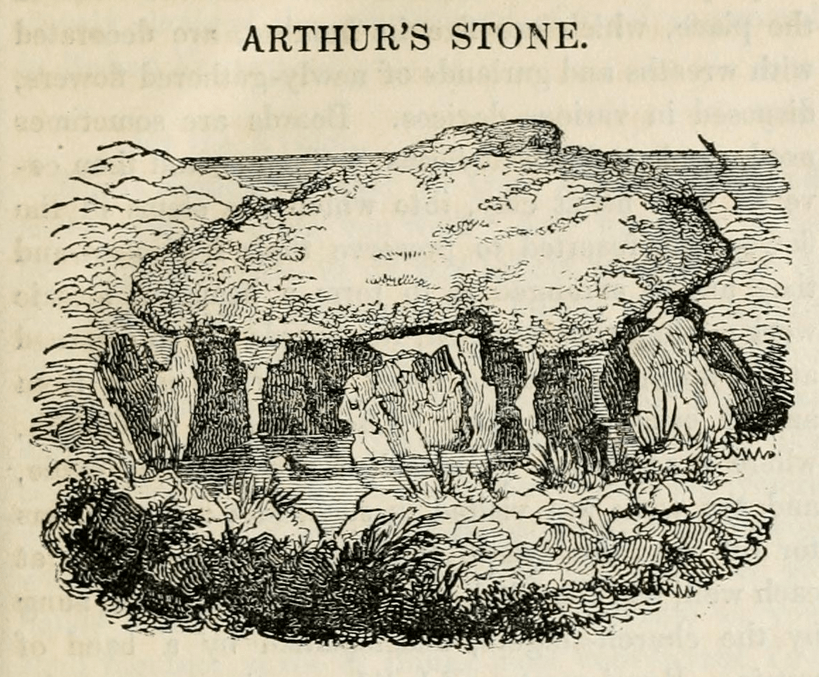
Immediately under the cromlech is a spring of clear water, or ” holy well,” which has obtained the name, in Welsh, of Our Lady’s Well: a spring thus situated plainly shews that the monument is not sepulchral. The fountain and cromlech are surrounded by a vallum of loose stones, piled in an amphitheatrical form. As we know that the Druids consecrated groves, rocks, caves, lakes, and fountains to their superstitions, there is little doubt but that Arthur’s Stone was erected over one of their sacred springs : it afterwards became a place of Christian assembly for instruction and prayer ; and, as the adoration of the Virgin began, in the darker ages, to vie with, if not altogether eclipse, that of the Saviour of Mankind, the fountain obtained the name of Our Lady’s Well.
Arthur’s Stone is celebrated in the Welsh Triads (which are notices of remarkable historical events and other matters conjoined in threes) as one of the three stupendous works effected in Britain ; of which Stonehenge is another, and Silbury Hill perhaps the third. In the Triads it is called the Stone of Sketty, from a place of that name in its neighbourhood; and, ” like the work of the Stone of Sketty,” has grown into a Welsh proverb to express undertakings of great difficulty. The people who elevated these enormous masses have left no written records of their own immediate times, although their descendants were not slow in lighting their torch at the flame of human learning. We gather what may be considered but obscure sketches of their customs, from the contemporary poets and historians of more polished nations ; yet they have scattered the surface of the British soil with imperishable monuments of their existence, against which the storms of two thousand years have wreaked their fury in vain. Though silent witnesses, the antiquary considers them as a link in the tangible records of human history, which connects it, in some degree, with the postdiluvian times.” https://archive.org/details/graphichistorica00brayuoft/page/28/mode/2up?q=wales
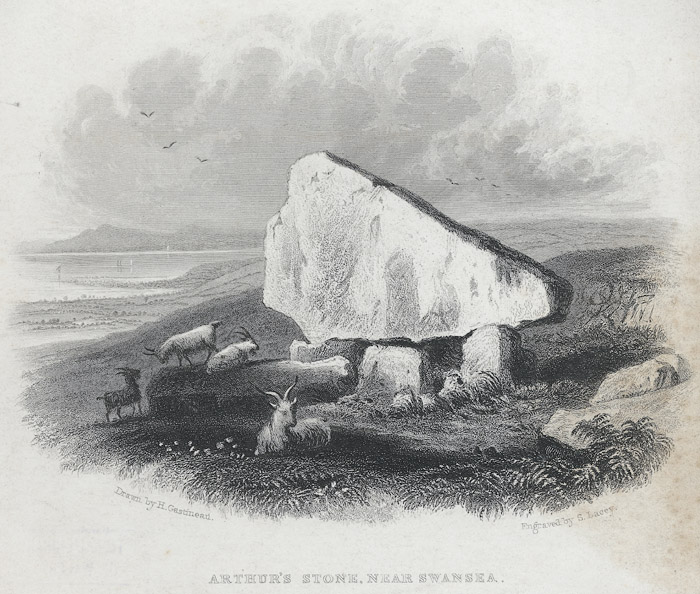
Marie Trevelyan writes in her book ‘Folk-lore and folk-stories of Wales’ (1853):
“Arthur’s stone, in Gower, is in a solitary spot, from which a fine view of land and sea can be obtained. IT is said that when King Arthur was on his way to the Battle of Camlan, he felt a pebble in his shoe. As it lamed him, he took off his shoe and flung the pebble as far as he could, and it fell on Cefn-y-Bryn, exactly on the stone where it is still seen, and quite seven miles from the spot where King Arthur stood. (William Howells, Cambrian Superstitions, p.101.)
At midnight and full moon maidens from Swansea and district used to deposit on the stone a cake made of barley-meal and honey wetted with milk and well kneaded. Then, on hands and knees, the girls had to crawl three times around the stone. This was done to test the fidelity of their lovers. If the young men were faithful to their sweethearts, they would make their appearance. If they did not come, the girls regarded it as a token of their fickleness, or intention never to marry them.
Beneath this stone is a spring which is said to flow with the ebb and flow of the tide. It is called Ffynon Fair, or Our Lady’s Well. The water therefrom was lifted in the palm of the hand while the person who drank it wished. This is situated on Cefn-y-Bryn, near Reynoldstone, Gower.” – https://archive.org/details/afl2317.0001.001.umich.edu/page/130/mode/1up?q=pembrokeshire&view=theater
In the book “Mysteries of freemasonry” (1877), John Fellows writes:
“Kit is no other than Ked, or Ceridwen, the British Ceres; and Cotti or Cetti meant Ark or Chest; hence the compound word refferred to the Ark of the diluvian god Noah, whos mysterious rites were celebrated in Britain; and Ceridwen was either the consort of Noah or the Ark itself; symbolically the great mother of mankind.” – In this passage, Fellows is apparently refering to Kit Cotti house in Kent, but the translation is another indication that The ancient goddess Ceridwen could be who this monument was originally erected in honour of.”
The Triads
The welsh triads are tradition of storytelling that present events and important people in groups of three, the earliest texts are from the late 13th century but the practice is believed to be much older and based on the tradition of handing down stories through word of mouth. It is said that a type of Druidic order used these sites as ritualistic meeting place,where they would recite the triads, and by repeating them impart and instill the generational knowledge.
This cromlech is mentioned in lolo Morganwg’s 18th century triads as one of the three Herculean labours. Triad 88 describes The three Works of Might of the Island of Britain: erecting of the stone of Cetti; erecting Stonehenge/Emrys and the piling of the Mount of Cyvrangon. However, while lolo and his work was vital in preserving national history and folklore, it is worth mentioning that many consider lolo’s writings to be unreliable.
In a publication in the Western Antiquary, November 1884 talks about the Druidic importance of a site named ‘Maen Cetti’ and quotes Samuel Rush Meyrick and Charles Hamilton Smith..
“ANCIENT BRITISH COINS FOUND AT MT. BATTEN, NEAR PLYMOUTH.-The Druidical stone erections known as Cromlechs were probably associated with some of the religious sites of the Druids, and in their use the Cromlech or cell of Ceridwen was covered with a mystic veil on which was displayed the representation of the Lunar-arkite Goddess.
The following is from Meyrick and Hamilton Smith on the costume of the original inhabitants of Great Britain;-“The Lan-y-on Cromlech in Cornwall, the covering stone of which is 19 feet long and 47 feet in girt, is placed so high that a man on horseback may ride under it. Lan-y-on signifies the enclosure of On, the Arkite divinity, and therefore exactly implies what all Cromlechs were intended to be, representations of the Noachic Ark. In it (the Cromlech) were performed various ceremonies relating to the Bardic orders, with a reference to the great event of the deluge, and the primary one of these was the sheathing of a sword as a token of their being devoted to peace and insulated from all the parties and disputes of the world. Being particularly dedicated to the Arkite genius it was entitled Maen Cetti, the stone of Cetti or the Ark, and the raising of it was, according to the Triads, one of the three mighty labours of the Isle of Britain. In it was celebrated all the mysteries of Ceridwen or Cetti, and in it her mystical cauldron was said to be warmed by the breath of nine damsels. Here the adventurous aspirants beheld some of the mysteries of Druidism when admitted behind the veil on which was portrayed the effigies of the goddess, and which on such occasions was hung over its entrance.”
Here is the video we made covering some of the history and legends of Maen Cetti –
We also have some drone footage of the site –


Leave a comment